
- July 29, 2026
- Posted by: Jhansi G
- Category: Uncategorized
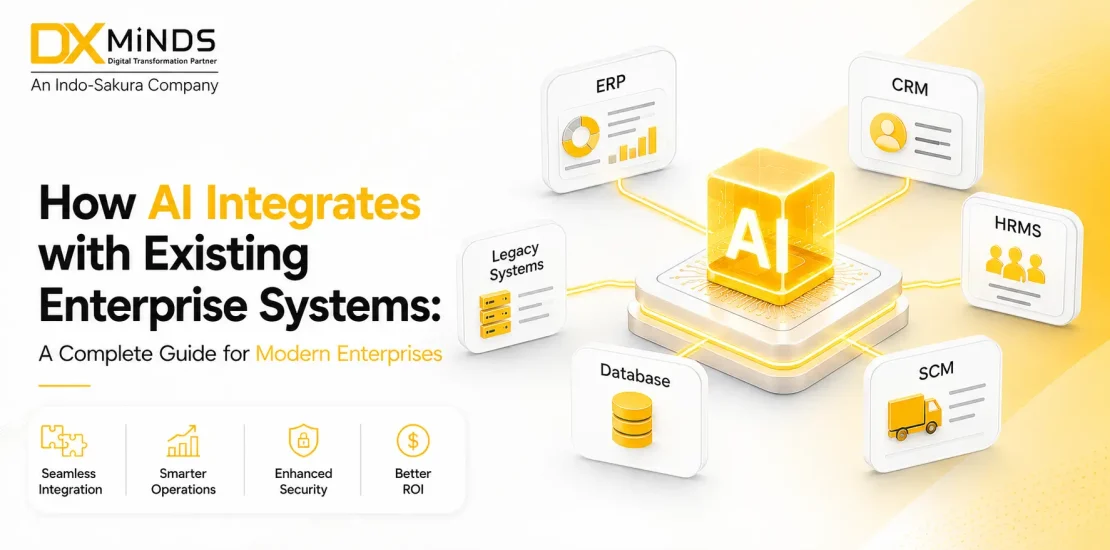
Artificial Intelligence (AI) has evolved from an emerging technology into a strategic business capability that is transforming how enterprises operate. Organizations across industries are leveraging AI to automate repetitive processes, improve decision-making, personalize customer experiences, and uncover valuable insights hidden within enterprise data.
Despite the growing enthusiasm around AI, many business leaders hesitate to begin their AI journey because they believe adopting AI requires replacing their existing software infrastructure. This misconception often delays digital transformation initiatives and prevents organizations from realizing the full potential of AI.
The reality is quite different.
Modern AI solutions are designed to integrate with existing enterprise systems rather than replace them. Whether your organization uses an Enterprise Resource Planning (ERP) platform, Customer Relationship Management (CRM) software, Human Resource Management System (HRMS), supply chain applications, or custom business software, AI can be seamlessly incorporated into your technology ecosystem.
Instead of rebuilding your infrastructure from scratch, AI acts as an intelligent layer that enhances existing applications by automating workflows, predicting outcomes, processing documents, analyzing customer behavior, and supporting better business decisions.
According to industry research, organizations that successfully integrate AI into their core business operations experience improvements in productivity, operational efficiency, customer satisfaction, and cost optimization. More importantly, AI enables enterprises to respond faster to changing market conditions while empowering employees with intelligent tools that simplify their work.
In this comprehensive guide, we’ll explore how AI integrates with existing enterprise systems, the technologies involved, integration architectures, implementation strategies, real-world use cases, challenges, and best practices that help businesses maximize return on investment.
Whether you’re planning your first AI project or scaling enterprise-wide AI adoption, this guide will help you understand how AI can become an integral part of your business without disrupting your existing operations.
What Is AI Integration?
AI integration is the process of connecting artificial intelligence technologies with an organization’s existing software, applications, databases, and workflows to improve business operations.
Rather than functioning as an independent application, AI becomes an extension of enterprise software by analyzing business data, identifying patterns, making predictions, automating repetitive tasks, and assisting employees with intelligent recommendations.
Think of AI as an experienced business consultant who works behind the scenes. Instead of replacing your ERP or CRM system, AI continuously learns from the information flowing through these platforms and provides insights that help employees make faster and more informed decisions.
For example:
- An AI model connected to your CRM can automatically prioritize high-value sales leads.
- AI integrated with your ERP can forecast inventory shortages before they occur.
- AI within HR software can identify employees who may require additional training.
- AI connected to customer support platforms can resolve common customer inquiries without human intervention.
This seamless interaction between AI and enterprise applications creates a connected digital ecosystem where data flows efficiently, decisions become more accurate, and business processes become increasingly intelligent.
Why AI Integration Matters for Modern Enterprises
Today’s enterprises generate enormous volumes of structured and unstructured data every day. Customer interactions, financial transactions, employee records, manufacturing data, emails, contracts, support tickets, and IoT sensor information all contribute to an ever-growing pool of valuable business intelligence.
Unfortunately, much of this data remains underutilized.
Employees often spend significant time manually searching for information, preparing reports, processing documents, or making decisions based on incomplete data.
AI changes this entirely.
By integrating AI into existing enterprise systems, organizations transform raw business data into actionable insights that improve efficiency and strategic decision-making.
Some of the key business drivers behind AI integration include:
Faster Decision-Making
Executives no longer need to rely solely on historical reports. AI analyzes live business data and generates predictive insights that support proactive decision-making.
Increased Operational Efficiency
Routine administrative work such as invoice processing, data entry, scheduling, approvals, and document classification can be automated, allowing employees to focus on higher-value activities.
Better Customer Experience
AI helps businesses personalize interactions by understanding customer preferences, predicting behavior, and delivering relevant recommendations across multiple communication channels.
Reduced Operational Costs
Automation minimizes repetitive work, reduces human errors, and optimizes resource allocation, resulting in measurable cost savings across departments.
Improved Business Agility
Organizations can respond more quickly to market changes because AI continuously monitors data, identifies trends, and recommends appropriate actions.
Instead of making business decisions based on assumptions, enterprises gain the confidence to act based on real-time intelligence.
How AI Integrates with Existing Enterprise Systems
One of the biggest misconceptions about AI implementation is that organizations must replace their existing software infrastructure. In reality, AI is designed to complement—not replace—business applications.
Most enterprises already rely on a wide range of software platforms, including ERP systems, CRM applications, HR management tools, finance software, customer support platforms, manufacturing systems, and business intelligence dashboards.
Modern AI solutions integrate with these systems using APIs, middleware, cloud services, databases, and event-driven architectures.
The integration process typically follows several key steps.
Step 1: Data Collection
Every enterprise application generates valuable operational data.
Examples include:
- Customer purchase history
- Sales pipeline information
- Inventory records
- Employee performance metrics
- Manufacturing data
- Financial transactions
- Customer support tickets
AI begins by securely accessing this information from connected systems.
Step 2: Data Preparation
Raw business data is rarely ready for AI processing.
The collected information is cleaned, validated, transformed, and standardized to ensure accuracy and consistency.
High-quality data is one of the most important factors influencing AI performance.
Step 3: AI Model Processing
Once the data is prepared, AI models analyze it using technologies such as:
- Machine Learning
- Deep Learning
- Natural Language Processing (NLP)
- Computer Vision
- Large Language Models (LLMs)
- Predictive Analytics
The AI identifies patterns, anomalies, relationships, and future trends that may not be immediately visible to human analysts.
Step 4: Intelligent Recommendations
The AI generates predictions or recommendations based on its analysis.
Examples include:
- Recommend products customers are most likely to purchase.
- Predict inventory shortages.
- Flag potentially fraudulent transactions.
- Forecast equipment maintenance.
- Prioritize customer support requests.
- Suggest optimal staffing levels.
Step 5: Business Action
The recommendations are delivered back into enterprise applications where employees can review them or allow automated workflows to execute predefined actions.
This creates a continuous feedback loop where AI becomes increasingly accurate as it learns from business outcomes.
Unlike traditional software that simply follows predefined rules, AI continuously adapts and improves based on new data, making enterprise systems progressively smarter over time.
Enterprise Systems That Benefit Most from AI Integration
Every enterprise relies on multiple software applications to manage different business functions. Traditionally, these systems operate independently, creating data silos that slow down decision-making and reduce operational efficiency. AI bridges these gaps by connecting systems, analyzing information across departments, and enabling intelligent automation.
Let’s explore how AI integrates with the most common enterprise platforms.
-
Enterprise Resource Planning (ERP)
Enterprise Resource Planning (ERP) systems are the backbone of many organizations. They manage core business functions such as finance, procurement, inventory, manufacturing, accounting, and operations.
Popular ERP platforms include SAP, Oracle ERP Cloud, Microsoft Dynamics 365, Infor, and NetSuite.
When AI integrates with ERP systems, it transforms them from transaction-processing tools into intelligent decision-support systems.
AI Capabilities in ERP
- Demand forecasting using historical sales and market trends
- Inventory optimization to reduce stock shortages and excess inventory
- Intelligent procurement recommendations
- Automated invoice processing using Optical Character Recognition (OCR)
- Predictive maintenance for manufacturing equipment
- Cash flow forecasting
- Financial anomaly detection
- Supplier performance analysis
Example
A manufacturing company can integrate AI with its ERP to analyze historical production data, supplier lead times, weather conditions, and customer demand. The AI predicts inventory shortages weeks in advance, enabling procurement teams to reorder materials before production is affected.
Instead of reacting to problems, businesses become proactive.
-
Customer Relationship Management (CRM)
Customer Relationship Management systems help organizations manage leads, customers, sales opportunities, and customer communications.
Popular CRM platforms include Salesforce, Microsoft Dynamics CRM, Zoho CRM, HubSpot, and Pipedrive.
AI significantly enhances CRM capabilities.
AI Features Inside CRM
- Intelligent lead scoring
- Sales forecasting
- Customer churn prediction
- Personalized product recommendations
- Automated email generation
- Opportunity prioritization
- Customer sentiment analysis
- Meeting summaries using Generative AI
Example
Suppose a sales representative manages 500 leads.
Without AI, identifying high-potential customers is time-consuming.
AI analyzes customer behavior, previous purchases, website visits, email engagement, and demographics to rank leads based on conversion probability.
Sales teams focus on opportunities most likely to close, increasing productivity and improving conversion rates.
-
Human Resource Management Systems (HRMS)
Human Resource departments are increasingly adopting AI to improve workforce management and employee experiences.
AI integrates with HRMS platforms such as Workday, BambooHR, SAP SuccessFactors, Oracle HCM, and ADP.
AI Applications
- Resume screening
- Candidate ranking
- Employee onboarding automation
- Attrition prediction
- Performance analytics
- Workforce planning
- Learning recommendations
- Employee engagement analysis
Example
Instead of manually reviewing thousands of resumes, AI automatically identifies candidates whose skills and experience match job requirements, reducing hiring time while helping recruiters focus on qualified applicants.
-
Supply Chain Management (SCM)
Supply chains generate enormous amounts of operational data.
AI improves supply chain efficiency through predictive analytics and intelligent automation.
AI Use Cases
- Route optimization
- Delivery prediction
- Supplier risk monitoring
- Warehouse automation
- Inventory forecasting
- Logistics optimization
- Demand planning
- Procurement intelligence
AI enables businesses to anticipate disruptions and make informed decisions before problems impact operations.
-
Customer Support Platforms
Customer expectations have changed dramatically.
People expect immediate responses, personalized assistance, and consistent service across multiple channels.
AI integrates with customer support platforms such as Zendesk, Freshdesk, ServiceNow, Salesforce Service Cloud, and Intercom.
AI Capabilities
- AI Chatbots
- Voice Assistants
- Automatic ticket classification
- Intelligent routing
- Customer sentiment detection
- Knowledge base recommendations
- Case summarization
- Response generation
Human agents can then concentrate on complex cases requiring empathy and judgment.
-
Finance and Accounting Systems
Finance departments process thousands of transactions daily.
AI integration improves accuracy while reducing manual effort.
AI in Finance
- Expense categorization
- Fraud detection
- Invoice matching
- Financial forecasting
- Budget optimization
- Cash flow prediction
- Compliance monitoring
Financial teams spend less time on repetitive processing and more time analyzing business performance.
AI Integration Technologies
Successful enterprise AI integration depends on selecting the right technologies that enable seamless communication between systems.
APIs (Application Programming Interfaces)
APIs are the most common method for integrating AI with enterprise software.
They allow different applications to exchange information securely and in real time.
For example:
CRM → AI Engine → Customer Recommendation → CRM Dashboard
This process happens automatically without requiring users to manually transfer data.
Middleware
Many enterprises still rely on legacy systems that lack modern APIs.
Middleware acts as a translator between older applications and AI services.
Benefits include:
- Faster integration
- Reduced development effort
- Improved scalability
- Lower implementation costs
Microservices Architecture
Modern enterprises increasingly adopt microservices instead of monolithic software.
Each business function operates independently.
AI services become another microservice within the architecture.
Advantages include:
- Easy deployment
- Independent scaling
- Better fault tolerance
- Continuous updates
Cloud AI Platforms
Cloud providers simplify enterprise AI implementation.
Organizations can deploy AI without investing heavily in infrastructure.
Popular cloud AI ecosystems include:
- Microsoft Azure AI
- Google Cloud Vertex AI
- Amazon Web Services (AWS) AI Services
These platforms offer pre-built machine learning, computer vision, speech recognition, and natural language processing capabilities that integrate with enterprise applications.
The Role of AI Agents in Enterprise Integration
Traditional AI analyzes data and provides recommendations.
AI Agents take automation further by independently executing tasks based on business rules and organizational goals.
Unlike conventional chatbots, AI Agents can:
- Access multiple enterprise applications
- Retrieve business information
- Make contextual decisions
- Trigger workflows
- Generate reports
- Coordinate activities across departments
Example
An AI Procurement Agent can
- Monitor inventory levels
- Check supplier performance
- Compare pricing
- Generate purchase requests
- Obtain approval
- Notify stakeholders
All without requiring continuous human intervention.
This level of intelligent automation significantly improves operational efficiency.
Retrieval-Augmented Generation (RAG) in Enterprise Systems
Many enterprises struggle because valuable information is scattered across different systems.
Employees waste hours searching through:
- PDFs
- Emails
- SharePoint
- Knowledge Bases
- ERP Systems
- CRM Records
- Internal Wikis
- Technical Documentation
Retrieval-Augmented Generation (RAG) solves this challenge.
Instead of relying solely on pre-trained AI models, RAG retrieves relevant enterprise information in real time before generating responses.
For example:
An employee asks:
“Show me all purchase orders approved by Vendor ABC during the last quarter.”
The AI retrieves data from the ERP, procurement portal, and document repository before providing an accurate answer with supporting references.
This dramatically improves information accessibility while reducing search time.
Typical Enterprise AI Integration Architecture
A modern enterprise AI ecosystem generally follows this flow:
Enterprise Applications
│
▼
ERP | CRM | HRMS | SCM | Finance
│
▼
APIs / Middleware / Integration Layer
│
▼
Data Processing & Security
│
▼
AI Models / LLMs / Machine Learning
│
▼
AI Agents / Predictive Analytics / Automation
│
▼
Dashboards, Reports, Business Applications
│
▼
Employees & Decision Makers
This architecture ensures AI works alongside existing enterprise systems rather than replacing them.
It creates a connected ecosystem where data flows securely between applications, AI generates insights, and employees receive actionable recommendations within the tools they already use.
Key Takeaways
Successful AI integration is not about implementing another software platform—it’s about enabling existing enterprise systems to work smarter together.
Whether integrating with ERP, CRM, HRMS, finance, customer support, or supply chain applications, AI helps organizations:
- Improve operational efficiency
- Automate repetitive workflows
- Deliver predictive insights
- Enhance employee productivity
- Strengthen customer experiences
- Enable data-driven decision-making
By leveraging technologies such as APIs, middleware, cloud platforms, AI Agents, and Retrieval-Augmented Generation (RAG), businesses can modernize their operations while protecting previous technology investments.
As organizations continue their digital transformation journeys, AI integration will become a foundational capability rather than a competitive advantage.
Benefits of AI Integration with Enterprise Systems
Integrating AI into enterprise systems delivers measurable business value beyond automation. It enables organizations to improve productivity, make informed decisions, reduce costs, and create better customer and employee experiences.
-
Improved Decision-Making
Traditional reporting provides historical insights, while AI delivers predictive and prescriptive analytics. By analyzing large volumes of structured and unstructured data in real time, AI helps executives identify trends, forecast outcomes, and make proactive business decisions.
For example, a retail business can use AI to predict seasonal demand, allowing procurement teams to adjust inventory before demand peaks.
-
Increased Operational Efficiency
Many business processes involve repetitive, manual tasks such as data entry, invoice processing, report generation, and customer support. AI automates these workflows, reducing processing time and minimizing human errors.
Employees can then focus on strategic initiatives that require creativity, collaboration, and critical thinking.
-
Enhanced Customer Experience
Customers expect personalized, fast, and consistent service across every touchpoint. AI enables organizations to meet these expectations by:
- Delivering personalized recommendations
- Providing 24/7 chatbot support
- Analyzing customer sentiment
- Automating follow-ups
- Predicting customer needs
These capabilities improve customer satisfaction, loyalty, and retention.
-
Cost Optimization
AI helps reduce operational costs by minimizing manual effort, improving resource utilization, and preventing costly errors. Predictive maintenance, intelligent inventory management, and automated document processing all contribute to long-term savings.
-
Better Data Utilization
Many organizations possess vast amounts of business data but struggle to extract meaningful insights. AI transforms this information into actionable intelligence by identifying hidden patterns, anomalies, and opportunities for improvement.
-
Improved Employee Productivity
Rather than replacing employees, AI acts as a digital assistant. It handles repetitive work, provides instant access to information, and supports faster decision-making, allowing teams to be more productive and effective.
Common Challenges in AI Integration
Although AI offers significant advantages, successful implementation requires careful planning and execution.
Legacy Systems
Many enterprises rely on legacy applications that were not designed for AI integration. Limited APIs, outdated architectures, and incompatible data formats can create integration challenges.
Solution: Use middleware, API gateways, or custom integration layers to connect legacy systems with modern AI services.
Poor Data Quality
AI models depend on accurate, complete, and consistent data. Duplicate records, missing values, and inconsistent formats reduce model performance.
Solution: Establish strong data governance, implement data validation processes, and maintain high-quality datasets before deploying AI.
Security and Compliance
AI systems often access sensitive business information, including financial records, employee data, and customer information.
Solution: Implement encryption, role-based access control (RBAC), audit logging, and comply with regulations such as GDPR, HIPAA, or industry-specific standards where applicable.
Change Management
Employees may hesitate to adopt AI if they fear it will replace their roles or significantly alter existing workflows.
Solution: Clearly communicate AI’s purpose, provide training, and involve employees throughout the implementation process to encourage adoption.
Integration Complexity
Large enterprises often operate dozens of interconnected systems, making AI integration technically complex.
Solution: Start with a pilot project, validate outcomes, and scale AI incrementally across departments.
Best Practices for Successful AI Integration
Organizations can maximize the value of AI by following these proven practices.
Define Clear Business Objectives
Begin with a specific business challenge rather than implementing AI for its own sake. Examples include reducing customer support response times, improving forecasting accuracy, or automating invoice processing.
Prioritize High-Impact Use Cases
Focus on areas where AI can deliver measurable business value quickly. Early success builds confidence and supports broader adoption.
Invest in Data Readiness
High-quality data is the foundation of every successful AI initiative. Standardize, clean, and govern enterprise data before training AI models.
Adopt a Human-in-the-Loop Approach
Allow employees to review AI-generated recommendations for critical business decisions. This improves trust, accuracy, and accountability.
Build Scalable Architecture
Choose AI platforms that support cloud deployment, API integration, and future business growth. A scalable architecture reduces long-term maintenance costs.
Monitor and Improve Continuously
AI models should be monitored regularly for accuracy, performance, and business impact. Continuous learning ensures models remain effective as business conditions evolve.
Industry Use Cases
Manufacturing
Manufacturers integrate AI with ERP, MES, and IoT platforms to monitor equipment, predict failures, optimize production schedules, and improve quality control. Predictive maintenance reduces downtime and extends equipment life.
Healthcare
Healthcare organizations connect AI with Electronic Health Records (EHRs) to support clinical decision-making, automate administrative workflows, analyze medical images, and improve patient engagement. AI assists healthcare professionals but does not replace clinical judgment.
Banking and Financial Services
Financial institutions integrate AI with core banking systems to detect fraud, automate credit assessments, improve risk management, and deliver personalized financial recommendations.
Retail and E-commerce
Retailers use AI to forecast demand, personalize shopping experiences, optimize pricing, and improve inventory management. AI also powers recommendation engines and customer service chatbots.
Logistics and Supply Chain
AI analyzes shipment data, warehouse operations, and transportation routes to improve delivery performance, reduce costs, and anticipate supply chain disruptions.
Why Choose DxMinds for Enterprise AI Integration?
Successful AI integration requires more than technical expertise—it requires a deep understanding of business processes, enterprise architecture, and long-term digital transformation.
At DxMinds, we help organizations integrate AI into their existing technology ecosystem with minimal disruption and maximum business value.
Our enterprise AI capabilities include:
- AI Strategy and Consulting
- Generative AI Development
- AI Agent Development
- Retrieval-Augmented Generation (RAG) Solutions
- Enterprise Chatbots and Voice AI
- Machine Learning Model Development
- ERP, CRM, and HRMS Integration
- Intelligent Workflow Automation
- Cloud AI Deployment
- Ongoing AI Optimization and Support
Our team follows secure, scalable, and industry-aligned implementation practices to ensure organizations achieve measurable outcomes from their AI investments.
Conclusion
Artificial Intelligence is transforming enterprise operations—not by replacing existing systems, but by making them more intelligent, connected, and efficient. Through seamless integration with ERP, CRM, HRMS, finance, customer support, and supply chain applications, AI empowers organizations to automate workflows, improve decision-making, enhance customer experiences, and unlock greater value from enterprise data.
The key to successful AI adoption lies in a thoughtful strategy, high-quality data, secure integration, and a scalable architecture. Organizations that approach AI as a business transformation initiative—not simply a technology upgrade—are better positioned to improve productivity, reduce operational costs, and stay competitive in an increasingly digital economy.
As AI technologies continue to evolve, enterprises that invest in intelligent integration today will be better equipped to innovate, adapt, and grow tomorrow.
Ready to Integrate AI into Your Enterprise?
Whether you’re planning to enhance your ERP, CRM, HRMS, or build AI-powered business applications, DxMinds can help you design and implement scalable, secure, and future-ready enterprise AI solutions.
Talk to our AI experts today and discover how intelligent integration can accelerate your digital transformation.
Frequently Asked Questions
-
Can AI integrate with legacy enterprise software?
Yes. AI can integrate with legacy applications through APIs, middleware, enterprise service buses (ESBs), and custom connectors, allowing businesses to modernize without replacing existing systems.
-
Does AI replace ERP or CRM software?
No. AI enhances ERP and CRM platforms by adding predictive analytics, intelligent automation, and decision support while preserving existing business processes.
-
How long does enterprise AI integration take?
The timeline depends on the complexity of your systems, data quality, and project scope. A focused pilot may take several weeks, while enterprise-wide implementations often take several months.
-
Is AI integration secure?
Yes, provided organizations implement strong security practices such as encryption, access controls, secure APIs, monitoring, and compliance with applicable regulations.
-
What industries benefit most from enterprise AI integration?
Manufacturing, healthcare, finance, retail, logistics, telecommunications, education, and professional services are among the industries seeing significant value from AI-enabled automation and analytics.