
- August 27, 2026
- Posted by: Admin
- Category: Artificial Intelligence
Introduction
Artificial intelligence has moved beyond being an emerging technology to becoming an important part of modern business strategy. Organizations across industries are adopting AI to automate repetitive processes, analyze large amounts of information, improve customer experiences, and make faster business decisions.
One of the most important developments in this transformation is the growth of AI-powered applications.
Traditional software applications generally operate according to predefined rules and instructions. AI-powered applications can go further by using technologies such as machine learning, natural language processing, computer vision, generative AI, and predictive analytics to understand information, identify patterns, and support intelligent decision-making.
From healthcare and banking to manufacturing, retail, logistics, education, and real estate, businesses are finding new ways to integrate AI into everyday operations.
For example, a healthcare application can use AI to help analyze medical information, while a retail application can personalize product recommendations. In manufacturing, AI can help identify equipment problems before failures occur. Financial institutions can use AI for fraud detection and risk analysis.
The impact of AI therefore extends far beyond automation.
AI-powered applications are helping businesses become more efficient, data-driven, responsive, and scalable.
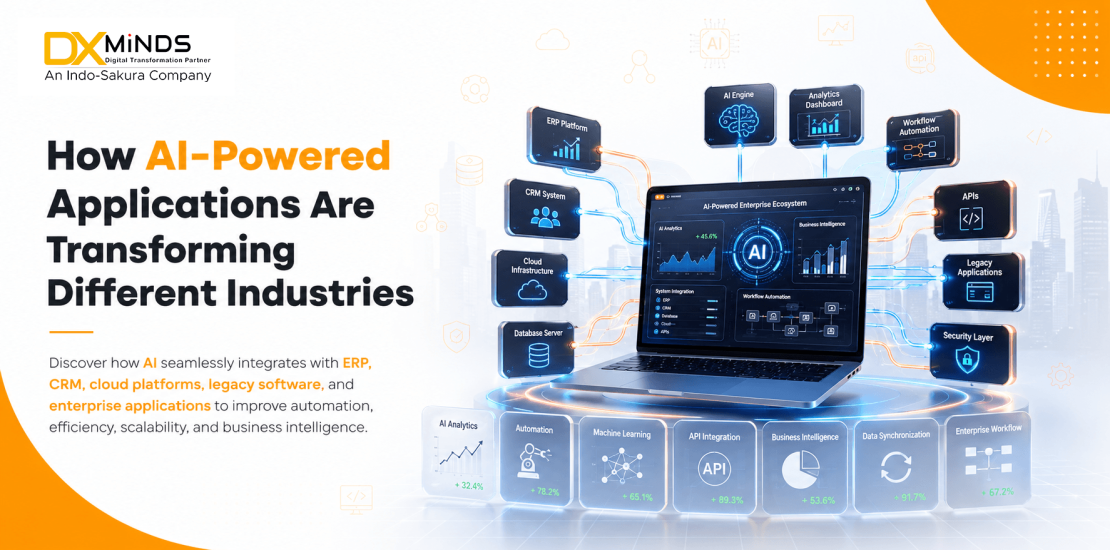
This article explores how AI-powered applications are transforming different industries, the benefits they provide, common use cases, implementation challenges, and what businesses should consider when developing AI-powered solutions.
What Are AI-Powered Applications?
AI-powered applications are software applications that use artificial intelligence technologies to perform tasks that traditionally require human intelligence or decision-making.
These applications can process data, recognize patterns, understand language, make predictions, generate content, or automate decisions depending on their design.
Some commonly used AI technologies include
- Machine learning
- Generative AI
- Natural language processing
- Computer vision
- Predictive analytics
- Large language models
- Speech recognition
- Recommendation systems
- Intelligent automation
- Conversational AI
For example, a traditional customer support application might provide a list of frequently asked questions.
An AI-powered customer support application can understand a customer’s question, determine the user’s intent, retrieve relevant information, generate a response, and potentially perform an action.
This ability to understand and respond dynamically is one of the major differences between conventional software and modern AI-powered applications.
Why Businesses Are Investing in AI-Powered Applications
Businesses are adopting AI for several reasons.
1. Increasing Operational Efficiency
AI can automate repetitive tasks that previously required employees to perform them manually.
Examples include:
- Data entry
- Document processing
- Customer inquiries
- Report generation
- Invoice processing
- Data classification
- Appointment scheduling
- Quality inspection
Automation allows employees to spend more time on strategic and creative activities.
2. Faster Decision-Making
Businesses generate enormous amounts of data every day.
AI applications can analyze large datasets quickly and identify patterns that may be difficult to detect manually.
This can help organizations make faster, data-driven decisions.
3. Better Customer Experiences
Customers increasingly expect personalized and immediate interactions.
AI-powered applications can provide personalized recommendations, intelligent chatbots, virtual assistants, automated notifications, and real-time support.
4. Cost Optimization
Automation can reduce the amount of manual effort required for repetitive processes.
Over time, this can help organizations optimize operational costs while maintaining productivity.
5. Predictive Capabilities
AI can analyze historical data and identify patterns that may indicate future outcomes.
Businesses can use these capabilities for:
- Demand forecasting
- Predictive maintenance
- Risk assessment
- Customer churn prediction
- Sales forecasting
- Fraud detection
How AI-Powered Applications Are Transforming Healthcare
Healthcare is one of the industries where AI-powered applications can have a significant impact.
Healthcare organizations generate large volumes of information, including medical records, diagnostic images, laboratory results, prescriptions, and patient communication.
AI can help process and analyze this information more efficiently.
AI-Powered Healthcare Applications
AI applications can support:
- Medical image analysis
- Patient data analysis
- Appointment scheduling
- Virtual health assistants
- Clinical documentation
- Drug discovery
- Predictive analytics
- Patient engagement
- Administrative automation
For example, computer vision systems can assist healthcare professionals in analyzing medical images.
AI-powered virtual assistants can also answer common patient questions, provide appointment information, and help patients navigate healthcare services.
Improving Administrative Efficiency
Healthcare employees often spend significant amounts of time on administrative activities.
AI applications can automate tasks such as documentation, scheduling, data classification, and information retrieval.
This allows healthcare professionals to dedicate more time to patient-focused activities.
AI should support healthcare professionals rather than replace professional judgement, particularly for high-stakes medical decisions.
AI-Powered Applications in Banking and Financial Services
The financial industry has been an early adopter of artificial intelligence.
Banks, fintech companies, insurance providers, and financial institutions process large amounts of transactional and customer data.
AI applications can help organizations analyze this information and identify unusual patterns.
Fraud Detection
AI-powered fraud detection systems can analyze transactions and identify potentially suspicious behaviour.
Instead of relying only on fixed rules, machine learning systems can identify patterns associated with unusual activity.
Risk Assessment
Financial institutions can use AI to support credit analysis, risk assessment, and financial forecasting.
Customer Service
AI chatbots and virtual assistants can answer common banking questions, assist customers with basic requests, and guide users through financial services.
Personalized Financial Services
AI can analyze customer behavior and preferences to provide more personalized recommendations and services.
This can improve customer engagement while helping financial institutions deliver more relevant experiences.
AI in Retail and E-Commerce
Retail businesses are increasingly using AI to understand customers and optimize operations.
Online shopping platforms generate valuable data about customer searches, purchases, preferences, and browsing behavior.
AI-powered applications can use this information to create more personalized experiences.
Product Recommendations
Recommendation engines can analyze customer behavior and suggest products that may be relevant to individual users.
Demand Forecasting
Retailers can use AI to predict product demand and optimize inventory.
Better demand forecasting can help businesses reduce overstocking and stock shortages.
Customer Support
AI chatbots and voice assistants can answer questions about:
- Products
- Orders
- Shipping
- Returns
- Payments
- Availability
Personalized Marketing
AI can help businesses segment customers and create more targeted marketing campaigns.
Instead of sending identical messages to every customer, businesses can create experiences based on customer interests and behavior.
AI-Powered Applications in Manufacturing
Manufacturing is another industry experiencing major AI-driven transformation.
Factories produce large amounts of operational data through machines, sensors, production systems, and quality-control processes.
AI applications can analyze this information to improve productivity and reduce downtime.
Predictive Maintenance
One of the most important applications is predictive maintenance.
Instead of waiting for a machine to fail, AI can analyze sensor data and identify patterns that may indicate potential equipment problems.
This allows maintenance teams to investigate issues before major failures occur.
Quality Inspection
Computer vision systems can inspect products for defects.
AI-powered inspection can help identify:
- Surface defects
- Incorrect components
- Manufacturing inconsistencies
- Packaging problems
- Product damage
Production Optimization
AI can analyze production data to identify inefficiencies and recommend ways to improve processes.
This can help manufacturers improve productivity and reduce waste.
AI in Logistics and Supply Chain
Supply chains involve multiple interconnected processes, including transportation, warehousing, inventory management, procurement, and delivery.
AI-powered applications can help businesses manage these processes more efficiently.
Demand Forecasting
AI can analyze historical sales, seasonal trends, market information, and other variables to improve demand forecasts.
Route Optimization
Logistics companies can use AI to analyze traffic, delivery locations, vehicle availability, and other factors to identify efficient routes.
Inventory Management
AI can help businesses determine when inventory should be reordered and identify products that may experience increased demand.
Supply Chain Risk Management
AI can analyze operational information to identify potential disruptions and help organisations respond more quickly.
AI-Powered Applications in Education
Education is also being transformed by artificial intelligence.
AI applications can help educational institutions create more personalized learning experiences.
Personalized Learning
AI systems can analyze student performance and recommend learning materials based on individual needs.
AI Tutors
Conversational AI applications can provide students with explanations, practice questions, and learning assistance.
Automated Administrative Tasks
Educational institutions can use AI for tasks such as:
- Student communication
- Scheduling
- Document processing
- Frequently asked questions
- Administrative support
Teachers can therefore spend more time focusing on teaching and student engagement.
AI in Real Estate
Real estate companies are using AI to improve property discovery, customer engagement, and market analysis.
AI applications can analyze property information and help users identify suitable properties.
Property Recommendations
AI can recommend properties based on factors such as
- Budget
- Location
- Property type
- Preferences
- Previous searches
Lead Qualification
AI chatbots and voice agents can communicate with prospective buyers and identify high-intent leads.
Property Valuation
AI-based analytical systems can analyze historical market data and property characteristics to support valuation processes.
Customer Support
Virtual assistants can answer questions about property availability, amenities, locations, and appointments.
AI in Insurance
Insurance companies deal with large volumes of customer, policy, and claims information.
AI applications can support several areas of insurance operations.
Claims Processing
AI can help classify claims and extract relevant information from documents.
Fraud Detection
Machine learning models can identify unusual claim patterns that may require further investigation.
Customer Service
AI-powered assistants can answer policy-related questions and provide basic information.
Risk Analysis
AI can help insurers analyze large datasets to improve risk assessment.
AI in Travel and Hospitality
Travel companies, hotels, airlines, and hospitality businesses can use AI to improve customer experiences and operational efficiency.
AI applications can assist with:
- Booking support
- Travel recommendations
- Personalized offers
- Customer service
- Hotel recommendations
- Itinerary planning
- Demand forecasting
AI-powered chatbots and voice assistants can provide customers with immediate assistance during the booking and travel process.
Hotels can also use AI to personalize guest experiences based on preferences and previous interactions.
AI in Telecommunications
Telecommunications companies manage millions of customer interactions and large amounts of network data.
AI-powered applications can help improve both customer service and network operations.
Customer Support
AI assistants can answer questions related to:
- Billing
- Plans
- Data usage
- Service availability
- Account information
Network Optimization
AI can analyze network performance and identify potential issues.
Customer Churn Prediction
AI can analyze customer behavior and identify customers who may be at risk of leaving.
This allows businesses to create targeted retention strategies.
AI in Automotive
The automotive industry is using AI across manufacturing, vehicle systems, customer service, and mobility.
AI applications can support:
- Predictive vehicle maintenance
- Driver assistance
- Manufacturing automation
- Quality inspection
- Customer support
- Demand forecasting
- Vehicle personalization
AI-powered applications can analyze vehicle data and potentially identify maintenance requirements before they become serious problems.
AI in Marketing and Advertising
Marketing teams are increasingly using AI to analyze customer behavior and improve campaign performance.
AI-powered marketing applications can help businesses with:
- Customer segmentation
- Content generation
- Campaign optimization
- Predictive analytics
- Recommendation systems
- Lead scoring
- Customer personalization
AI can process large datasets and identify patterns that help marketers understand what types of messages and offers are more relevant to specific audiences.
However, businesses should combine AI-generated insights with human creativity and strategic judgement.
AI-Powered Applications and Customer Service
Customer service is one of the most visible applications of AI.
Businesses can use:
- AI chatbots
- AI voice agents
- Virtual assistants
- Automated email systems
- Intelligent knowledge bases
- Customer sentiment analysis
These applications can provide immediate support and reduce the workload of customer service teams.
For example, an AI-powered customer service application can understand a customer’s question, search a company knowledge base, provide an answer, and escalate the conversation when human assistance is needed.
This creates a hybrid customer service model where AI manages routine interactions while human employees handle complex cases.
Key Benefits of AI-Powered Applications for Businesses
Across industries, AI applications can provide several common benefits.
Increased Productivity
AI automates repetitive processes and helps employees work more efficiently.
Better Data Analysis
AI can analyze large datasets and identify useful patterns.
Improved Customer Experience
Personalized and faster interactions can increase customer satisfaction.
Scalability
AI applications can handle increasing workloads without requiring a proportional increase in manual resources.
Faster Operations
Automated workflows can reduce delays and improve business processes.
Better Forecasting
Predictive AI can help organizations anticipate future trends and potential problems.
Reduced Operational Costs
Automation can reduce the amount of manual effort required for repetitive activities.
Challenges of Implementing AI-Powered Applications
Despite their benefits, AI applications also introduce challenges.
Data Quality
AI systems require reliable data. Poor-quality or incomplete data can reduce the effectiveness of AI models.
Integration With Legacy Systems
Many businesses still rely on older software systems.
Integrating modern AI applications with legacy infrastructure can require careful planning and technical development.
Security and Privacy
AI applications may process sensitive business or customer information.
Organizations need appropriate security controls to protect data.
AI Accuracy
AI systems are not perfect.
Businesses should establish testing, monitoring, validation, and human oversight processes.
Implementation Costs
Developing and deploying AI applications requires investment in technology, infrastructure, development, and ongoing maintenance.
For this reason, organizations should identify high-value use cases and define measurable objectives before beginning implementation.
How Businesses Can Successfully Adopt AI
A successful AI strategy starts with the business problem rather than the technology.
Step 1: Identify a Business Problem
Determine which process creates the greatest operational challenge.
Step 2: Evaluate AI Suitability
Not every business problem requires AI.
Organizations should determine whether AI can provide measurable value.
Step 3: Prepare Data
Identify the data sources required for the AI application and assess their quality.
Step 4: Build a Proof of Concept
A small proof of concept can help organizations evaluate feasibility before investing in a larger implementation.
Step 5: Integrate With Existing Systems
The AI application should connect with relevant business systems where necessary.
Step 6: Test and Monitor
Organizations should continuously monitor performance, accuracy, security, and user experience.
Step 7: Scale Gradually
Once the AI solution demonstrates measurable value, businesses can expand it to additional departments or use cases.
The Future of AI-Powered Applications
The future of AI applications is moving toward more intelligent, autonomous, and context-aware systems.
Generative AI and large language models are already changing how users interact with software.
Instead of navigating multiple menus, users can increasingly communicate with applications using natural language.
For example, an employee could ask:
“Show me this month’s sales performance and identify the regions where revenue has declined.”
An AI-powered business application could potentially analyze relevant data and provide a natural-language response.
Agentic AI is another emerging direction.
AI agents can be designed to understand objectives, plan multiple steps, interact with software systems, and execute workflows under appropriate controls.
This could transform enterprise applications from passive tools into intelligent systems capable of actively supporting business processes.
Why Businesses Need a Strategic AI Application Development Approach
AI should not be implemented simply because it is a popular technology.
Successful AI applications should solve real business problems.
A strong AI application development strategy should consider:
- Business objectives
- User requirements
- Data availability
- AI model selection
- Application architecture
- Security
- Integration
- Scalability
- Testing
- Monitoring
- Maintenance
Businesses should also define measurable KPIs before implementation.
For example, an organization implementing an AI customer support application might measure:
- Reduction in support tickets
- Average response time
- Customer satisfaction
- Automation rate
- Cost per interaction
Measuring these results makes it easier to determine whether the AI investment is generating meaningful business value.
How DX Minds Helps Businesses Leverage AI
DX Minds helps businesses explore and implement technology solutions designed around their specific operational requirements.
For organizations considering AI application development, the right solution depends on the industry, business process, available data, existing technology stack, and desired outcomes.
AI-powered solutions can be designed for areas such as:
- Intelligent automation
- AI chatbots
- Generative AI applications
- Machine learning solutions
- Predictive analytics
- Computer vision
- Enterprise AI
- Customer service automation
- AI-powered business applications
The objective should be more than simply adding an AI feature to an existing product.
A successful AI application should deliver measurable value, integrate effectively with existing systems, and provide a reliable experience for its users.
Businesses can start with a specific use case, validate the results, and then expand AI capabilities across additional workflows.
Conclusion
AI-powered applications are changing how businesses operate across industries.
Healthcare organizations are using AI to support healthcare workflows and data analysis. Financial institutions are applying AI to fraud detection and customer service. Retailers are using AI for personalization and demand forecasting. Manufacturers are adopting predictive maintenance and intelligent quality inspection. Logistics companies are optimizing supply chains, while education, real estate, insurance, telecommunications, automotive, travel, and marketing organizations are finding new AI applications.
The common factor is that AI can help organizations turn data into actionable insights, automate repetitive work, improve customer experiences, and make business processes more intelligent.
However, successful AI adoption requires more than selecting an AI model.
Businesses need a clear strategy, reliable data, secure architecture, appropriate integrations, continuous monitoring, and measurable objectives.
As AI technologies continue to evolve, AI-powered applications are likely to become increasingly integrated into everyday business operations.
Organisations that identify the right use cases and implement AI strategically can position themselves for greater efficiency, improved customer experiences, and long-term digital transformation.
Frequently Asked Questions
1. How are AI-powered applications transforming different industries?
AI-powered applications are helping businesses automate repetitive tasks, improve decision-making, analyze large amounts of data, personalise customer experiences, and increase operational efficiency across industries such as healthcare, finance, retail, manufacturing, logistics, and education.
2. What are the main benefits of AI-powered applications for businesses?
The main benefits include improved productivity, process automation, faster data analysis, reduced operational costs, better customer experiences, predictive insights, and more accurate business decision-making.
3. Which industries can benefit from AI-powered applications?
Almost every industry can benefit from AI applications. Healthcare, banking and finance, manufacturing, retail, logistics, education, real estate, e-commerce, and customer service are some of the sectors using AI to improve their operations and services.
4. How can businesses implement AI-powered applications?
Businesses can start by identifying processes where AI can provide measurable value. They can then select suitable AI technologies, integrate them with existing systems, develop or customise AI applications, test their performance, and continuously monitor and improve the solution.
5. Why should businesses work with an AI application development company?