
- September 2, 2026
- Posted by: Admin
- Category: Artificial Intelligence
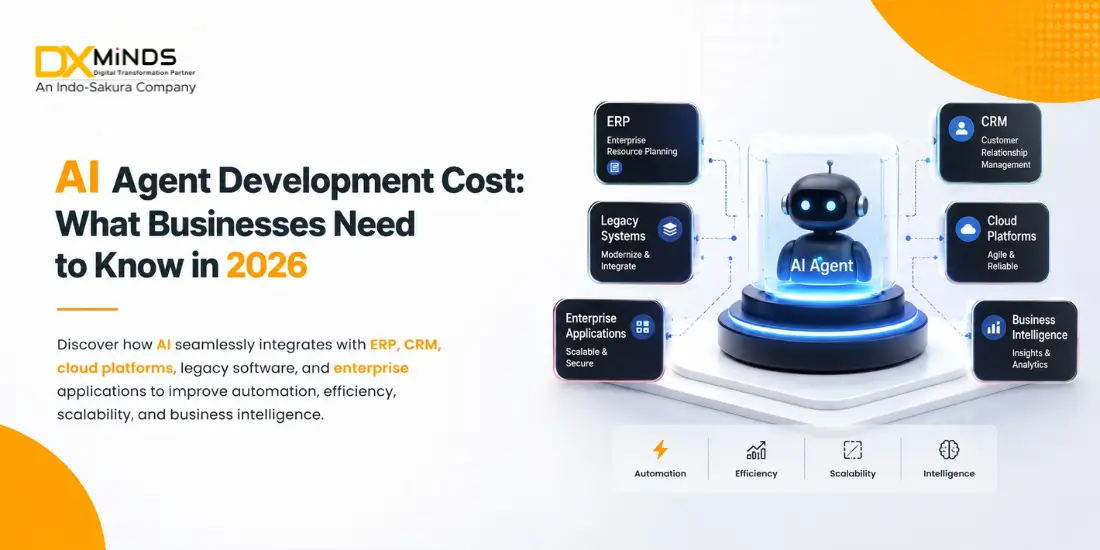
AI agent development cost is one of the first questions businesses ask when they begin exploring AI automation. As AI agents become more capable of understanding information, using business tools, and completing multi-step workflows, companies across industries are considering them for customer service, sales, healthcare, finance, software development, operations, and internal productivity.
But there is no universal price for building an AI agent.
In 2026, the cost to build an AI agent can range from around $10,000 for a basic solution to $150,000 or more for complex enterprise implementations. The final investment depends on factors such as the agent’s capabilities, AI model, integrations, data requirements, security, user volume, workflow complexity, and deployment environment.
More importantly, businesses should not choose an AI agent based only on development price.
The right question is
What business problem will the AI agent solve, how complex is the workflow, and what will it cost to operate and maintain over time?
This guide provides a practical look at AI agent development costs in 2026, including pricing factors, technology requirements, development stages, use cases, ROI considerations, and the differences between AI agents, chatbots, and traditional automation.
AI Agent Development Cost in 2026: At a Glance
The following ranges can be used as an initial budgeting reference:
|
AI Agent Complexity |
Estimated Cost | Typical Timeline |
|
Basic AI Agent |
$10,000 – $25,000 |
4–8 weeks |
|
Intermediate AI Agent |
$25,000 – $60,000 | 8–14 weeks |
| Advanced AI Agent | $60,000 – $150,000 |
3–6 months |
| Enterprise AI Agent System |
$150,000+ |
6+ months |
These figures are indicative estimates, not fixed industry prices. Two AI agents with similar descriptions can have very different development costs.
The best way to estimate cost is to evaluate the complete technical and business scope.
What Is an AI Agent?
An AI agent is a software system that can understand a goal, process information, use tools, make decisions within defined boundaries, and perform one or more actions.
A traditional chatbot might answer:
“What are your business hours?”
To complete that workflow, the agent may need to:
- Understand the user’s request.
- Retrieve customer information.
- Access an order-management system.
- Analyze the available information.
- Select the appropriate action.
- Call an API.
- Confirm the result.
- Respond to the customer.
This combination of AI reasoning, enterprise data, tools, APIs, workflows, and controlled actions is what makes AI agent development more complex than building a basic chatbot.
Why Is AI Agent Development Becoming Important in 2026?
Organizations are exploring AI agents to:
- Automate repetitive tasks
- Improve customer service
- Support employees
- Qualify leads
- Process documents
- Retrieve enterprise knowledge
- Assist sales teams
- Automate administrative workflows
- Analyze business information
- Connect multiple software systems
For example, a company could use an AI sales agent to research prospects, retrieve CRM information, prepare personalized outreach, update customer records, and create follow-up tasks.
However, not every workflow needs an AI agent.
If a process can be reliably handled using a simple rule-based automation, adding an AI layer may increase complexity and cost without creating enough additional value.
The strongest AI implementations begin with the business problem, not the technology.
What Determines AI Agent Development Cost?
Several factors influence the final cost of an AI agent project.
The most important are
- Agent complexity
- Number of workflows
- AI model selection
- Enterprise integrations
- Data and RAG requirements
- Security and compliance
- Voice or multimodal capabilities
- User volume
- Testing and evaluation
- Infrastructure and maintenance
Let’s look at each factor.
1. AI Agent Complexity
The simplest AI agent may have only a few components:
User → AI Agent → LLM → Response
An advanced enterprise agent may look more like
User → Agent Orchestrator → LLM → RAG → Tools → APIs → Enterprise Systems → Validation → Human Approval → Action
Every additional component can increase development effort.
2. Number of Workflows
Example: Single Workflow
A customer support agent answers product-related questions.
Example: Multiple Workflows
A customer-support agent:
- Answers questions
- Checks orders
- Processes returns
- Creates tickets
- Updates CRM records
- Escalates complaints
- Sends notifications
The second system requires more integrations, testing, permissions, business logic, and error handling.
As the number of workflows increases, development costs rise.
3. AI Model Selection
Depending on the application, businesses may consider:
- Commercial LLM APIs
- Open-source language models
- Smaller task-specific models
- Multimodal models
- Speech-to-text models
- Text-to-speech models
- Embedding models
A common misconception is that the most powerful model is always the best choice.
In practice, an AI agent can use different models for different tasks.
Simple classification → Smaller model
Complex reasoning → Advanced model
Information retrieval → Embedding model
Voice transcription → Speech model
This approach can help balance accuracy, performance, latency, and cost.
4. Enterprise Software Integrations
Integrations can become one of the largest contributors to AI agent development costs.
An AI agent may need access to:
- CRM systems
- ERP platforms
- HR systems
- Helpdesk software
- Payment systems
- Databases
- E-commerce platforms
- Internal APIs
- Cloud services
Consider a sales AI agent.
It might need to:
- Identify a prospect.
- Search the CRM.
- Retrieve previous interactions.
- Research relevant information.
- Generate an outreach message.
- Update the CRM.
- Create a follow-up activity.
The AI model itself is only one part of the solution.
5. RAG and Enterprise Data
Many businesses want their AI agents to work with proprietary company information.
This can include:
- Policies
- Product documentation
- Customer information
- Technical manuals
- Internal knowledge bases
- Contracts
- Support documentation
- Databases
A RAG implementation may require:
- Data ingestion
- Document processing
- Chunking
- Embeddings
- Vector search
- Metadata
- Retrieval optimization
- Access controls
- Evaluation
6. Security and Compliance Requirements
Depending on the application, organizations may require:
- Authentication
- Authorization
- Role-based access control
- Encryption
- API security
- Audit logs
- Data protection
- Permission management
- Human approval
- Secure tool execution
- AI guardrails
For example, an AI agent may be allowed to create a support ticket automatically but require human approval before issuing a high-value refund.
This type of permission architecture helps businesses control what the AI can do.
7. Voice and Multimodal AI
A voice-enabled AI agent may require:
Speech-to-Text → AI Agent → Business Logic → Text-to-Speech
Additional requirements can include:
- Real-time processing
- Voice recognition
- Speech synthesis
- Call handling
- Conversation management
- Latency optimization
8. User Volume and Usage
Consider the difference between:
100 internal employees
and
100,000 customers interacting with an AI agent every month.
Higher usage can increase:
- AI model consumption
- API calls
- Database usage
- Cloud infrastructure
- Storage
- Monitoring requirements
This is why AI agent budgeting should include both development costs and recurring operational costs.
AI Agent Development Cost by Project Complexity
Basic AI Agent: $10,000–$25,000
A basic AI agent usually focuses on a specific, limited workflow.
Examples
- FAQ assistant
- Internal knowledge assistant
- Basic lead qualification
- Simple customer support
- Appointment assistance
Typical features
- LLM integration
- Basic prompts
- Limited knowledge base
- One or two integrations
- Web interface
- Basic analytics
Estimated timeline
4–8 weeks
Intermediate AI Agent: $25,000–$60,000
An intermediate AI agent can support multiple workflows and business integrations.
Typical features
- RAG
- Multiple APIs
- CRM integration
- Tool calling
- Conversation memory
- Authentication
- Workflow automation
- Human escalation
- Analytics
Example
A customer-service agent that can answer questions, retrieve customer information, check order status, create support tickets, and escalate complex issues.
Estimated timeline
8–14 weeks
Advanced AI Agent: $60,000–$150,000
Advanced agents are designed for more complex business workflows.
They may include:
- Multi-step reasoning
- Multiple tools
- Advanced RAG
- Multiple enterprise integrations
- Voice capabilities
- Workflow orchestration
- Human-in-the-loop controls
- Advanced monitoring
- Security controls
- Evaluation frameworks
Estimated timeline
3–6 months
Enterprise AI Agent System: $150,000+
An enterprise implementation could include:
- Multiple specialized agents
- Agent orchestration
- Enterprise knowledge infrastructure
- Multiple AI models
- CRM and ERP integrations
- Advanced authentication
- Governance
- Audit logging
- Monitoring
- Human approval workflows
- High availability
- Scalability
The final cost can vary substantially depending on the organization’s existing infrastructure and requirements.
AI Agent Development Cost: Initial Investment vs. Ongoing Cost
One of the most important considerations when budgeting for AI agents is understanding the difference between development cost and operational cost.
Initial development may include:
- Business analysis
- Architecture
- UI/UX
- AI development
- RAG
- API integrations
- Backend development
- Security
- Testing
- Deployment
Ongoing costs may include:
- LLM usage
- Cloud infrastructure
- Database usage
- API usage
- Monitoring
- Maintenance
- Security updates
- Model optimization
- Feature enhancements
For this reason, businesses should calculate the Total Cost of Ownership (TCO) rather than evaluating an AI agent project based only on the initial quotation.
AI Agent Technology Stack in 2026
The technology stack varies according to the project’s requirements.
AI Models
Potential choices include:
- OpenAI
- Anthropic
- Google Gemini
- Open-source LLMs
- Specialized AI models
The selection should consider accuracy, cost, latency, privacy, reliability, and deployment requirements.
Agent Frameworks
Agent systems may use technologies such as
- LangGraph
- LangChain
- Microsoft Semantic Kernel
- Custom orchestration
RAG and Knowledge
Potential technologies include:
- Pinecone
- Weaviate
- Qdrant
- Elasticsearch
- PostgreSQL with vector capabilities
Backend
Common choices include
- Python
- Node.js
- Java
- .NET
- REST APIs
- GraphQL
- Microservices
Cloud
AI agents can be deployed using:
- AWS
- Microsoft Azure
- Google Cloud
The right stack should be determined by the business requirements rather than simply following technology trends.
AI Agent Development Process: From Idea to Production
A structured AI agent development process can help businesses control scope and validate the business case.
Step 1: Identify the Business Problem
Start by identifying the process you want to improve.
Ask:
- What is currently manual?
- Where are employees spending the most time?
- What causes delays?
- What information does the workflow require?
- What outcome should improve?
Step 2: Select the Right AI Use Case
Not every process needs an AI agent.
Evaluate:
- Business value
- Workflow complexity
- Data availability
- Automation potential
- Risk
- Frequency
- Integration requirements
Start with a use case where success can be measured.
Step 3: Define the Agent’s Responsibilities
Clearly establish what the AI agent can and cannot do.
For example:
The agent can:
- Search approved documents
- Answer customer questions
- Retrieve order information
- Create support tickets
The agent cannot:
- Change permissions
- Delete sensitive records
- Approve high-value transactions
- Perform restricted actions without authorization
Clear boundaries are important for reliability and governance.
Step 4: Design the Architecture
The development team determines:
- AI models
- Agent architecture
- RAG
- APIs
- Databases
- Authentication
- Security
- Monitoring
- Human escalation
Step 5: Build an MVP
Rather than automating an entire department at once, businesses can start with a focused MVP.
The MVP can help validate:
- Accuracy
- User experience
- Workflow performance
- Integration reliability
- Cost per task
- Business value
If the results are positive, additional capabilities can be added.
Step 6: Integrate Existing Systems
Connect the agent with the systems required to complete the workflow.
For example:
AI Agent → CRM
AI Agent → ERP
AI Agent → Knowledge Base
AI Agent → Helpdesk
AI Agent → Internal APIs
Step 7: Test and Evaluate
AI agent testing should go beyond checking whether the application works.
Teams should evaluate:
- Accuracy
- Task completion
- Hallucination rate
- Tool selection
- Failure handling
- Response time
- Security
- Cost per interaction
Testing with realistic business scenarios is particularly important before allowing an agent to perform production actions.
Step 8: Deploy and Monitor
After testing, the agent can be deployed in a controlled production environment.
Monitoring should track:
- Usage
- Errors
- Performance
- AI responses
- API failures
- Cost
- Security events
Step 9: Optimize and Scale
AI agent development does not necessarily end at deployment.
Organizations may continuously improve:
- Prompts
- Models
- Retrieval
- Workflows
- Tools
- Guardrails
- Performance
- Cost efficiency
A successful AI agent should evolve as business requirements change.
AI Agent Use Cases Across Industries
AI agents can support different workflows across industries.
Healthcare
Potential applications include:
- Patient support
- Appointment assistance
- Administrative workflows
- Documentation support
- Insurance workflows
- Knowledge retrieval
For high-impact clinical workflows, appropriate professional oversight and safeguards are essential.
Banking and Financial Services
Potential applications include:
- Customer support
- Document processing
- Fraud investigation assistance
- Loan workflow support
- Internal knowledge management
- Financial research assistance
Security, authorization, auditability, and governance are particularly important in financial applications.
Retail and E-Commerce
AI agents can support:
- Product discovery
- Customer service
- Order tracking
- Returns
- Product recommendations
- Inventory workflows
Manufacturing
Potential use cases include:
- Maintenance support
- Technical documentation
- Production assistance
- Quality workflows
- Supply-chain information
- Employee knowledge assistance
Software Development
AI agents can assist developers with:
- Code generation
- Code review
- Testing
- Documentation
- Bug analysis
- Developer support
- DevOps workflows
Sales and Marketing
AI agents can support:
- Lead qualification
- Prospect research
- CRM updates
- Outreach preparation
- Follow-up workflows
- Customer intelligence
- Marketing operations
AI Agent vs Chatbot vs Traditional Automation
Choosing the right technology is just as important as understanding its cost.
|
Capability |
Traditional Automation | Chatbot | AI Agent |
| Rule-based tasks | Excellent | Limited |
Excellent |
|
Natural-language understanding |
Low | High |
High |
|
Multi-step workflows |
Limited | Limited | Strong |
| Tool usage | Limited | Moderate |
Strong |
|
Autonomous actions |
Low | Low–Moderate | High |
| Enterprise integrations | Moderate | Moderate |
Strong |
|
Complex workflow support |
Low | Moderate | High |
| Human escalation | Possible | Common |
Advanced |
|
Adaptability |
Low | Moderate | High |
|
Development complexity |
Low–Medium | Medium | Medium–High |
How to Reduce AI Agent Development Costs
Businesses can reduce unnecessary AI development expenses by taking a structured approach.
Start Small
Choose one high-value workflow instead of trying to automate everything.
Build an MVP.
Validate the concept before expanding.
Use Existing AI Models
For most applications, businesses do not need to build a foundation model from scratch.
Reuse Existing APIs
Use existing business systems and APIs wherever possible.
Select Models Based on the Task
Use advanced models when necessary and more cost-efficient models for simpler tasks.
Avoid Unnecessary Autonomy
If human approval is appropriate, incorporate it instead of trying to make every workflow fully autonomous.
Plan for Scale
An architecture that works for 100 users may not work efficiently for 100,000 users. Scalability should be considered early.
How to Calculate AI Agent ROI
Development cost alone does not determine whether an AI agent is a good investment.
Businesses should estimate the measurable benefits.
A simplified formula is
Annual AI Agent Benefit = Labor Savings + Revenue Impact + Error Reduction + Productivity Gains
Then:
AI Agent ROI = (Annual Benefit − Annual AI Operating Cost) ÷ Total AI Investment × 100
For example, an AI agent could potentially:
- Reduce repetitive support work
- Improve lead response time
- Reduce manual data entry
- Increase employee productivity
- Reduce processing errors
These benefits should be compared against development, infrastructure, model usage, maintenance, and support costs.
The goal is to determine whether the AI agent produces sufficient business value over its expected lifecycle.
Hidden Costs Businesses Should Consider
AI agent development quotes do not always include every cost associated with operating an AI system.
Businesses should consider:
Model Usage
Higher usage can increase recurring AI costs.
Cloud Infrastructure
Servers, databases, storage, and networking create ongoing expenses.
Data Preparation
Business information may need cleaning, restructuring, and indexing.
Monitoring
Production AI systems require monitoring and evaluation.
Maintenance
Business processes, APIs, models, and integrations change over time.
Security
Additional security controls may be required for sensitive workflows.
Employee Adoption
Employees may need training and updated processes to work effectively with AI.
Considering these expenses early provides a more realistic AI agent budget.
Build vs Buy: Which AI Agent Approach Is Right?
Businesses generally have three options:
Build Completely From Scratch
Suitable when:
- Requirements are highly specialized
- Deep customization is necessary
- Existing platforms cannot meet requirements
Use an Existing AI Agent Platform
Suitable when:
- The workflow is relatively standardized
- Fast deployment is important
- Existing integrations meet requirements
Use a Hybrid Approach
A hybrid approach combines existing AI technologies with custom workflows, integrations, and business logic.
For many organizations, this can provide a balance between development speed, customization, cost, and control.
How to Choose an AI Agent Development Company
When evaluating AI agent development companies, price should not be the only consideration.
Look for experience in:
- AI application development
- LLM integration
- RAG
- Agent orchestration
- API development
- Enterprise integrations
- Cloud architecture
- AI testing
- Security
- Production monitoring
Ask potential development partners:
- How will you determine whether an AI agent is appropriate for our workflow?
- What architecture do you recommend?
- Which AI models will you use?
- How will our data be protected?
- Will the agent require RAG?
- How will it integrate with our existing systems?
- Which actions require human approval?
- How will you evaluate AI accuracy?
- How will you manage hallucinations?
- What will our estimated ongoing operating cost be?
- How will the solution scale?
- What support is available after deployment?
These questions help businesses evaluate the overall quality and long-term value of a development partner.
Why Businesses Should Not Choose an AI Agent Based Only on Price
Suppose one provider quotes $20,000 and another quotes $50,000.
The cheaper proposal is not automatically better.
The difference could come from:
- Number of integrations
- Security architecture
- RAG requirements
- Testing depth
- Infrastructure
- AI model strategy
- Scalability
- Post-launch support
A poorly designed AI agent can become expensive to maintain or rebuild.
Therefore, businesses should compare proposals based on:
Scope + Architecture + Security + Scalability + Performance + Support + Total Cost of Ownership
rather than development cost alone.
What Should Businesses Budget for an AI Agent in 2026?
For early-stage planning, the following approach can be useful:
Small business or focused workflow
$10,000–$25,000
Suitable for a narrowly defined AI agent with limited integrations.
Growing business
$25,000–$60,000
Suitable for more sophisticated workflows, RAG, APIs, and business integrations.
Complex enterprise workflow
$60,000–$150,000
Suitable for advanced automation, multiple integrations, security, monitoring, and sophisticated AI capabilities.
Enterprise AI ecosystem
$150,000+
Suitable for organizations requiring multiple agents, complex orchestration, enterprise governance, extensive integrations, and large-scale deployment.
These numbers should be treated as budgeting ranges rather than guaranteed project prices.
The final estimate should be based on a technical discovery and clearly defined scope.
The Future of AI Agent Development
AI agents are moving toward increasingly sophisticated forms of workflow automation.
- Multi-agent collaboration
- AI orchestration
- Enterprise RAG
- Multimodal AI
- Voice-enabled agents
- AI-powered workflow automation
- Human-in-the-loop systems
- AI governance
- Agent observability
- Automated task execution
As AI agents become capable of taking more actions, businesses will need stronger controls around permissions, security, monitoring, evaluation, and accountability.
The goal should not be to give an AI agent unlimited autonomy.
The goal should be to give it the right level of autonomy for the task it is designed to perform.
Final Thoughts: Is AI Agent Development Worth the Investment?
AI agent development can represent a significant investment, but the potential value can also be substantial when the technology is applied to the right business problem.
The cost of building an AI agent depends on much more than the AI model itself.
Businesses need to consider:
- Workflow complexity
- AI architecture
- Data
- RAG
- Integrations
- Security
- AI model usage
- Infrastructure
- Testing
- Monitoring
- Maintenance
- ROI
The most practical strategy is to identify one high-value workflow, validate the business case with an MVP, measure performance, and scale gradually.
Frequently Asked Questions
How much does it cost to build an AI agent in 2026?
The estimated cost can range from approximately $10,000 to $150,000+, depending on the complexity, integrations, AI models, data requirements, security, and deployment scale.
What is the cheapest way to build an AI agent?
The most cost-effective approach is usually to start with a focused use case, use existing AI models and APIs, minimize unnecessary integrations, and build an MVP before expanding.
How long does AI agent development take?
A basic AI agent may take around 4–8 weeks, while intermediate projects can take 8–14 weeks. Advanced and enterprise implementations can take several months.
What is the most expensive part of AI agent development?
There is no single universal cost driver. Complex integrations, security requirements, data architecture, multi-step workflows, testing, and enterprise infrastructure can all substantially increase project cost.
Does an AI agent need RAG?
Not necessarily. RAG is particularly useful when an agent needs access to private, organization-specific, or frequently changing information.