
- March 20, 2026
- Posted by: Admin
- Category: Software Development
Introduction
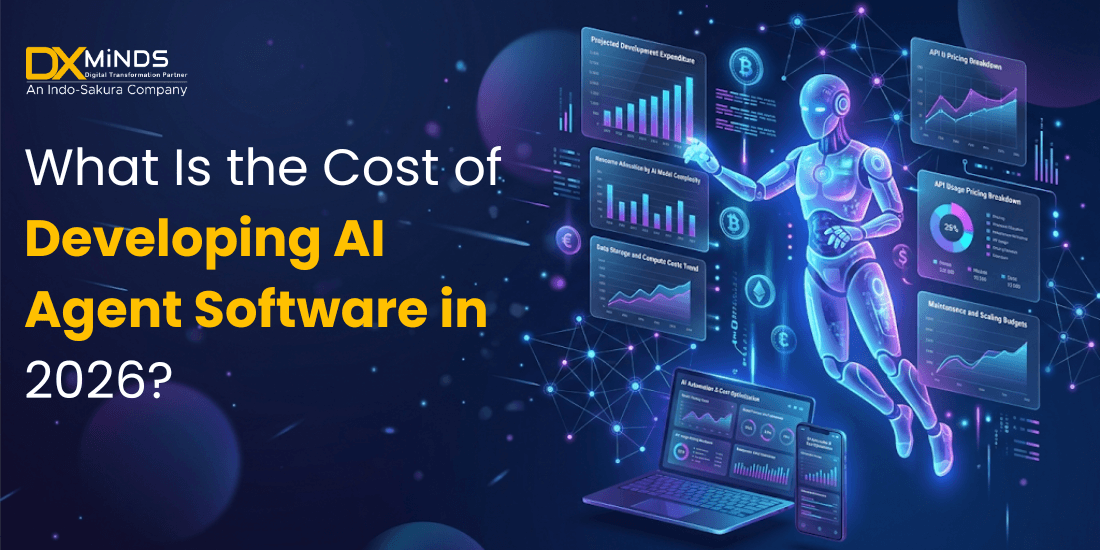
Artificial Intelligence continues to reshape how businesses operate, and in 2026, AI agent software has become a key driver of innovation and efficiency. These systems are designed to handle tasks autonomously, interact with users intelligently, and improve continuously through data and feedback. From customer service automation to complex enterprise workflows, AI agents are now an essential part of modern digital ecosystems.
As businesses explore AI adoption, one common question arises: What does it cost to develop AI agent software? The answer is not straightforward because every AI project is unique. The overall investment depends on several factors such as system complexity, integrations, and long-term scalability requirements.
Instead of focusing on fixed pricing, it is more valuable to understand the elements that influence development effort. This blog provides a clear and structured explanation to help businesses plan their AI investment effectively.
What Is AI Agent Software?
AI agent software refers to intelligent systems that can perform tasks independently by analyzing data, understanding user intent, and making decisions. Unlike traditional applications, these systems are adaptive and capable of learning over time.
They are commonly used in areas such as customer support, virtual assistance, recommendation systems, and workflow automation. Depending on the use case, AI agents can range from simple rule-based systems to advanced models capable of reasoning and executing multi-step processes.
Key Reasons Why AI Agent Adoption Is Increasing
Businesses are rapidly adopting AI agents due to the value they bring across operations. Some of the main reasons include:
- Automation of repetitive tasks, reducing manual workload, and improving efficiency
- Round-the-clock availability, ensuring uninterrupted customer support
- Personalized user experiences, driven by data and behavior analysis
- Scalability, allowing systems to handle increased demand without additional resources
- Improved decision-making, based on real-time data insights
These advantages make AI agents a strategic investment rather than just a technological upgrade.
Understanding AI Agent Development Cost
The cost of developing AI agent software in 2026 cannot be defined by a fixed number. It varies based on project requirements, technical complexity, and business goals.
Rather than asking for an exact price, businesses should focus on understanding what drives development effort. Each AI system is different, and even small changes in functionality or integrations can significantly impact the scope of work.
A better approach is to evaluate the key factors that influence development and align them with business objectives.
Key Factors That Influence AI Agent Development Cost
Complexity and Level of Intelligence
The complexity of the AI agent is one of the most important factors. A basic system designed for simple interactions requires less effort compared to an advanced agent capable of decision-making and task execution.
As intelligence increases, additional components such as machine learning models, training processes, and optimization techniques are required. This naturally increases the development effort.
Features and Functional Capabilities
The features included in the AI agent define its scope and functionality. Some common capabilities include:
- Natural language understanding for conversations
- Voice interaction for hands-free communication
- Multi-language support for global users
- Real-time analytics for performance tracking
- Workflow automation for task execution
Each added feature introduces new layers of development and testing.
Data Requirements and Preparation
Data plays a central role in AI development. High-quality data is essential for building accurate and reliable systems.
Key activities involved in data preparation include:
- Collecting relevant datasets
- Cleaning and organizing data
- Labeling and structuring information
- Updating data continuously
These processes require time and resources but are critical for system performance.
Integration with Existing Systems
AI agents often need to work with existing tools and platforms. This includes systems such as:
- Customer relationship management (CRM) tools
- Enterprise resource planning (ERP) systems
- Websites and mobile applications
- Internal business software
Integration increases complexity because the AI agent must communicate effectively across multiple systems.
Technology Stack and Architecture
The choice of technology influences both development and scalability. Modern AI systems rely on a combination of tools, frameworks, and cloud platforms.
Advanced architectures may include real-time processing, memory systems, and data pipelines. While these technologies improve performance, they also add to the development effort.
User Experience and Interaction Design
An AI agent is only effective if users can interact with it easily. A well-designed user interface ensures smooth communication and better adoption.
Key elements of user experience include:
- Chat-based interfaces
- Voice-enabled interactions
- Visual dashboards for insights
Designing and testing these elements requires additional effort but significantly enhances usability.
Security and Compliance Requirements
Security is critical, especially for businesses handling sensitive data. AI systems must include measures such as:
- Data encryption
- Access control mechanisms
- Compliance with regulations
- Monitoring and auditing systems
These requirements ensure reliability and trust but also increase development complexity.
Scalability and Performance
AI agents must be designed to handle growth. As user demand increases, the system should maintain performance without disruptions.
This requires careful planning of infrastructure, load handling, and optimization strategies. Building scalable systems from the beginning helps avoid future challenges.
Maintenance and Continuous Improvement
AI systems require ongoing updates after deployment. This includes:
- Improving model accuracy
- Fixing bugs and errors
- Adding new features
- Monitoring system performance
Continuous improvement ensures that the AI agent remains effective over time.
AI Agent Development Process
The development of an AI agent follows a structured approach to ensure efficiency and reliability.
- Requirement analysis to define goals and use cases
- System design to plan architecture and workflows
- Development to build and integrate AI models
- Testing to validate performance and accuracy
- Deployment to launch the system
- Optimization to improve performance over time
Each stage plays a crucial role in shaping the final system.
Hidden Factors That Impact Development Effort
In addition to visible components, several hidden factors can influence development:
- Data preparation may take more time than expected
- Integration challenges can increase complexity
- Compliance requirements may add extra steps
- Infrastructure setup requires careful planning
- Scaling the system may require further optimization
Being aware of these factors helps in better planning and execution.
Industry Applications of AI Agents
AI agents are widely used across industries, each with specific use cases:
- Healthcare: Patient interaction and diagnostics support
- Finance: Fraud detection and financial analysis
- Retail: Personalized recommendations and customer service
- Telecom: Voice-based support systems
- Logistics: Route optimization and supply chain management
These applications demonstrate the versatility and impact of AI agents.
Custom vs Pre-Built AI Solutions
Businesses often choose between custom development and pre-built solutions.
Custom AI agents offer flexibility and are tailored to specific needs, making them ideal for complex use cases. However, they require more planning and development effort.
Pre-built solutions are quicker to implement and suitable for standard requirements, but may have limitations in customization.
A hybrid approach, combining custom development with pre-trained models, is often the most effective strategy.
Ways to Optimize AI Development Investment
Businesses can optimize their AI investment by following these strategies:
- Start with a clear and focused use case
- Build a minimum viable product before scaling
- Use pre-trained models to reduce development effort
- Prioritize essential features in early stages
- Work with experienced development partners
These steps help in achieving better results while managing development effort effectively.
Return on Investment (ROI)
AI agents provide long-term value by improving efficiency and productivity.
Some of the key benefits include:
- Reduced manual workload
- Faster response times
- Improved customer satisfaction
- Better operational efficiency
- Enhanced decision-making
Over time, these benefits contribute to measurable business growth.
Future Trends in AI Agent Development
AI agent technology continues to evolve, with several trends shaping its future:
- Agentic AI systems capable of autonomous decision-making
- Multi-modal AI combining text, voice, and visual inputs
- AI-as-a-service models are simplifying adoption
- Low-code platforms are making development more accessible
- Increased focus on governance and transparency
These trends are expected to further accelerate AI adoption.
Conclusion
The cost of developing AI agent software in 2026 depends on multiple factors, including complexity, features, data requirements, and integration needs. Instead of focusing on fixed pricing, businesses should consider the overall value and long-term benefits that AI agents can deliver.
By understanding the key factors involved and following a structured approach, organizations can build AI solutions that align with their goals and support sustainable growth.
Frequently Asked Questions
What determines AI agent development cost?
The cost depends on factors such as system complexity, features, integrations, and scalability requirements.
Can AI agents be customized?
Yes, AI agents can be tailored to meet specific business needs across industries.
Is AI development a one-time process?
No, it requires continuous updates and improvements.
How should businesses start?
It is best to begin with a clear use case and build a minimum viable product.