
- April 24, 2026
- Posted by: Jhansi G
- Category: Artificial Intelligence
Introduction
In the digital economy, data is often described as the “new oil.” But unlike oil, data only becomes valuable when it is refined into meaningful insights. Today, businesses across industries are generating massive volumes of structured and unstructured data—from customer interactions and transactions to IoT devices and social media.
The challenge is no longer data collection—it’s making sense of it quickly and accurately.
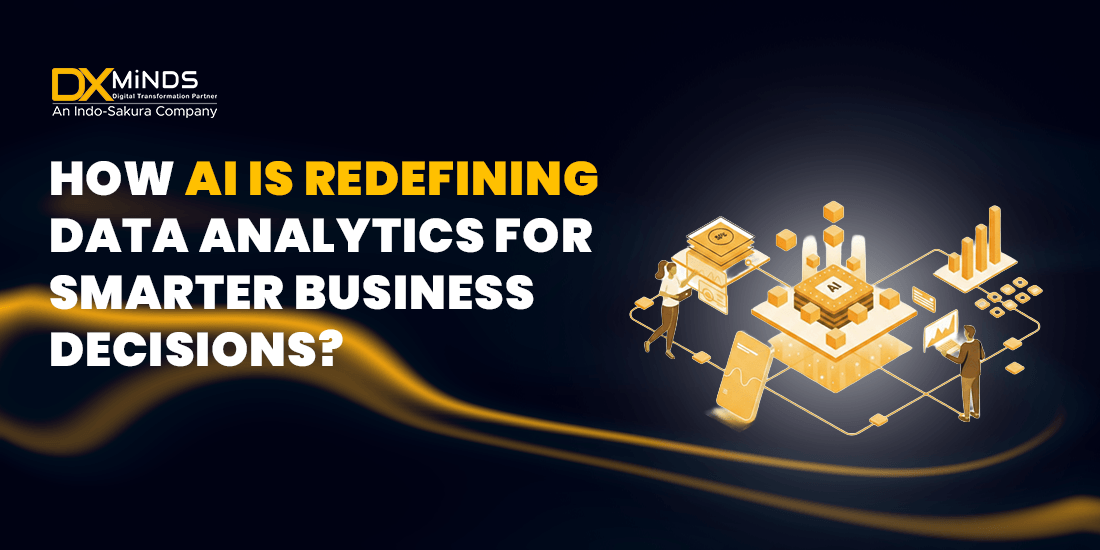
This is where Artificial Intelligence (AI) in data analytics is transforming the game. By combining machine learning, automation, and advanced algorithms, AI enables organizations to go beyond traditional analytics and unlock predictive, real-time, and highly personalized insights.
In 2026, AI is not just supporting decision-making—it is redefining how decisions are made.
What is AI in Data Analytics?
AI in data analytics refers to the integration of artificial intelligence technologies such as machine learning (ML), natural language processing (NLP), and deep learning into the data analysis process.
Unlike traditional analytics methods that rely heavily on human input and static models, AI-driven analytics systems can:
- Learn from historical data
- Identify hidden patterns
- Predict future outcomes
- Continuously improve over time
For example, instead of simply reporting last quarter’s sales, AI can forecast next quarter’s demand, identify factors affecting performance, and recommend actions to improve results.
The Evolution from Traditional Analytics to AI-Driven Insights
To understand the impact of AI, it’s important to look at how analytics has evolved:
- Descriptive Analytics (What happened?)
Focused on historical data and reporting.
- Diagnostic Analytics (Why did it happen?)
Analyzed patterns and relationships to explain outcomes.
- Predictive Analytics (What will happen?)
Used statistical models to forecast future trends.
- Prescriptive Analytics (What should we do?)
This is where AI plays a major role—providing actionable recommendations.
AI accelerates this entire evolution by enabling real-time, automated, and intelligent decision-making.
Why Traditional Data Analytics Falls Short
While traditional analytics tools have served businesses for decades, they come with limitations:
- Manual Processing: Time-consuming and resource-intensive
- Limited Scalability: Struggles with large datasets
- Delayed Insights: Often based on historical data
- Human Bias: Decisions influenced by subjective interpretation
In a fast-moving business environment, these limitations can lead to missed opportunities and slower growth.
AI addresses these gaps by delivering speed, accuracy, and scalability.
How AI is Transforming Data Analytics
- Predictive Analytics for Proactive Decisions
AI-powered predictive models analyze historical data to forecast future outcomes with high accuracy.
Business Impact:
- Anticipate customer demand
- Identify potential risks
- Optimize pricing strategies
Instead of reacting to events, businesses can now plan with confidence.
- Real-Time Data Processing
AI systems can process massive datasets in real time, enabling instant insights.
Example Use Cases:
- Fraud detection in banking
- Dynamic pricing in e-commerce
- Real-time customer support
This capability allows organizations to respond instantly to changing conditions.
- Automation of Data Workflows
One of the biggest advantages of AI is automation.
AI can handle:
- Data collection and cleaning
- Data integration across platforms
- Report generation
This reduces manual effort and allows teams to focus on strategic tasks.
- Enhanced Data Visualization
AI-powered analytics tools provide intuitive dashboards and visualizations that make complex data easier to understand.
Features include:
- Automated chart generation
- Natural language queries (“Ask your data”)
- Interactive dashboards
This democratizes data, making it accessible even to non-technical users.
- Personalization at Scale
AI analyzes customer behavior, preferences, and interactions to deliver personalized experiences.
Examples:
- Product recommendations
- Targeted marketing campaigns
- Customized user experiences
Personalization drives higher engagement, conversion, and customer satisfaction.
Key Benefits of AI in Business Decision-Making
- Faster Decision-Making
AI processes data in seconds, enabling real-time decisions.
- Improved Accuracy
Advanced algorithms reduce errors and provide reliable insights.
- Cost Optimization
Automation lowers operational costs and improves efficiency.
- Scalability
AI systems can handle growing data volumes without performance issues.
- Competitive Advantage
Organizations leveraging AI gain a strategic edge in their markets.
Real-World Use Cases of AI in Data Analytics
Retail Industry
Retailers use AI to analyze customer behavior, forecast demand, and optimize inventory.
Outcome: Increased sales and reduced stockouts.
Healthcare Industry
AI analyzes patient data to predict diseases and recommend treatments.
Outcome: Improved patient outcomes and reduced costs.
Financial Services
AI detects fraudulent transactions and assesses credit risks.
Outcome: Enhanced security and better risk management.
Marketing & Advertising
AI helps marketers optimize campaigns, segment audiences, and track ROI.
Outcome: Higher conversion rates and improved campaign performance.
Manufacturing
AI enables predictive maintenance and supply chain optimization.
Outcome: Reduced downtime and increased efficiency.
Challenges and Considerations
Despite its advantages, implementing AI in data analytics comes with challenges:
- Data Quality
AI systems rely on high-quality data. Poor data leads to inaccurate insights.
- High Initial Investment
AI implementation requires infrastructure, tools, and skilled talent.
- Skill Gap
Organizations need data scientists and AI experts.
- Data Privacy & Security
Handling sensitive data requires strict compliance with regulations.
Future Trends in AI-Driven Data Analytics
The future of AI in analytics is promising and rapidly evolving.
- Augmented Analytics
Combining human intelligence with AI for better decision-making.
- Explainable AI (XAI)
Providing transparency into how AI models make decisions.
- Edge Analytics
Processing data closer to the source for faster insights.
- Automated Machine Learning (AutoML)
Simplifying model development and deployment.
- Decision Intelligence
Integrating AI directly into business decision processes.
How Businesses Can Get Started with AI in Data Analytics
If you’re looking to adopt AI, follow these steps:
- Define Business Goals
Identify what you want to achieve (e.g., improve sales, reduce costs). - Assess Data Readiness
Ensure your data is clean, structured, and accessible. - Choose the Right Tools
Select AI platforms that align with your needs. - Build Skilled Teams
Invest in training or hire AI professionals. - Start Small and Scale
Begin with pilot projects and expand gradually.
Conclusion
AI is fundamentally changing how businesses analyze data and make decisions.
From predictive analytics to real-time insights and automation, AI empowers organizations to move faster, reduce uncertainty, and stay competitive in an increasingly complex market.
In 2026 and beyond, the question is no longer whether businesses should adopt AI in data analytics but how quickly they can implement it to stay ahead.
Frequently Asked Questions
-
What is AI in data analytics?
AI in data analytics involves using machine learning and intelligent algorithms to analyze data, identify patterns, and generate actionable insights.
-
How does AI help in business decision-making?
AI provides real-time, predictive, and accurate insights, enabling businesses to make faster and smarter decisions.
-
What are the benefits of AI-powered analytics?
Benefits include improved accuracy, automation, scalability, cost savings, and better customer insights.
-
Is AI in data analytics suitable for small businesses?
Yes, many scalable and cost-effective AI tools are available for small and medium-sized businesses.
-
What is the future of AI in data analytics?
The future includes augmented analytics, explainable AI, real-time processing, and fully automated decision-making systems.