
- May 8, 2026
- Posted by: Jhansi G
- Category: Software Development
Introduction
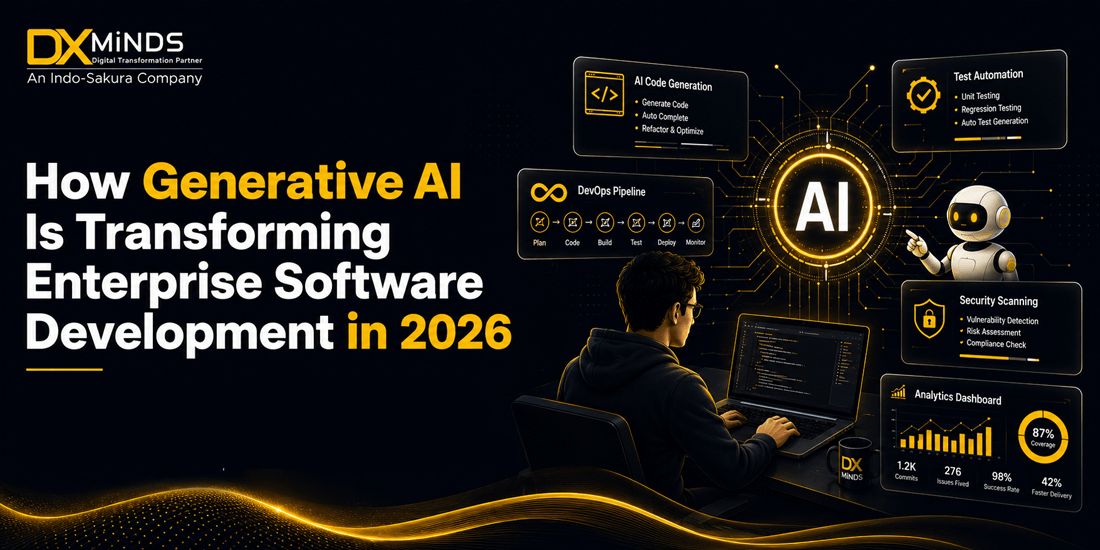
The enterprise software industry is experiencing one of the biggest technological shifts in recent history. Businesses are no longer relying solely on traditional software development approaches that require months of coding, testing, deployment, and maintenance. Instead, organizations are increasingly adopting Generative AI in enterprise software development to accelerate innovation, reduce costs, and improve operational efficiency.
In 2026, Generative AI has become a core component of digital transformation strategies for enterprises worldwide. From AI-assisted coding and automated testing to intelligent customer support systems and predictive analytics, Generative AI is helping businesses build smarter, faster, and more scalable software solutions.
Enterprises across healthcare, finance, manufacturing, retail, logistics, and telecommunications are leveraging AI-powered software engineering to streamline workflows and gain a competitive advantage. Modern businesses now expect software systems to be intelligent, adaptive, and capable of automating complex business processes.
This blog explores how Generative AI is transforming enterprise software development, its major benefits, use cases, challenges, and future trends shaping the next generation of enterprise applications.
What Is Generative AI?
Generative AI refers to advanced artificial intelligence models capable of generating content, code, designs, text, audio, images, and even software applications based on user inputs and training data.
Unlike traditional AI systems that focus mainly on analysis and prediction, Generative AI can create new outputs dynamically. Technologies such as Large Language Models (LLMs), AI copilots, neural networks, and multimodal AI systems are driving this transformation.
Examples of Generative AI applications include the following:
- AI coding assistants
- Automated documentation generation
- Chatbots and virtual assistants
- Intelligent workflow automation
- AI-generated UI/UX designs
- Automated software testing
- AI-based code optimization
- Smart enterprise analytics systems
Today, enterprises are integrating Generative AI tools into their software development lifecycle (SDLC) to improve productivity and innovation.
The Evolution of Enterprise Software Development
Traditional enterprise software development often involved:
- Long development cycles
- Manual coding processes
- High infrastructure costs
- Repetitive testing
- Complex debugging
- Limited scalability
- Resource-intensive maintenance
However, the rise of AI software development solutions has dramatically changed how organizations build and maintain enterprise applications.
Modern AI-powered enterprise development focuses on:
- Faster software delivery
- Agile development models
- Automated DevOps pipelines
- Intelligent testing frameworks
- Low-code and no-code platforms
- Real-time analytics
- Hyperautomation
- Cloud-native architectures
Generative AI is now enabling developers to automate repetitive tasks and focus more on innovation and strategic problem-solving.
Key Ways Generative AI Is Transforming Enterprise Software Development
AI-Assisted Code Generation
One of the biggest transformations is AI-generated coding.
Developers can now use AI coding assistants to:
- Generate boilerplate code
- Suggest code snippets
- Detect syntax errors
- Optimize programming logic
- Automate repetitive coding tasks
This significantly reduces development time and improves software quality.
Benefits of AI-Assisted Coding
- Faster project delivery
- Improved developer productivity
- Reduced coding errors
- Enhanced code consistency
- Lower development costs
AI-powered development environments are helping enterprises accelerate application delivery without compromising quality.
Intelligent Software Testing Automation
Testing is one of the most time-consuming phases of enterprise software development. Generative AI helps automate testing processes by:
- Creating test cases automatically
- Identifying bugs faster
- Predicting potential failures
- Running regression testing
- Improving software reliability
AI-driven testing tools can analyze thousands of test scenarios in minutes, improving software performance and reducing deployment risks.
Advantages of AI Testing
- Faster QA cycles
- Reduced manual effort
- Better application stability
- Improved user experience
- Lower maintenance costs
Businesses adopting AI automation for enterprises are significantly reducing software downtime.
Accelerating Digital Transformation
Generative AI is becoming the backbone of enterprise digital transformation initiatives.
Organizations are using AI-powered enterprise applications to modernize legacy systems, automate operations, and improve decision-making.
AI in digital transformation enables the following:
- Process automation
- Intelligent business workflows
- Smart data management
- Customer experience personalization
- Predictive business analytics
- Enterprise process optimization
AI-driven modernization helps businesses remain competitive in rapidly evolving markets.
Enhancing DevOps and CI/CD Pipelines
Modern software development heavily depends on DevOps practices. Generative AI improves DevOps efficiency through:
- Automated deployment scripts
- Predictive monitoring
- Infrastructure optimization
- Intelligent incident detection
- Auto-remediation systems
AI-integrated CI/CD pipelines reduce deployment failures and improve software delivery speed.
Benefits for Enterprises
- Faster software releases
- Better infrastructure management
- Reduced operational risks
- Improved collaboration between teams
AI-powered DevOps is enabling continuous innovation in enterprise environments.
Personalized Enterprise Applications
Generative AI enables enterprises to build highly personalized applications based on user behavior and preferences.
Examples include:
- AI-powered CRM systems
- Personalized eCommerce platforms
- Smart healthcare applications
- Intelligent financial dashboards
- Customized learning management systems
AI can dynamically adapt interfaces, recommendations, and workflows according to user interactions.
This improves:
- Customer engagement
- User satisfaction
- Business efficiency
- Revenue generation
Automated Documentation and Knowledge Management
Enterprise software projects require extensive documentation. Generative AI simplifies documentation by automatically generating:
- API documentation
- Technical manuals
- User guides
- Workflow diagrams
- Release notes
This reduces the burden on developers and ensures documentation remains accurate and updated.
Key Benefits
- Improved collaboration
- Faster onboarding
- Better compliance management
- Enhanced project transparency
AI-generated documentation is becoming a major productivity enhancer for software engineering teams.
Low-Code and No-Code Development
Generative AI is accelerating the growth of low-code and no-code platforms.
Business users can now build applications using simple prompts without extensive programming knowledge.
This democratization of software development helps enterprises:
- Build applications faster
- Reduce dependency on large development teams
- Improve innovation speed
- Empower non-technical departments
AI-powered low-code platforms are revolutionizing enterprise application development.
Benefits of Generative AI in Enterprise Software Development
Increased Development Speed
AI automates repetitive development tasks, allowing faster project completion.
Reduced Operational Costs
Enterprises can minimize manual work and optimize resource utilization.
Improved Software Quality
AI helps identify errors early and improves testing efficiency.
Better Scalability
AI-driven systems can adapt to growing business requirements.
Enhanced Decision-Making
AI analytics provide valuable business insights in real time.
Greater Innovation
Developers can focus on creative problem-solving instead of repetitive coding.
Industry Use Cases of Generative AI
Healthcare
AI-powered healthcare software solutions help hospitals improve diagnostics, patient management, and telemedicine services.
Examples
- AI medical assistants
- Predictive patient analytics
- Automated healthcare workflows
- Medical documentation automation
Finance
Financial institutions use Generative AI for:
- Fraud detection
- Risk analysis
- Automated reporting
- AI-powered customer service
- Intelligent investment platforms
AI improves financial security and operational efficiency.
Retail and eCommerce
Retail companies are leveraging AI software development solutions to create:
- Personalized shopping experiences
- Smart recommendation engines
- AI chatbots
- Automated inventory systems
This enhances customer engagement and sales performance.
Manufacturing
Manufacturers are using enterprise AI platforms for:
- Predictive maintenance
- Supply chain optimization
- Industrial automation
- Smart production monitoring
AI improves productivity and reduces operational disruptions.
Telecommunications
Telecom companies use AI-driven enterprise applications for:
- Automated customer support
- Network optimization
- Predictive issue resolution
- Intelligent billing systems
AI helps telecom businesses improve service quality and reduce operational costs.
Challenges of Implementing Generative AI in Enterprises
Although Generative AI offers significant advantages, enterprises also face several challenges.
Data Privacy and Security
AI systems require access to large datasets, increasing cybersecurity risks.
Organizations must ensure:
- Secure AI infrastructure
- Compliance with data regulations
- Responsible AI governance
Integration Complexity
Integrating AI with legacy enterprise systems can be difficult and time-consuming.
Businesses often require the following:
- Custom AI integration strategies
- API modernization
- Cloud migration support
AI Bias and Ethical Concerns
Poor-quality training data can result in biased AI outputs.
Enterprises must focus on:
- Ethical AI practices
- Transparent AI models
- Human oversight
Skill Gaps
Many organizations lack experienced AI developers and engineers.
This increases demand for:
- AI development services
- Enterprise AI consulting
- AI training programs
Future Trends in Generative AI for Enterprise Software Development
AI-Native Enterprise Applications
Future enterprise software will be built with AI capabilities from the ground up.
Autonomous Software Engineering
AI systems will increasingly handle the following:
- Coding
- Testing
- Deployment
- Monitoring
- Maintenance
with minimal human intervention.
Hyperautomation
Businesses will automate entire operational workflows using AI-driven systems.
AI-Powered Cybersecurity
Generative AI will strengthen enterprise cybersecurity through:
- Threat prediction
- Automated threat detection
- Real-time response systems
Multimodal AI Systems
Future enterprise applications will process:
- Text
- Voice
- Images
- Video
- Sensor data
within unified AI platforms.
Best Practices for Enterprises Adopting Generative AI
Start with Clear Business Goals
Identify specific problems AI can solve.
Invest in High-Quality Data
AI performance depends heavily on clean and accurate data.
Focus on Security
Implement strong cybersecurity and compliance measures.
Use Scalable Cloud Infrastructure
Cloud-native AI platforms improve scalability and performance.
Partner with Experienced AI Development Companies
Expert AI partners help businesses accelerate implementation and reduce risks.
Why Businesses Need AI Development Partners
Implementing enterprise AI solutions requires technical expertise, infrastructure planning, and continuous optimization.
An experienced AI software development company can help businesses:
- Build custom AI applications
- Integrate AI into existing systems
- Modernize enterprise infrastructure
- Develop scalable cloud solutions
- Improve operational efficiency
Partnering with the right AI technology provider ensures a successful digital transformation.
How Generative AI Improves Developer Productivity
Developer productivity is one of the most impacted areas in modern software engineering.
AI tools assist developers by:
- Generating code suggestions
- Explaining complex logic
- Refactoring legacy code
- Automating debugging
- Improving collaboration
This allows development teams to focus more on innovation and product strategy.
According to industry trends, organizations adopting AI-powered software engineering are seeing significant productivity improvements and faster product launches.
Generative AI and Enterprise Software Modernization
Many enterprises still rely on outdated legacy systems.
Generative AI helps modernize legacy applications by:
- Migrating old systems to cloud platforms
- Rewriting outdated code
- Improving system performance
- Enhancing scalability
- Automating maintenance processes
AI-driven modernization reduces technical debt and improves long-term business agility.
The Role of Cloud Computing in Enterprise AI
Cloud infrastructure plays a major role in enabling enterprise AI solutions.
Cloud-based AI platforms provide the following:
- High-performance computing
- Scalable AI infrastructure
- Real-time analytics
- Secure data storage
- Faster deployment capabilities
Businesses adopting cloud-native AI development gain greater flexibility and operational efficiency.
How Generative AI Enhances Customer Experience
Customer expectations are evolving rapidly.
Generative AI improves customer experiences through:
- Intelligent chatbots
- Personalized recommendations
- Faster support systems
- Automated workflows
- Predictive customer insights
AI-powered enterprise applications enable businesses to deliver faster and more personalized services.
Conclusion
Generative AI is fundamentally transforming enterprise software development in 2026. From AI-assisted coding and intelligent testing to automated workflows and enterprise modernization, AI is redefining how organizations build, deploy, and manage software solutions.
Businesses adopting Generative AI in enterprise software development are gaining substantial advantages in productivity, scalability, innovation, and customer experience.
As AI technologies continue to evolve, enterprises that invest early in AI-driven software engineering and digital transformation will be better positioned to compete in the future digital economy.
Organizations looking to modernize their operations should explore AI-powered software development solutions to unlock new growth opportunities and accelerate innovation.
Frequently Asked Questions:
What is Generative AI in enterprise software development?
Generative AI in enterprise software development refers to the use of AI technologies to automate coding, testing, documentation, analytics, and software optimization processes.
How does Generative AI improve software development?
Generative AI improves software development by accelerating coding, automating testing, reducing errors, improving productivity, and enhancing software quality.
Which industries use Generative AI for enterprise applications?
Industries such as healthcare, finance, retail, manufacturing, logistics, and telecommunications actively use Generative AI for enterprise solutions.
Is Generative AI suitable for enterprise digital transformation?
Yes. Generative AI plays a major role in enterprise digital transformation by automating workflows, improving analytics, and modernizing legacy systems.
What are the challenges of implementing enterprise AI solutions?
Common challenges include data security concerns, integration complexity, AI bias, compliance issues, and a lack of skilled AI professionals.
Why should businesses invest in AI-powered software development?
AI-powered software development helps businesses improve operational efficiency, reduce costs, accelerate innovation, and enhance customer experiences.