
- May 14, 2026
- Posted by: Jhansi G
- Category: Generative AI
Introduction
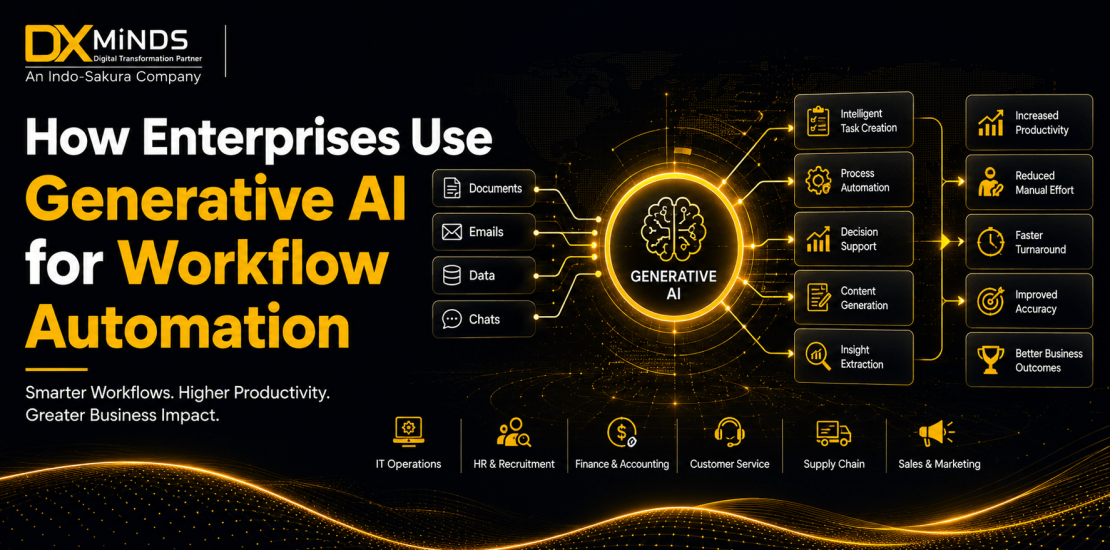
Generative AI is no longer an experimental technology reserved for innovation labs. In 2026, enterprises across industries are actively integrating Generative AI into business workflows to improve operational efficiency, reduce manual tasks, accelerate decision-making, and deliver better customer experiences.
From automating repetitive documentation to generating intelligent business insights, Generative AI is transforming how enterprises operate at scale. Organizations are now using AI-powered workflow automation to streamline operations in customer support, HR, finance, healthcare, manufacturing, logistics, software development, and enterprise communication.
As businesses continue their digital transformation journey, Generative AI workflow automation has become a strategic investment for enterprises seeking faster growth, improved productivity, and competitive advantage.
This blog explores how enterprises use Generative AI for workflow automation, its business benefits, real-world applications, implementation strategies, challenges, and future trends.
What Is Generative AI Workflow Automation?
Generative AI workflow automation” refers to the use of AI models such as Large Language Models (LLMs), AI copilots, intelligent agents, and multimodal AI systems to automate business processes and workflows.
Unlike traditional automation tools that follow fixed rules, Generative AI can:
- Understand human language
- Generate content
- Analyze large datasets
- Summarize information
- Create reports
- Assist in decision-making
- Automate communication
- Generate code
- Learn workflow patterns
This makes enterprise workflow automation smarter, more adaptive, and significantly more efficient.
Why Enterprises Are Investing in Generative AI Automation
Enterprises are increasingly adopting AI workflow automation to solve major operational challenges.
-
Reduces Manual Work
Employees spend significant time on repetitive activities such as:
- Data entry
- Documentation
- Email responses
- Report generation
- Ticket handling
- Compliance paperwork
Generative AI automates repetitive tasks, allowing teams to focus on strategic work.
-
Improves Productivity
AI-powered workflow automation helps enterprises:
- Complete tasks faster
- Reduce turnaround time
- Minimize bottlenecks
- Improve cross-team collaboration
Organizations can handle higher workloads without increasing operational costs.
-
Enhances Decision-Making
Generative AI can analyze enterprise data and generate actionable insights instantly.
Businesses use AI to:
- Predict trends
- Identify risks
- Generate summaries
- Recommend actions
- Create intelligent dashboards
This improves executive decision-making and operational planning.
-
Scales Business Operations
Enterprises need scalable systems to support global operations.
AI workflow automation enables organizations to:
- Manage high-volume requests
- Automate customer interactions
- Handle multilingual communication
- Streamline enterprise processes
This helps businesses scale efficiently.
-
Improves Customer Experience
Generative AI helps enterprises deliver faster and more personalized customer interactions through:
- AI chatbots
- AI voice agents
- Smart recommendation systems
- Automated ticket resolution
- Personalized communication
Customer satisfaction improves significantly with intelligent automation.
How Generative AI Works in Enterprise Workflow Automation
Generative AI workflow systems typically combine:
- Large Language Models (LLMs)
- Machine Learning algorithms
- Natural Language Processing (NLP)
- AI Agents
- Robotic Process Automation (RPA)
- Enterprise APIs
- Cloud infrastructure
These technologies work together to automate enterprise workflows intelligently.
Example Workflow
A customer submits a support request.
Generative AI can:
- Understand the request
- Categorize the issue
- Retrieve relevant knowledge base data
- Generate a response
- Escalate if necessary
- Create support documentation automatically
The entire workflow can happen within seconds.
Top Enterprise Use Cases of Generative AI Workflow Automation
-
Customer Support Automation
Customer support is one of the largest areas where enterprises use Generative AI.
AI-Powered Support Capabilities
- Automated ticket responses
- AI chatbots
- Voice AI assistants
- Sentiment analysis
- Knowledge base generation
- Smart ticket routing
Business Benefits
- Faster response times
- Reduced support costs
- 24/7 customer assistance
- Improved customer satisfaction
Example
An enterprise telecom company uses AI agents to automatically handle billing queries, plan upgrades, and provide troubleshooting support without human intervention.
-
HR Workflow Automation
HR departments manage large volumes of repetitive tasks.
Generative AI automates:
- Resume screening
- Candidate communication
- Interview scheduling
- Employee onboarding
- HR documentation
- Policy assistance
AI in Recruitment
AI can analyze resumes and identify the best candidates based on skills, experience, and job descriptions.
AI in Employee Support
Employees can interact with AI HR assistants to:
- Apply leave
- Access company policies
- Generate HR requests
- Resolve payroll questions
This improves HR efficiency and employee experience.
-
Finance and Accounting Automation
Finance teams use Generative AI to automate:
- Invoice processing
- Financial reporting
- Expense analysis
- Fraud detection
- Compliance documentation
- Audit preparation
Benefits for Enterprises
- Reduced human errors
- Faster reporting
- Better compliance
- Real-time financial insights
Example
AI can automatically generate monthly financial summaries from ERP data and provide actionable recommendations to finance leaders.
-
IT Operations and DevOps Automation
Generative AI is revolutionizing IT workflow automation.
Enterprise AI Use Cases in IT
- Automated incident management
- AI-generated code
- Infrastructure monitoring
- Root cause analysis
- Automated documentation
- Security threat analysis
AI Copilots for Developers
Developers use AI coding assistants to:
- Generate code
- Debug software
- Create APIs
- Write test cases
- Document applications
This accelerates software development and improves productivity.
-
Sales and Marketing Automation
Marketing teams leverage Generative AI for:
- Content generation
- Campaign automation
- Lead qualification
- Customer segmentation
- Sales email generation
- SEO optimization
AI-Powered Sales Assistance
AI tools can:
- Generate personalized sales proposals
- Analyze customer behavior
- Predict conversion probability
- Automate CRM updates
Benefits
- Higher lead conversion
- Faster campaign execution
- Improved personalization
- Increased revenue opportunities
-
Healthcare Workflow Automation
Healthcare enterprises use Generative AI to streamline administrative and clinical workflows.
AI Applications in Healthcare
- Patient scheduling
- Medical transcription
- Clinical documentation
- AI voice agents
- Insurance processing
- Healthcare chatbot support
Benefits
- Reduced administrative burden
- Faster patient support
- Better operational efficiency
- Improved healthcare accessibility
AI workflow automation helps healthcare professionals focus more on patient care.
-
Manufacturing Process Automation
Manufacturing enterprises use Generative AI to automate operations and optimize production workflows.
AI in Manufacturing
- Predictive maintenance
- Supply chain optimization
- Production planning
- Quality inspection
- Inventory forecasting
Business Impact
- Reduced downtime
- Lower operational costs
- Improved production efficiency
- Better resource utilization
-
Legal and Compliance Automation
Legal departments manage extensive documentation and compliance processes.
Generative AI helps automate:
- Contract drafting
- Compliance checks
- Legal summaries
- Risk analysis
- Policy generation
Advantages
- Faster document review
- Improved compliance management
- Reduced legal costs
- Higher operational accuracy
Key Benefits of Generative AI Workflow Automation
Increased Operational Efficiency
AI reduces manual intervention and speeds up workflows.
Cost Optimization
Businesses reduce operational expenses through automation.
Faster Business Processes
Workflow execution becomes faster and more reliable.
Better Employee Productivity
Employees spend more time on high-value work.
Improved Accuracy
AI minimizes human errors in repetitive processes.
Enhanced Scalability
Enterprises can handle growing workloads efficiently.
Intelligent Insights
AI helps organizations make data-driven decisions.
Real-World Enterprise Examples of Generative AI Automation
Banking Sector
Banks use Generative AI for:
- Loan processing
- Fraud detection
- Customer service automation
- Financial document analysis
Retail Industry
Retail enterprises automate:
- Product recommendations
- Customer engagement
- Inventory forecasting
- Marketing campaigns
Logistics Companies
Logistics providers use AI for:
- Route optimization
- Shipment tracking
- Warehouse automation
- Delivery communication
Software Enterprises
Technology companies leverage AI for:
- Software development
- QA automation
- DevOps workflows
- Technical documentation
Challenges Enterprises Face in AI Workflow Automation
Although Generative AI offers major benefits, enterprises must address several challenges.
-
Data Privacy and Security
AI systems process sensitive enterprise data.
Organizations must ensure:
- Data encryption
- Secure infrastructure
- Compliance standards
- Access control
-
AI Hallucinations
Generative AI may sometimes generate inaccurate outputs.
Enterprises need:
- Human validation
- AI governance
- Monitoring systems
-
Integration Complexity
Integrating AI with legacy systems can be challenging.
Businesses require:
- API integrations
- Cloud modernization
- Enterprise architecture planning
-
Change Management
Employees may resist workflow transformation.
Successful adoption requires:
- Training programs
- Clear communication
- AI adoption strategies
-
Regulatory Compliance
Enterprises must comply with regulations related to:
- Data privacy
- AI governance
- Industry compliance
Best Practices for Implementing Generative AI Workflow Automation
Define clear business goals.
Enterprises should identify workflows with:
- High repetition
- Manual dependency
- Process inefficiencies
Start with pilot projects.
Begin with smaller AI automation projects before scaling enterprise-wide.
Ensure Data Quality
AI systems perform better with structured and accurate enterprise data.
Combine AI with Human Oversight
Human validation improves workflow reliability.
Focus on Security and Governance
Implement AI governance frameworks to ensure responsible AI usage.
Choose Scalable AI Infrastructure
Cloud-native AI platforms support enterprise scalability and flexibility.
Future of Generative AI Workflow Automation
The future of enterprise workflow automation will be driven by:
- Autonomous AI agents
- Hyperautomation
- AI copilots
- Multimodal AI systems
- AI-driven enterprise operations
AI Agents Will Manage Entire Workflows
Future AI agents will independently:
- Execute business processes
- Coordinate systems
- Communicate with teams
- Make operational decisions
Hyperautomation Will Become Standard
Enterprises will combine:
- AI
- RPA
- Analytics
- Cloud computing
to fully automate business ecosystems.
Personalized Enterprise AI
AI systems will provide personalized workflow experiences for employees and customers.
AI-Augmented Workforce
AI will not replace employees entirely. Instead, it will enhance human productivity and decision-making.
How Enterprises Can Prepare for AI Automation
To succeed with Generative AI workflow automation, enterprises should:
Build an AI strategy.
Create long-term AI transformation roadmaps.
Invest in AI Talent
Hire AI engineers, data scientists, and automation specialists.
Modernize Infrastructure
Adopt cloud-native and API-first systems.
Develop AI Governance Policies
Ensure ethical and secure AI adoption.
Prioritize Employee Upskilling
Train employees to collaborate effectively with AI systems.
Why Generative AI Is Becoming Essential for Enterprises
Generative AI is evolving from a competitive advantage into a business necessity.
Organizations that adopt AI workflow automation gain:
- Faster innovation
- Operational agility
- Better customer experiences
- Reduced costs
- Improved scalability
Enterprises delaying AI adoption risk losing competitiveness in rapidly evolving markets.
How DxMinds Helps Enterprises Implement Generative AI Automation
At DxMinds, we help enterprises build intelligent AI-powered workflow automation solutions tailored to business needs.
Our Generative AI development services include:
- Enterprise AI strategy consulting
- AI workflow automation
- AI chatbot development
- AI voice agent solutions
- Custom AI application development
- AI integration services
- AI-powered enterprise platforms
- Generative AI software development
We help businesses automate operations, improve productivity, and accelerate digital transformation using scalable and secure AI technologies.
Conclusion
Generative AI workflow automation is reshaping modern enterprises by enabling smarter, faster, and more scalable business operations.
From customer support and HR to finance, IT, healthcare, and manufacturing, enterprises are leveraging AI-powered automation to optimize workflows, reduce costs, and improve efficiency.
As AI technologies continue to evolve, businesses that strategically adopt Generative AI automation will gain long-term competitive advantages in innovation, operational excellence, and customer experience.
The future of enterprise automation is intelligent, adaptive, and AI-driven.
Now is the time for enterprises to embrace Generative AI workflow automation and unlock the next phase of digital transformation.
Frequently Asked Questions:
1) What is Generative AI workflow automation?
Generative AI workflow automation uses AI models to automate business processes such as customer support, documentation, reporting, communication, and enterprise operations.
2) How do enterprises use Generative AI?
Enterprises use Generative AI for workflow automation, AI chatbots, content generation, software development, customer service, analytics, and operational optimization.
3) What are the benefits of AI workflow automation?
Key benefits include:
- Improved productivity
- Reduced operational costs
- Faster workflows
- Better customer experiences
- Increased scalability
- Enhanced decision-making
4) Which industries use Generative AI automation?
Industries using AI workflow automation include:
- Healthcare
- Finance
- Retail
- Manufacturing
- Logistics
- IT
- Telecommunications
5) Is Generative AI secure for enterprises?
Yes, when implemented with proper security measures such as encryption, governance frameworks, compliance standards, and access controls.