
- March 27, 2026
- Posted by: Jhansi G
- Category: Artificial Intelligence
Introduction
Businesses today are under constant pressure to operate faster, reduce costs, and deliver better customer experiences. Automation has long been the solution to these challenges—but the type of automation you choose can make a significant difference.
For years, traditional automation has helped organizations streamline repetitive tasks. Now, a new wave of technology—AI agents—is transforming how businesses operate by adding intelligence, adaptability, and decision-making capabilities.
So the big question is
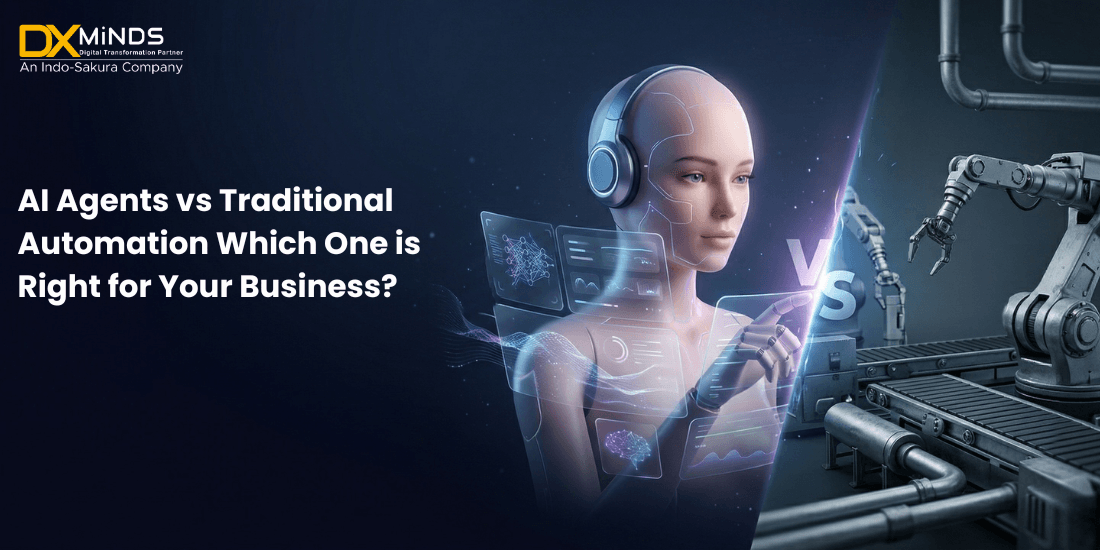
AI Agents vs. Traditional Automation — Which one is right for your business?
In this in-depth guide, we’ll break down both approaches, compare their strengths and limitations, and help you decide the best fit for your business goals.
What is Traditional Automation?
Traditional automation refers to rule-based systems that follow predefined instructions to perform repetitive tasks. These systems operate on “if-this-then-that” logic and are commonly used across industries.
Key Characteristics:
- Rule-based workflows
- Structured data dependency
- Limited flexibility
- High accuracy for repetitive tasks
- Requires manual updates for changes
Common Examples:
- Data entry automation
- Payroll processing systems
- Email autoresponders
- CRM workflow triggers
- Manufacturing assembly lines
Popular tools like UiPath and Automation Anywhere are widely used for implementing traditional automation.
Benefits:
- Cost-effective for repetitive tasks
- Improves efficiency and speed
- Reduces human errors
- Easy to implement for simple workflows
Limitations:
- Cannot handle unstructured data
- Lacks decision-making capability
- Not adaptable to dynamic environments
- Requires frequent manual intervention for updates
What are AI Agents?
AI agents are intelligent systems that can analyze data, make decisions, learn from interactions, and perform tasks autonomously. Unlike traditional automation, AI agents don’t just follow rules—they understand context and adapt accordingly.
Powered by technologies like machine learning and natural language processing (NLP), AI agents can simulate human-like thinking and behavior.
Companies like OpenAI and Google DeepMind are leading innovations in this space.
Key Characteristics:
- Context-aware decision-making
- Ability to learn and improve over time
- Handles structured and unstructured data
- Autonomous execution
- Integrates with multiple systems
Common Examples:
- AI customer support agents (chatbots & voice bots)
- Intelligent virtual assistants
- AI-powered fraud detection systems
- Personalized recommendation engines
- Autonomous IT support systems
Benefits:
- Reduces manual intervention
- Improves over time with data
- Handles complex and dynamic tasks
- Enhances customer experience
- Scales easily
Limitations:
- Higher initial cost
- Requires quality data for training
- Complex implementation
- Needs monitoring and fine-tuning
Key Differences: AI Agents vs Traditional Automation
|
Feature |
Traditional Automation | AI Agents |
|
Logic Type |
Rule-based | Data-driven & intelligent |
|
Flexibility |
Low |
High |
|
Learning Ability |
None |
Continuous learning |
| Data Handling | Structured only |
Structured + unstructured |
|
Decision Making |
Predefined |
Autonomous |
|
Adaptability |
Static |
Dynamic |
|
Use Cases |
Repetitive tasks |
Complex workflows |
When to Choose Traditional Automation
Traditional automation is still highly relevant—especially for businesses that rely on predictable and repetitive processes.
Best Use Cases:
- Data entry and processing
- Invoice generation
- Report creation
- Payroll systems
- Basic CRM workflows
Ideal For:
- Small businesses with limited budgets
- Organizations with stable processes
- Tasks with clear, fixed rules
Example:
If your business needs to send invoices after a purchase automatically, traditional automation is sufficient. There’s no need for AI decision-making here.
When to Choose AI Agents
AI agents are best suited for businesses that need intelligence, adaptability, and scalability.
Best Use Cases:
- Customer support automation (chat & voice AI)
- Lead qualification and sales automation
- Fraud detection and risk analysis
- Predictive analytics
- Personalized marketing
Ideal For:
- Growing businesses
- Enterprises with complex workflows
- Companies handling large volumes of data
- Customer-centric industries
Example:
An AI-powered voice agent can handle customer queries, understand intent, respond naturally, and even escalate issues when needed—something traditional automation cannot do.
Real-World Applications
- Customer Support
- Traditional Automation: FAQ-based chatbots with fixed responses
- AI Agents: Conversational bots that understand context and intent
AI agents significantly improve customer satisfaction by delivering human-like interactions.
- Sales & Marketing
- Traditional Automation: Email drip campaigns
- AI Agents: Personalized recommendations and lead scoring
AI agents can analyze user behavior and optimize campaigns in real time.
- IT Operations
- Traditional Automation: Script-based system monitoring
- AI Agents: Predictive maintenance and auto-resolution
AI agents can detect anomalies and fix issues before they impact operations.
- Finance & Fraud Detection
- Traditional Automation: Rule-based fraud checks
- AI Agents: Pattern recognition and anomaly detection
AI systems can identify suspicious activity faster and more accurately.
Cost Comparison
Traditional Automation:
- Lower upfront cost
- Minimal infrastructure required
- Limited scalability
AI Agents:
- Higher initial investment
- Requires data and training
- Long-term ROI is significantly higher
Insight: While AI agents may seem expensive initially, they reduce operational costs in the long run by minimizing human effort and improving efficiency.
Scalability & Future Growth
Traditional automation struggles to scale beyond predefined rules. Every change requires manual updates.
AI agents, on the other hand:
- Learn from new data
- Adapt to new scenarios
- Scale across multiple processes
This makes AI agents a future-proof solution for growing businesses.
Challenges to Consider
Traditional Automation Challenges:
- Limited capabilities
- Cannot evolve
- Breaks when processes change
AI Agent Challenges:
- Data dependency
- Implementation complexity
- Ethical and security concerns
Businesses must evaluate their readiness before adopting AI.
Hybrid Approach: The Best of Both Worlds
In many cases, the ideal solution is not choosing one over the other but combining both.
How It Works:
- Use traditional automation for repetitive tasks
- Use AI agents for decision-making and complex workflows
Example:
- Automate data entry using RPA
- Use AI to analyze that data and generate insights
This hybrid model maximizes efficiency and minimizes cost.
How to Decide What’s Right for Your Business
Ask yourself these key questions:
- How complex are your processes?
- Simple → Traditional Automation
- Complex → AI Agents
- Do you need decision-making capabilities?
- No → Traditional Automation
- Yes → AI Agents
- What type of data do you handle?
- Structured → Traditional Automation
- Mixed/Unstructured → AI Agents
- What is your budget?
- Limited → Start with automation
- Scalable → Invest in AI
- What are your long-term goals?
- Efficiency → Automation
- Innovation & growth → AI Agents
Future Trends in Automation
The future is clearly shifting toward intelligent automation.
Key Trends:
- Rise of autonomous AI agents
- Integration of AI with RPA
- Hyperautomation strategies
- AI-driven decision intelligence
- Voice and conversational AI adoption
Companies that embrace AI early will gain a competitive advantage.
Conclusion
Choosing between AI agents and traditional automation isn’t about picking a “better” technology. it’s about selecting the right tool for the right job.
Traditional automation remains a reliable solution for handling structured, repetitive processes with speed and accuracy. It’s a strong foundation for operational efficiency, especially when workflows are stable and clearly defined.
AI agents, however, bring a new level of capability by introducing intelligence, adaptability, and real-time decision-making. They unlock opportunities for businesses to go beyond efficiency and move toward automation that thinks, learns, and improves continuously.
The smarter approach:
Instead of viewing this as a competition, forward-thinking businesses are adopting a layered strategy:
- Automate routine tasks with traditional systems
- Enhance critical workflows with AI-driven intelligence
If your goal is cost reduction and process efficiency, traditional automation will serve you well.
If your goal is scalability, innovation, and superior customer experience, AI agents are the way forward.
Ultimately, the future belongs to businesses that don’t just automate tasks but build intelligent systems that evolve with their growth.
Frequently Asked Questions
-
Are AI agents replacing traditional automation?
No. AI agents are enhancing automation, not replacing it. Both can work together.
-
Are AI agents expensive to implement?
They require a higher initial investment but deliver better long-term ROI.
-
Can small businesses use AI agents?
Yes, with cloud-based solutions, AI is becoming more accessible to small businesses.
-
What industries benefit most from AI agents?
Customer service, healthcare, finance, e-commerce, and telecom.
-
Is coding required to implement AI agents?
Not always. Many platforms offer low-code or no-code AI solutions.