
- June 4, 2026
- Posted by: Jhansi G
- Category: Artificial Intelligence
Introduction
Healthcare organizations across the United States, the United Kingdom, and the UAE are under immense pressure to deliver exceptional patient experiences while managing rising operational costs, workforce shortages, and growing patient expectations. Traditional patient communication methods, such as phone calls, paper reminders, and manual follow-ups, consistently result in delayed responses, missed appointments, and lower patient satisfaction scores.
The scale of the problem is significant. No-show appointments cost the U.S. healthcare system an estimated $150 billion annually, according to the American Medical Association. Meanwhile, a 2024 Accenture Health study found that 77% of patients are willing to switch providers for a better digital experience.
AI-powered patient engagement platforms have emerged as a transformative solution helping healthcare providers automate communication, personalize care interactions, reduce no-shows, and improve clinical outcomes at scale. This comprehensive guide explores the benefits, ROI, key features, real-world use cases, and implementation best practices of these platforms for healthcare organizations in the USA, UK, and UAE.
What Are AI-Powered Patient Engagement Platforms?
An AI-powered patient engagement platform is a healthcare technology solution that leverages artificial intelligence, machine learning, predictive analytics, and conversational AI to enhance communication and interactions between healthcare providers and patients throughout the entire care journey.
Unlike traditional patient portals that require patients to log in and navigate complex interfaces, AI-driven engagement solutions proactively reach patients through the channels they prefer, SMS, email, WhatsApp, voice, or in-app at exactly the right moment in their care journey.
Core Components of an AI Patient Engagement Platform
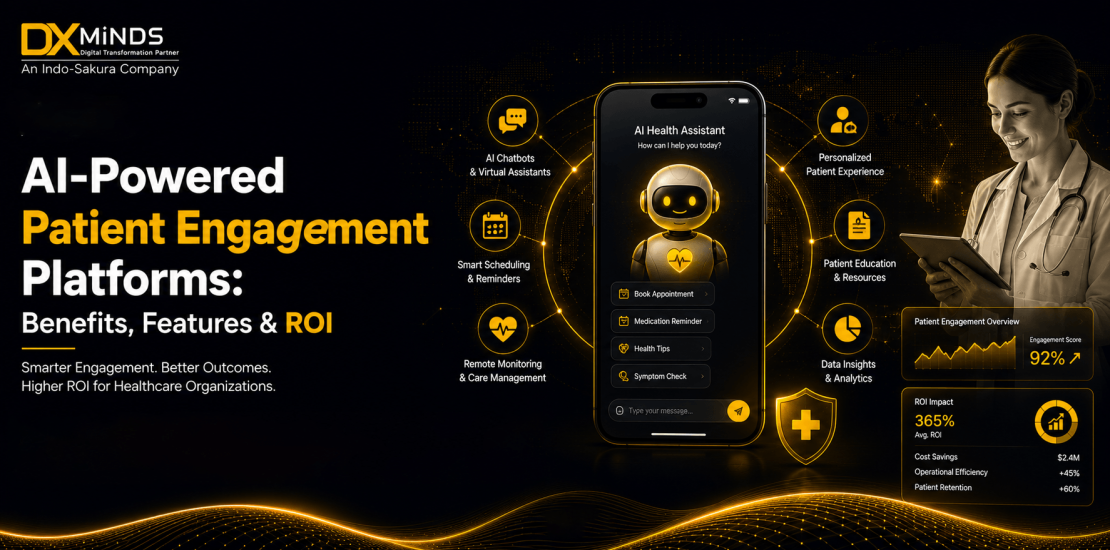
1. AI Chatbots and Virtual Assistants
AI-powered healthcare chatbots handle patient interactions 24/7 without human intervention. Key capabilities include appointment booking and rescheduling, answering frequently asked questions, medication reminders and refill assistance, symptom guidance and triage support, and insurance verification and inquiry handling.
2. Automated Omnichannel Communication
Modern platforms automate outreach across SMS, email, push notifications, and voice calls, ensuring patients receive appointment reminders, lab result notifications, follow-up messages, preventive care alerts, and wellness campaign content through their preferred channel.
3. Predictive Analytics Engine
AI analyzes historical patient data to predict no-show likelihood, identify high-risk patients, detect care gaps, flag readmission risks, and surface chronic disease management opportunities, enabling proactive rather than reactive engagement.
4. Personalized Patient Experiences
The platform tailors every interaction based on a patient’s medical history, demographics, behavioral patterns, health conditions, and treatment plans, replacing generic mass communication with individualized care journeys.
Why Patient Engagement Matters in Healthcare
Patient engagement is no longer a ‘nice to have’; it is a core clinical and business imperative. Research published in the New England Journal of Medicine demonstrates that engaged patients are significantly more likely to follow treatment plans, attend scheduled appointments, manage chronic conditions effectively, and achieve measurably better health outcomes.
Yet healthcare organizations continue to face persistent challenges that undermine engagement at every step.
Common Patient Engagement Challenges
- Missed Appointments: No-shows cost U.S. hospitals and clinics an estimated $150B+ annually, reducing revenue and disrupting care continuity.
- Limited Staff Resources: Clinical and administrative teams spend 30–40% of their time on routine communication tasks that could be automated.
- Fragmented Communication: Patients interact across phone, email, app, and in-person channels, creating disconnected, inconsistent experiences.
- Lack of Personalization: Generic, one-size-fits-all communication reduces patient participation and satisfaction scores.
- Rising Patient Expectations: Post-pandemic patients expect digital-first, on-demand healthcare experiences comparable to retail and banking.
AI-powered patient engagement platforms directly address each of these challenges through intelligent automation, predictive intelligence, and hyper-personalization.
Key Benefits of AI-Powered Patient Engagement Platforms
1. Dramatically Improved Patient Satisfaction
Patient satisfaction is directly correlated with communication quality, speed, and accessibility. AI platforms deliver 24/7 multilingual support, sub-second response times, personalized interactions, and seamless omnichannel communication, ensuring patients feel heard and supported whenever they need assistance.
Example: A patient at a multi-location clinic can instantly book, reschedule, or cancel an appointment via an AI chat assistant at 11 PM on a Saturday, without waiting for office hours or navigating a complex IVR phone system.
2. Reduced No-Show Rates and Increased Appointment Attendance
Predictive AI can identify patients most likely to miss appointments based on historical behavior, then trigger personalized, timely reminders across their preferred channel, reducing no-show rates by up to 30–40% according to HIMSS Digital Health benchmarks.
Automated workflows send appointment reminders, SMS confirmations, email alerts, and one-tap rescheduling options, making it frictionless for patients to stay engaged with their care.
3. Reduced Administrative Burden on Healthcare Staff
Healthcare administrative teams spend an average of 15+ hours per week managing routine communication tasks—scheduling, reminders, registrations, and follow-ups. AI automation reclaims this time, allowing clinical staff to focus on direct patient care.
Key automations include appointment scheduling and rescheduling, reminder and notification workflows, patient registration and intake forms, post-visit follow-up communications, and referral coordination.
4. Improved Medication Adherence and Clinical Outcomes
Non-adherence to medication costs the U.S. healthcare system approximately $300 billion annually (New England Journal of Medicine). AI platforms deliver personalized medication reminders, refill prompts, and adherence coaching, improving adherence rates and reducing preventable hospitalizations.
5. Enhanced Patient Retention and Loyalty
Acquiring a new patient costs 5–7x more than retaining an existing one. AI engagement platforms maintain consistent, personalized touchpoints through wellness reminders, preventive care campaigns, birthday check-ins, and follow-up engagement, building long-term relationships that keep patients loyal to your practice.
6. Scalable Operations Without Proportional Cost Growth
As healthcare organizations grow, adding locations, expanding telehealth, or scaling patient volumes, AI enables simultaneous engagement with thousands of patients without increasing staffing costs proportionally. This scalability is critical for hospital networks, multi-location clinics, telehealth providers, and healthcare enterprises operating across regions.
7. Proactive Chronic Disease Management
A 2025 review published in Frontiers for Public Health found that AI-powered patient engagement tools improved chronic disease management outcomes by 30% compared to standard care driven by continuous monitoring, personalized education, and timely clinical alerts.
ROI of AI-Powered Patient Engagement Platforms
Healthcare executives increasingly evaluate technology investments on measurable business outcomes. Here is how AI patient engagement platforms deliver quantifiable ROI across multiple dimensions.
Revenue Growth Through Reduced No-Shows
Consider a mid-sized clinic with 5,000 appointments monthly and a 15% no-show rate, which is 750 missed appointments per month. At an average revenue of $200 per appointment, the clinic loses $150,000 monthly. Reducing no-shows to 8% through AI-powered reminders and rescheduling recovers approximately $70,000 in monthly revenue, a $840,000 annual impact from a single use case.
Operational Cost Reduction
AI automation reduces costs associated with call center staffing, administrative scheduling labor, manual patient outreach programs, and paper-based reminder systems. Healthcare organizations typically report 20–35% reductions in administrative operational costs within the first 12 months of deployment.
Reduced Hospital Readmissions
CMS penalizes hospitals for excess readmissions under the Hospital Readmissions Reduction Program (HRRP). AI-driven post-discharge follow-up automated check-ins, medication reminders, and symptom monitoring help patients adhere to discharge instructions and reduce 30-day readmission rates, improving both quality metrics and financial performance.
Increased Patient Lifetime Value
Satisfied, engaged patients are measurably more likely to return for future services, refer family members and colleagues, participate in wellness and preventive care programs, and accept add-on services when clinically appropriate. This compounds patient lifetime value significantly over time.
Improved Staff Productivity and Reduced Burnout
By automating repetitive, low-value communication tasks, AI platforms free clinical and administrative staff to focus on meaningful patient interactions. This directly reduces burnout, one of the most significant challenges in healthcare workforce retention today.
Real-World Use Cases of AI Patient Engagement Platforms
Hospitals and Health Systems
Large hospitals and health systems leverage AI patient engagement across the full care continuum from pre-admission intake automation and surgical preparation reminders to post-discharge follow-up, chronic disease management programs, and readmission prevention protocols. AI-powered triage chatbots help route patients to the appropriate level of care, reducing ED overcrowding and improving patient flow.
Specialty Clinics
Oncology, cardiology, orthopedics, and behavioral health clinics use AI engagement to send treatment-specific reminders, coordinate multi-step care pathways, automate lab result notifications, and deliver condition-specific educational content between visits. Personalized engagement at the specialty level improves treatment adherence and significantly reduces care gaps.
Telehealth Providers
Virtual care organizations use AI to automate patient onboarding and digital intake, provide intelligent symptom triage before virtual consultations, send pre-visit preparation reminders, and deliver post-consultation follow-up care plans. This removes friction from the virtual care experience and improves consultation completion rates.
Healthcare Insurance Organizations
Payers and insurance organizations deploy AI engagement platforms for member onboarding communication, preventive care campaign outreach, benefits utilization reminders, claims status updates, and chronic disease management programs, improving member satisfaction and reducing costly emergency interventions.
Multi-Location Clinic Networks
For healthcare organizations operating 10, 50, or 500+ locations, AI patient engagement provides centralized communication management with location-specific personalization, ensuring consistent brand experiences while accommodating local operational workflows and patient demographics.
Essential Features of Modern AI Patient Engagement Platforms
When evaluating AI patient engagement solutions, healthcare organizations should prioritize these core capabilities:
- AI Chatbots & Virtual Assistants: NLP-powered conversational AI for 24/7 patient support
- Omnichannel Communication: SMS, email, voice, WhatsApp, and in-app messaging from a single platform
- Predictive Analytics: No-show prediction, care gap identification, and readmission risk scoring
- EHR/EMR Integration: Seamless connectivity with Epic, Cerner, Athenahealth, and other major EHR platforms
- Patient Portal & Mobile App: Self-service scheduling, health records access, and secure messaging
- Automated Workflows: Configurable care journey automation for reminders, follow-ups, and campaigns
- Telehealth Integration: Video consultation scheduling and virtual care coordination
- HIPAA/GDPR Compliance: End-to-end encryption, audit logs, and regulatory compliance controls
- Analytics Dashboard: Real-time KPI tracking for satisfaction, attendance, engagement, and ROI
- Multilingual Support: AI-powered translation for diverse patient populations
AI Patient Engagement Across the USA, UK, and UAE
United States
U.S. healthcare organizations are accelerating AI patient engagement adoption to support value-based care models, HIPAA-compliant digital communication, telehealth expansion post-pandemic, and CMS quality reporting requirements. The transition from fee-for-service to value-based care creates strong financial incentives to improve outcomes through proactive engagement, making AI platforms a strategic investment rather than a discretionary technology.
United Kingdom
NHS modernization initiatives, including the NHS Long Term Plan and the NHSX digital transformation roadmap, are driving significant investment in AI-powered patient communication, digital appointment management, and population health engagement tools. Private healthcare providers across the UK are also deploying AI engagement platforms to differentiate on patient experience and reduce wait times.
United Arab Emirates
The UAE has positioned itself as a global leader in healthcare innovation, with Vision 2031 healthcare goals driving rapid investment in smart hospitals, AI-driven care delivery, and digital patient experiences across Dubai Health Authority, Abu Dhabi Health Services, and private healthcare networks. AI patient engagement is central to the UAE’s ambition to build a world-class, digitally enabled healthcare infrastructure.
Best Practices for Implementing AI Patient Engagement Platforms
1. Define Clear, Measurable Objectives
Before selecting a platform, define specific KPIs: reduce no-show rate from 15% to 8%, improve HCAHPS patient satisfaction scores by 10 points, reduce administrative call volume by 30%, or achieve 85%+ medication adherence in chronic care populations. Clear objectives drive vendor selection, implementation priorities, and ROI measurement.
2. Ensure Seamless EHR Integration
AI engagement platforms deliver maximum value when deeply integrated with your existing EHR, CRM, and scheduling systems. Prioritize vendors with proven integrations with your specific EHR platform, Epic, Cerner, Athenahealth, Meditech, or others, and validate integration depth before contract signing.
3. Prioritize Security, Compliance, and Data Privacy
Healthcare data is among the most sensitive personal information. Require HIPAA compliance (USA), GDPR compliance (UK/EU), and data localization capabilities (UAE) from any platform vendor. Verify end-to-end encryption, role-based access controls, audit logging, and Business Associate Agreement (BAA) coverage.
4. Start with High-Impact, Low-Complexity Use Cases
Begin with appointment reminders and no-show reduction, a high-ROI, low-risk starting point that delivers quick wins, builds organizational confidence in AI, and funds investment in more complex use cases like chronic disease management or predictive analytics.
5. Continuously Monitor and Optimize Performance
Track KPIs monthly: patient satisfaction scores, appointment attendance rates, engagement open rates, cost per automated interaction, readmission rates, and staff productivity metrics. Use data insights to continuously refine messaging, timing, channel mix, and automation logic.
Future of AI-Powered Patient Engagement
The next generation of AI patient engagement technology will be defined by several emerging capabilities that healthcare organizations should monitor and plan for:
- Generative AI in Healthcare: Large language models enabling highly personalized, conversational patient education and care navigation at scale
- Voice AI Assistants: Ambient voice interfaces for hands-free patient interaction and clinical documentation support
- Remote Patient Monitoring Integration: AI-driven engagement triggered by real-time biometric data from wearables and IoT devices
- Predictive Care Management: AI that identifies patients at risk of deterioration weeks before clinical symptoms appear
- Hyper-Personalized Health Coaching: AI coaches that adapt to individual patient psychology, motivations, and behavior patterns
- AI-Powered Virtual Care: Fully autonomous AI care coordination for routine clinical pathways and chronic condition management
Healthcare organizations that invest strategically in AI patient engagement today will build significant competitive advantages in patient experience, clinical outcomes, operational efficiency, and financial performance as these technologies mature over the coming years.
Why Partner with DxMinds for AI-Powered Healthcare Solutions?
At DxMinds, we build intelligent, scalable, and secure digital health solutions tailored to the unique clinical, operational, and regulatory requirements of healthcare organizations in the USA, UK, and UAE.
Our healthcare AI expertise spans the full technology stack from AI strategy and solution architecture to custom development, EHR integration, compliance validation, and post-launch optimization.
Our Healthcare Technology Capabilities
- AI Healthcare Solutions & Strategy
- Healthcare Software Development
- Healthcare Mobile App Development
- AI Chatbot & Virtual Assistant Development
- AI Agent Development for Clinical Workflows
- Telehealth Platform Solutions
- Patient Engagement Platform Development
- HIPAA & GDPR-Compliant Application Development
- EHR/EMR Integration Services
- Cloud-Based Healthcare Systems
Ready to transform your patient engagement and accelerate your healthcare digital transformation?
Talk to our healthcare AI experts today. We offer a free 60-minute consultation to assess your current patient engagement challenges and design a roadmap tailored to your organization’s goals. Book Your Free Consultation →
Conclusion
AI-powered patient engagement platforms are rapidly becoming a cornerstone of modern, high-performance healthcare delivery. By automating communication, personalizing patient interactions, enabling proactive care coordination, and reducing operational inefficiencies, these platforms deliver measurable, compounding benefits for both patients and healthcare organizations.
From increased patient satisfaction and improved clinical outcomes to reduced administrative costs and stronger financial ROI, AI-driven engagement solutions provide a powerful, proven pathway to healthcare transformation. The organizations that invest in AI patient engagement today, building the infrastructure, workflows, and data capabilities now, will be significantly better positioned to meet the evolving expectations of tomorrow’s patients and the demands of value-based care models.
Frequently Asked Questions
Q1: What is an AI-powered patient engagement platform?
An AI-powered patient engagement platform is a healthcare technology solution that uses artificial intelligence, machine learning, and automation to improve communication between healthcare providers and patients. It automates appointment reminders, personalizes health outreach, provides 24/7 chatbot support, and uses predictive analytics to proactively identify and engage at-risk patients across their entire care journey.
Q2: How does AI reduce no-show rates in healthcare?
AI reduces no-show rates by analyzing historical patient behavior to predict which patients are most likely to miss appointments, then automatically triggering personalized, multi-channel reminders via SMS, email, or voice at optimal times. AI platforms also make it easy for patients to reschedule with a single click, converting would-be no-shows into rescheduled appointments rather than lost revenue.
Q3: What is the typical ROI of an AI patient engagement platform?
ROI varies by organization size and use cases deployed, but healthcare organizations typically see measurable returns within 6–12 months. Common ROI drivers include a 20–40% reduction in no-show rates (directly recovering lost appointment revenue), a 20–35% reduction in administrative call center and staffing costs, improved reimbursement through better quality metrics, reduced readmission penalties, and increased patient lifetime value through higher retention rates.
Q4: Are AI patient engagement platforms HIPAA compliant?
Reputable AI patient engagement platforms are built with HIPAA compliance as a foundational requirement—including end-to-end data encryption, role-based access controls, audit logging, secure data transmission, and Business Associate Agreement (BAA) coverage. Organizations should verify compliance certifications and request BAAs before deployment. For UK deployments, GDPR compliance is equally essential.
Q5: How long does it take to implement an AI patient engagement platform?
Implementation timelines vary based on organizational complexity, EHR integration requirements, and scope of deployment. Focused deployments (e.g., appointment reminders + basic chatbot) typically go live in 4–8 weeks. Full enterprise deployments with deep EHR integration, custom workflow automation, and multi-location rollouts typically require 3–6 months. Phased implementation, starting with high-impact, lower-complexity use cases, is recommended for most organizations.
Q6: Which EHR systems do AI patient engagement platforms integrate with?
Leading AI patient engagement platforms integrate with all major EHR systems, including Epic, Cerner, Oracle Health, Athenahealth, Meditech, Allscripts, and eClinicalWorks. Integration depth varies by vendor; some offer real-time bidirectional data sync while others provide scheduled batch data exchange. Always validate specific EHR integration capabilities with your shortlisted vendors before selection.