
- October 16, 2026
- Posted by: Admin
- Category: Mobile App Development
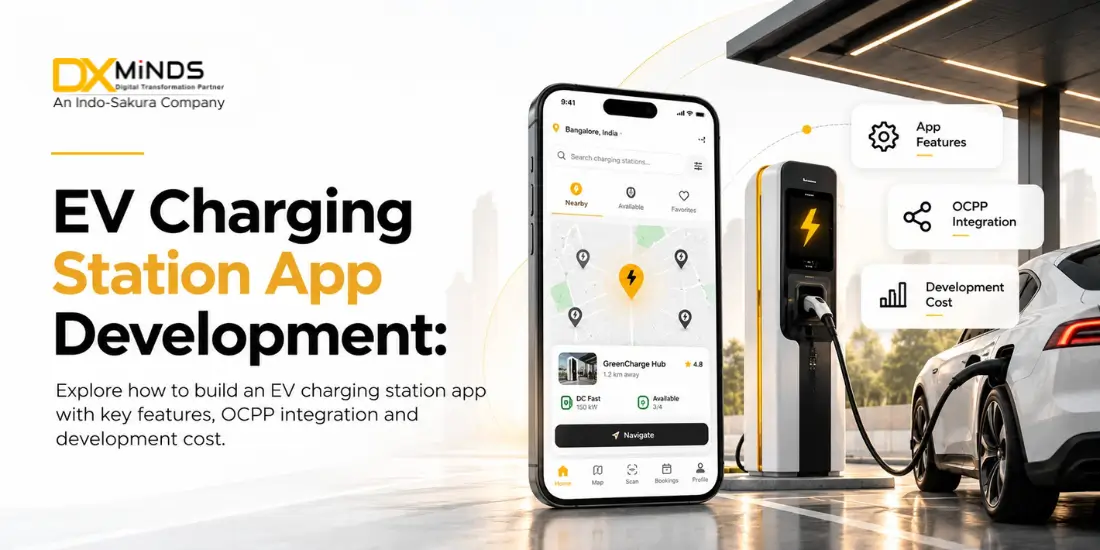
Introduction
The growing adoption of electric vehicles (EVs) is creating demand for convenient, reliable, and connected charging infrastructure. However, installing charging stations alone is not enough to deliver a seamless charging experience. EV drivers also need a simple way to locate charging points, check availability, reserve charging slots, make payments, and monitor charging sessions. Charging network operators need software to manage chargers, track performance, process transactions, and maintain their infrastructure.
This is where EV charging station app development becomes important. A well-designed EV charging application connects drivers, charging stations, payment systems, and network operators through a unified digital platform. It can support public charging networks, workplace charging, residential charging, commercial parking facilities, and electric vehicle fleets.
Modern EV charging software development also involves more than building a mobile application. It may require a backend charging management system, hardware integration, real-time communication, billing automation, analytics, and security controls. Technologies such as the Open Charge Point Protocol (OCPP) help charging stations communicate with a central management system, while additional standards can support interoperability between charging networks.
For businesses planning to enter the EV charging market, understanding the essential features, OCPP integration requirements, technical architecture, and development cost is critical.
This guide explains how to build an EV charging station app, the features to prioritize, how charger communication works, and which factors influence the overall investment.
What Is EV Charging Station App Development?
EV charging station app development is the process of designing and building software that allows electric vehicle drivers to discover, access, and pay for charging services while enabling operators to manage their charging infrastructure.
Depending on the business model, the solution may consist of a driver-facing mobile app, a web-based administration dashboard, a charging station management system, and integrations with charging hardware and external services.
A typical EV charging platform includes three main components:
- Driver application: Helps users find charging stations, view connector availability, navigate to a location, start or stop charging, and pay for charging sessions.
- Charging station management system (CSMS): Connects compatible chargers to the backend, processes status updates, manages remote commands, and monitors station performance.
- Operator dashboard: Allows charging network operators to manage stations, configure tariffs, review transactions, resolve faults, and analyze network utilization.
These components work together to provide a connected charging experience. For example, when a driver searches for a nearby charger, the application can retrieve station information and current status from the backend. After the driver connects a vehicle, the system can authorize the session, communicate with the charger, collect meter readings, and calculate the final amount.
The exact capabilities depend on the supported charging hardware, communication protocols, payment integrations, and business requirements.
Why Are Businesses Investing in EV Charging Software Development?
Charging infrastructure providers need digital systems to manage growing networks efficiently. A dedicated EV charging application can help businesses improve customer experience, automate operations, and create additional revenue opportunities.
1. Simplify the charging experience
Drivers want to find compatible chargers without calling station operators or visiting multiple applications. A charging station locator app can display nearby locations, connector types, charging speeds, prices, and availability in one place.
2. Manage multiple charging locations
Operators with chargers across different cities or facilities need a centralized way to monitor their infrastructure. EV charging station management software helps consolidate operational information into a single dashboard.
3. Automate payments and billing
Manual billing can become difficult when charging sessions increase. Integrating payment gateways, digital receipts, tariff rules, and transaction records allows businesses to automate important billing tasks.
4. Improve charging station utilization
Reservation options, accurate availability information, and usage analytics can help drivers find suitable charging points while helping operators identify underused locations.
5. Support scalable charging networks
A modular EV charger management system can accommodate additional stations, new locations, and multiple hardware vendors without requiring a complete redesign of the platform.
6. Enable smarter energy management
Advanced platforms can use load balancing, charging schedules, and energy monitoring to manage available electrical capacity. With compatible infrastructure, these capabilities can help reduce peak demand and optimize charging operations.
For businesses developing a long-term charging network, the goal is to build a platform that supports current operational needs while allowing new capabilities to be introduced as the network expands.
Essential Features of an EV Charging Station App
The right features depend on whether the platform serves individual drivers, commercial fleets, charging station operators, or multiple customer groups. However, several capabilities form the foundation of a practical EV charging application.
1. User registration and profile management
A straightforward registration process helps users access charging services and manage their preferences.
Common features include:
- Email, mobile number, or supported social sign-in.
- User profile and contact information.
- Vehicle details and charging connector preferences.
- Saved payment methods through a payment provider.
- Charging history and digital invoices.
- Account settings and notification preferences.
For fleet customers, the application may also support business accounts, employee profiles, vehicle groups, and organization-level billing.
2. EV charging station locator
A charging station locator app helps drivers discover charging points based on their current location or intended destination.
Useful capabilities include:
- Map-based station discovery.
- Search by city, address, or destination.
- Filters for connector type and charging speed.
- Station availability and operational status.
- Distance and navigation information.
- Pricing details and facility information.
- Accessibility information where available.
Location data should be combined with reliable station information. A map pin alone does not guarantee that a charger is operational or compatible with a particular vehicle.
3. Real-time charger availability
Real-time availability is one of the most valuable features in EV charging app development. Drivers need to know whether a connector is available before travelling to a station.
The backend can receive charger status updates through supported communication protocols and display information in the mobile app.
Depending on hardware support, statuses may include available, occupied, charging, reserved, faulted, or unavailable. The application should distinguish between live operational data and information that has not been refreshed recently.
This distinction improves transparency and helps avoid situations where drivers arrive at a station expecting a charger to be available.
4. Charging slot booking and reservations
Reservation features can be useful for workplace charging, private parking facilities, fleet depots, and selected public charging networks.
The app may allow users to:
- Select an available station or connector.
- Choose a supported time slot.
- Review reservation rules.
- Receive booking confirmation.
- Cancel or modify a reservation according to policy.
- Receive reminders before the reserved period.
Reservation functionality requires coordination between the booking system and the charger’s actual status. Developers should also define what happens when a driver arrives late, a session runs beyond its expected duration, or a charger becomes unavailable.
5. Remote start and stop charging
For supported charging equipment, users can initiate or terminate charging through the mobile app.
A typical workflow involves user authorization, backend validation, a command sent to the charging station, and confirmation of the resulting status. The interface should clearly communicate whether a command was accepted, is pending, or failed.
Remote control must be implemented carefully. The backend should validate permissions, prevent unauthorized commands, and handle network interruptions or delayed charger responses.
6. In-app payments and automated billing
An EV charging app needs a reliable payment workflow that matches the operator’s pricing model.
Common payment capabilities include:
- Credit and debit card payments.
- Supported digital wallets or regional payment methods.
- Prepaid balances or charging credits.
- Charging session cost estimates.
- Automated final billing.
- Refund and transaction management.
- Digital invoices and receipts.
- Tax calculations where applicable.
Pricing may be based on energy consumed, charging duration, a fixed session fee, parking time, or a combination of permitted tariff components. The business must define how rates are displayed and how the final charge is calculated.
Payment gateway integration should also account for failed transactions, authorization holds, duplicate requests, refunds, and reconciliation.
7. Charging session monitoring
Drivers should be able to monitor an active charging session without repeatedly refreshing the application.
Depending on the charger and protocol implementation, the app can display:
- Session status.
- Energy consumed in kilowatt-hours.
- Elapsed charging time.
- Estimated or confirmed session cost.
- Available charging power, when supported.
- Session completion notifications.
Developers should distinguish measured values from estimates. Battery percentage, for example, may not be available directly from every charging station or vehicle integration.
8. Notifications and alerts
Push notifications, email, or SMS can help users stay informed throughout the charging process.
Typical alerts include charging start confirmation, session completion, reservation reminders, payment confirmation, failed charging attempts, and relevant station status changes.
Notification preferences should be configurable so users can choose which updates they receive. Operational alerts for administrators should be handled separately from customer-facing messages.
9. Ratings, reviews, and customer support
A customer support module can help users report faulty chargers, payment problems, inaccurate station details, or difficulties starting a session.
Possible features include station reviews, issue reporting, support tickets, FAQs, and in-app chat. Feedback can also help operators identify recurring problems at specific locations.
10. Admin dashboard and network management
The operator dashboard is essential for businesses managing multiple charging stations.
Core functions can include:
- Charger registration and configuration.
- Station and connector status monitoring.
- Tariff and pricing management.
- User and account administration.
- Charging session history.
- Payment and revenue reports.
- Fault notifications and maintenance tracking.
- Access permissions for staff.
- Utilization and operational analytics.
A robust dashboard allows operators to identify service issues, review network performance, and make informed decisions about expanding charging infrastructure.
OCPP Integration for EV Charging Apps: How It Works
OCPP integration is one of the most important technical considerations in EV charging software development.
The Open Charge Point Protocol (OCPP) is an open communication standard that enables charging stations to communicate with a charging station management system. It helps operators connect compatible charging equipment with centralized software, reducing dependence on proprietary communication systems. The Open Charge Alliance maintains the protocol and publishes its specifications.
What does OCPP do?
OCPP provides a structured way for a charging station and its central management system to exchange information and commands.
Depending on the protocol version and implementation, this can support:
- Charger connection and status reporting.
- Authorization of charging sessions.
- Starting and stopping charging remotely.
- Meter readings and transaction updates.
- Charger configuration and diagnostics.
- Firmware management.
- Smart charging and power management.
- Fault reporting and operational monitoring.
For example, suppose a driver opens an EV charging app and selects a compatible charging point. The backend checks the user’s authorization and sends the appropriate request to the connected charger. The charger responds through the supported protocol, and the application updates the user about the session status.
The application does not normally communicate with the physical charger directly. Instead, the charging station management system acts as the central communication and control layer.
OCPP 1.6 vs. OCPP 2.0.1 vs. OCPP 2.1
Selecting the right OCPP version is an important part of planning an EV charger management system. The decision should depend on existing hardware, manufacturer support, required functionality, and future expansion plans.
|
OCPP version |
Key capabilities | Best suited for |
| OCPP 1.6 | Charging transactions, status updates, diagnostics, and smart charging capabilities |
Existing charging networks and compatible installed hardware |
|
OCPP 2.0.1 |
Enhanced device management, transaction handling, security, and advanced smart charging |
New platforms requiring richer management capabilities |
|
OCPP 2.1 |
Additional support for bidirectional charging, distributed energy resources, advanced smart charging, and expanded payment options |
Networks planning advanced energy management or V2X capabilities |
These versions are not interchangeable in every implementation. In particular, OCPP 1.6 and OCPP 2.0.1 are not backward compatible, so the software and charger must support a compatible protocol version. OCPP 2.1 builds on OCPP 2.0.1 and introduces additional functionality.
For a new EV charging app development project, it is important to verify which version the selected charger manufacturers actually support. A newer protocol is not automatically the right choice if the required hardware cannot implement it.
OCPP integration architecture
A typical OCPP-enabled charging platform contains several interconnected layers.
EV Driver Mobile App
Station discovery, booking, charging controls, payments
Backend APIs and Business Logic
Authentication, reservations, pricing, sessions, payments
Charging Station Management System (CSMS)
OCPP communication, charger status, commands, telemetry
EV Charging Stations
Compatible chargers, connectors, meters, hardware controllers
The architecture may also include a cloud database, notification service, payment gateway, mapping provider, analytics platform, and third-party charging network integrations.
The mobile application and CSMS serve different purposes. The app focuses on the driver experience, while the CSMS handles communication with physical charging equipment. Separating these responsibilities helps the platform scale and makes it easier to update individual components.
Steps to implement OCPP integration
Step 1: Assess charger compatibility. Identify the charger manufacturer, supported OCPP version, connector types, firmware capabilities, and communication requirements.
Step 2: Select or develop the CSMS. Decide whether to integrate an existing charging management platform or build a custom solution. A custom CSMS offers more control but requires additional engineering, testing, and maintenance.
Step 3: Establish secure connectivity. Configure the required network connections, WebSocket communication, device identity, and security mechanisms supported by the selected OCPP version and hardware.
Step 4: Implement message handling. Build the workflows for status updates, authorization, charging transactions, meter values, remote commands, and error responses.
Step 5: Connect the CSMS to application APIs. Expose the relevant station, session, pricing, and transaction data to the mobile app and administration dashboard.
Step 6: Test real-world scenarios. Validate successful charging, rejected authorization, lost connectivity, delayed responses, interrupted sessions, duplicate messages, and charger restarts.
Step 7: Validate interoperability. Test against the actual hardware and applicable protocol requirements. The Open Charge Alliance provides official specifications and compliance testing resources for supported versions.
The integration should be tested with representative chargers before the application is released across a larger network.
OCPP vs. OCPI: What Is the Difference?
OCPP and OCPI are related to EV charging infrastructure, but they solve different problems.
OCPP connects a charging station to its central management system. OCPI, maintained by the EVRoaming Foundation rather than the Open Charge Alliance, supports communication and data exchange between charging service providers and charging point operators, including roaming-related use cases.
|
Area |
OCPP | OCPI |
| Main purpose | Charger-to-management-system communication | Information exchange between charging ecosystem participants |
| Typical connection | Charging station and CSMS |
Charging operators and e-mobility service providers |
|
Example use case |
Receive charger status and manage charging sessions | Share station information, tariffs, and roaming-related data |
| When needed | When the platform needs to manage compatible physical chargers |
When the business needs supported cross-network services |
A platform that only manages its own compatible chargers may initially prioritize OCPP. A business that wants drivers to access chargers across multiple independent networks may also need OCPI or another suitable interoperability integration.
The requirements depend on the business model and participating networks. Implementing both protocols does not automatically guarantee compatibility with every operator.
Advanced Features for a Scalable EV Charging Platform
Once the core application and charging workflows are stable, businesses can introduce advanced capabilities to improve network efficiency and customer experience.
Smart charging and load balancing
Smart charging adjusts charging power or schedules based on available capacity, pricing, demand, or other configured constraints.
For example, a commercial facility may need to distribute limited electrical capacity among several vehicles. A compatible charging management system can apply charging limits to avoid exceeding the site’s configured power threshold.
Implementation depends on charger capabilities, electrical infrastructure, and the relevant protocol features.
Fleet charging management
Fleet operators need more than a station map. Their platform may include vehicle assignment, employee access, depot charging schedules, fleet-level reporting, charging expense allocation, and alerts for vehicles that need charging.
These features can help logistics businesses, delivery companies, corporate transport providers, and other EV fleet operators coordinate charging operations.
Energy analytics and predictive maintenance
Charging station analytics can reveal peak usage periods, common faults, session failures, and differences in utilization across locations.
With sufficient historical data, predictive models may help identify equipment that needs inspection. However, predictive maintenance should be treated as a data-driven capability that requires validation, not as a guarantee that all failures can be predicted.
Renewable energy and bidirectional charging
Some businesses may want to coordinate charging with solar generation, battery storage, or other energy resources. Advanced deployments may also explore vehicle-to-grid (V2G) or vehicle-to-building (V2B) use cases.
OCPP 2.1 adds capabilities related to bidirectional power transfer and distributed energy resource control, but realizing these use cases requires compatible vehicles, charging equipment, electrical systems, and supporting commercial arrangements.
Multi-language and accessibility support
For charging networks serving diverse markets, multiple languages, accessible navigation, readable pricing, and clear charging instructions can improve usability.
Localization may also require different currencies, payment providers, tax handling, and region-specific operating rules.
EV Charging App Development Cost: What Should Businesses Expect?
The cost of EV charging app development depends on the number of features, supported platforms, OCPP requirements, charger compatibility, payment integrations, backend complexity, and testing scope.
A basic station discovery app is significantly different from a full-scale EV charging network platform with a custom CSMS, real-time charger control, fleet management, and advanced energy optimization.
The following estimates are illustrative planning ranges, not vendor quotations. Actual pricing will vary based on project requirements, team location, and existing infrastructure.
|
Development scope |
Estimated cost (USD) | Indicative timeline |
| Basic station locator app | 10,000–25,000 |
6–10 weeks |
|
EV charging app MVP with user accounts and payments |
25,000–50,000 | 10–16 weeks |
|
App with OCPP integration and operator dashboard |
50,000–100,000 |
4–7 months |
| Enterprise charging platform with fleet and advanced management features | 100,000–200,000+ |
6–12+ months |
These ranges are indicative estimates for early planning. They are not standardized market prices, and project durations can overlap depending on team size, hardware readiness, and parallel development.
Key factors affecting EV charging app development cost
-
Feature complexity
Basic features such as station discovery and user registration require less engineering than real-time charger control, automated refunds, reservations, and fleet management.
-
OCPP integration requirements
Integrating an existing CSMS may reduce development effort compared with building a custom OCPP communication layer and complete charging management system. Multi-vendor charger support can add further testing and compatibility work.
-
Mobile platform selection
Developing separate native applications for iOS and Android may require additional resources. Cross-platform frameworks can help share code, although some hardware integrations and platform-specific functionality may still require native development.
-
Backend infrastructure
The backend must manage users, charging sessions, payments, charger telemetry, pricing, and operational events. A larger network may require more sophisticated event processing, monitoring, database design, and infrastructure scaling.
-
Third-party integrations
Mapping services, payment gateways, SMS providers, analytics platforms, roaming systems, and identity services can affect implementation effort and ongoing operating expenses.
-
Security and compliance
Secure authentication, access control, payment handling, audit logging, data protection, and applicable regional requirements must be included in project planning.
-
Maintenance and upgrades
After launch, the platform needs bug fixes, infrastructure monitoring, security updates, charger compatibility testing, and enhancements. Ongoing maintenance should be planned separately from the initial development budget.
How can businesses optimize development costs?
Businesses can reduce unnecessary initial investment by defining a focused minimum viable product (MVP).
A practical first release could include:
- User registration and vehicle profiles.
- Station discovery and connector information.
- Live status for supported charging stations.
- Basic charging session management.
- Payment gateway integration.
- An operator dashboard.
- OCPP integration for a defined set of compatible chargers.
Advanced analytics, multi-network roaming, predictive maintenance, and complex energy management can be introduced after the core workflows have been validated.
This approach helps businesses test market demand before committing to a broader platform.
Step-by-Step Process for EV Charging Station App Development
A structured development process helps align business goals, hardware requirements, software architecture, and customer expectations.
Step 1: Define business requirements
Identify the target users, charging business model, operating regions, supported charger types, revenue model, and required integrations. Decide whether the product will serve public charging, private facilities, fleets, or a combination.
Step 2: Plan the technical architecture
Define the mobile app, backend APIs, database, CSMS, OCPP implementation, payment services, and administration dashboard. Select a suitable architecture based on the expected number of stations and concurrent charging sessions.
Step 3: Design the user experience
Create wireframes and prototypes for onboarding, station discovery, charger details, reservations, active charging sessions, payment, and support. Ensure that charging status and pricing are easy to understand.
Step 4: Develop the application and backend
Implement mobile screens, backend APIs, user management, pricing rules, charging sessions, payment workflows, and operator tools. Integrate OCPP communication according to the selected charger specifications.
Step 5: Test hardware integration and security
Test charging start and stop commands, status synchronization, meter readings, payment calculations, connectivity failures, authorization, and recovery scenarios with actual compatible charging equipment.
Step 6: Deploy and optimize
Launch with a controlled group of charging stations, monitor application performance, gather driver feedback, resolve operational issues, and gradually expand the network.
Security Considerations in EV Charging App Development
Security is important because an EV charging platform connects user accounts, financial transactions, cloud infrastructure, and physical charging equipment.
A secure development approach should include:
- Authentication and authorization: Ensure users, administrators, and charging stations have only the permissions they need.
- Secure communication: Use appropriate transport encryption and implement protocol-specific security mechanisms.
- Payment security: Use a suitable payment provider and avoid storing sensitive card data unnecessarily.
- API protection: Apply request validation, rate limiting, access controls, and abuse monitoring.
- Charger identity management: Register charging stations securely and prevent unauthorized devices from issuing trusted messages.
- Operational logging: Record important charging commands, session events, administrative changes, and payment actions.
- Data protection: Limit personal data collection and apply appropriate retention, access, and privacy controls.
- Recovery and monitoring: Detect service interruptions, monitor failed commands, and design safe recovery procedures.
Security requirements should be considered during architecture design rather than added only after development. Businesses must also assess the regulatory and data protection obligations applicable to their operating markets.
Common Challenges in EV Charging App Development
Even a well-designed charging application can encounter challenges when it interacts with real-world charging infrastructure.
1. Compatibility across charger manufacturers
Different charging stations may support different OCPP versions, optional features, firmware versions, and vendor-specific behaviors. Testing against representative hardware is essential.
2. Inaccurate or delayed charger status
Network interruptions and delayed status messages can result in outdated availability information. The platform should monitor data freshness and communicate uncertainty to users instead of displaying stale information as live.
3. Charging session and payment mismatches
The final payment must correspond to the actual session and configured tariff. The system needs to handle interrupted sessions, missing meter values, delayed transaction updates, and duplicate payment requests.
4. Poor network connectivity
Charging stations may temporarily lose connectivity. The software must define how authorization, status reporting, session recovery, and remote commands behave when communication is unavailable.
5. Scaling across multiple locations
As the charging network grows, the backend must handle more devices, incoming events, user requests, and reporting workloads. Load testing and monitoring can help identify performance bottlenecks before they affect customers.
6. Complex reservation management
A reservation system must account for charging sessions that run late, charger faults, overlapping bookings, and no-shows. Clear policies and synchronization with charger status are essential.
Addressing these challenges early can reduce support costs and improve the reliability of the final product.
How to Choose an EV Charging App Development Company
Choosing the right technology partner can influence the delivery timeline, system reliability, and long-term scalability of the platform.
Businesses should evaluate potential development partners based on the following criteria:
- EV charging domain knowledge: Experience with charging workflows, connector compatibility, tariffs, and station management.
- OCPP expertise: Practical knowledge of OCPP implementation, charger integration, session management, and interoperability testing.
- Mobile and backend capabilities: Ability to develop reliable mobile applications, APIs, dashboards, and cloud infrastructure.
- Third-party integrations: Experience connecting payment gateways, maps, notifications, and relevant charging network services.
- Security practices: Clear processes for authentication, authorization, data protection, and security testing.
- Scalability planning: A realistic approach to supporting additional chargers, locations, and user demand.
- Post-launch support: Defined arrangements for monitoring, maintenance, bug fixes, and future upgrades.
Ask shortlisted vendors to explain how they would handle a failed charging command, an interrupted network connection, and a payment discrepancy. These scenarios can provide more useful insight into their technical approach than a feature checklist alone.
Future Trends in EV Charging App Development
EV charging software is evolving beyond station discovery and payments. Several developments may influence how businesses design their next generation of charging platforms.
Smart energy management: Charging schedules can respond to power availability, energy tariffs, and operational constraints.
Vehicle-to-grid integration: Compatible vehicles and charging systems can support bidirectional power transfer for selected use cases.
AI-assisted operations: Analytics and machine learning may help forecast station demand, identify unusual behavior, and prioritize maintenance.
Charging network interoperability: Roaming integrations can help drivers access participating networks through a more unified experience.
Fleet electrification: Dedicated charging platforms can coordinate depot charging, vehicle availability, employee access, and operational reporting.
Plug & Charge: With compatible vehicles, chargers, and supporting systems, standards such as ISO 15118 can support automated identification and authorization workflows.
These trends are not mandatory for every project. Businesses should prioritize them according to customer demand, hardware readiness, energy infrastructure, and measurable business value.
Conclusion
EV charging station app development requires a combination of mobile application engineering, backend development, charging hardware integration, payment processing, and operational management. A successful platform must deliver a convenient experience for drivers while providing charging network operators with reliable tools to manage their infrastructure.
OCPP integration is particularly important for communicating with compatible charging stations, monitoring sessions, and enabling remote charger management. Choosing the appropriate protocol version, testing hardware compatibility, and designing a scalable backend can help businesses avoid expensive integration problems as their networks grow.
The best starting point is to define the target business model, prioritize the essential features, and build an MVP around validated charging workflows. Advanced capabilities such as smart charging, fleet management, roaming, AI-assisted analytics, and bidirectional charging can then be introduced as the platform evolves.
For businesses planning to enter the EV charging market, investing in a secure, interoperable, and scalable software foundation can support better customer experiences and more efficient charging operations over the long term.
Planning an EV charging platform? Work with an experienced software development team to define your feature requirements, evaluate charger compatibility, plan OCPP integration, and establish a realistic development roadmap.
Frequently Asked Questions
1. How much does EV charging station app development cost?
The cost depends on the features, mobile platforms, OCPP integration, backend complexity, payment requirements, and hardware compatibility. A basic locator application may cost around 10,000–25,000, while a platform with charger management and advanced integrations can cost 50,000–200,000 or more. These are illustrative estimates rather than fixed market prices.
2. How long does it take to develop an EV charging app?
A basic application may take approximately 6–10 weeks. An MVP with user accounts and payments may require 10–16 weeks, while an enterprise platform with OCPP integration, fleet management, and advanced backend functionality can take six months or longer. Hardware integration and testing can significantly affect the timeline.
3. Why is OCPP integration important for EV charging apps?
OCPP enables compatible charging stations to communicate with a central charging management system. It supports functions such as charger status monitoring, charging session management, remote commands, and operational diagnostics, depending on the version and implementation.
4. Can an EV charging app support multiple charging station brands?
Yes, provided the chargers and the management platform support compatible protocols and required features. However, different vendors may implement optional capabilities differently, so multi-brand compatibility requires careful integration and testing.
5. What is the difference between an EV charging app and a charging station management system?
An EV charging app primarily serves drivers by providing station discovery, charging controls, payments, and session information. A charging station management system communicates with compatible chargers, processes operational data, manages commands, and supports network administration.