
- August 7, 2026
- Posted by: Jhansi G
- Category: Artificial Intelligence
Introduction
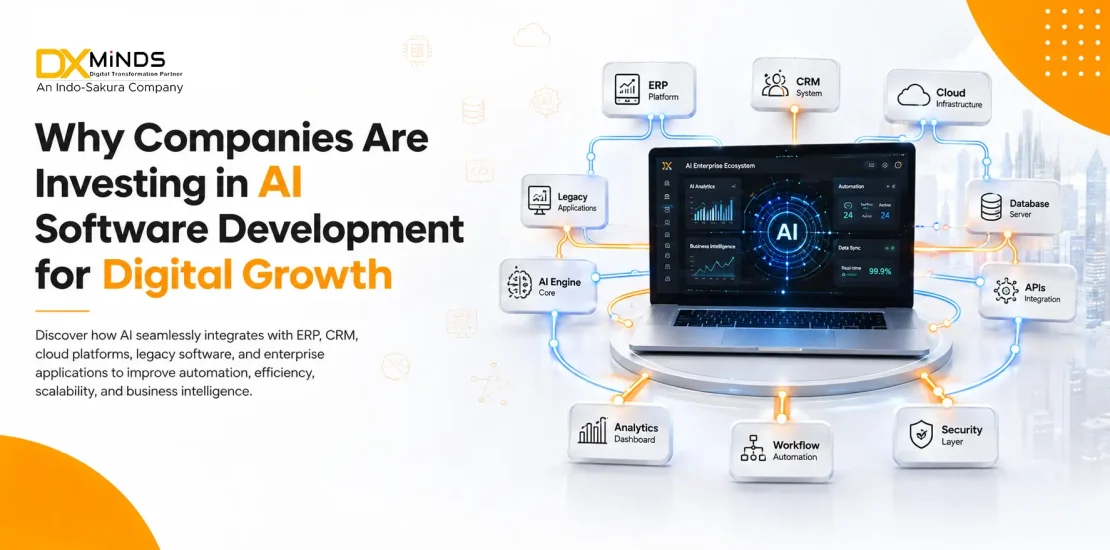
Artificial Intelligence (AI) has become one of the most transformative technologies of the modern business era. What was once considered a futuristic concept is now a strategic investment for organizations looking to improve efficiency, enhance customer experiences, and accelerate digital transformation. Businesses across industries are increasingly investing in AI software development to remain competitive in a rapidly evolving digital landscape.
From automating repetitive tasks to enabling predictive analytics and intelligent decision-making, AI-powered applications are helping organizations unlock new growth opportunities. Companies are no longer asking whether they should invest in AI; instead, they are exploring how quickly they can integrate AI into their operations to achieve measurable business outcomes.
The growing demand for digital solutions, combined with advancements in machine learning, natural language processing, computer vision, and generative AI, has made AI software development more accessible than ever before. Businesses can now build intelligent systems that analyze data, learn from user behavior, automate workflows, and deliver personalized experiences at scale.
As organizations face increasing competition, changing customer expectations, and the need for operational efficiency, AI software development has emerged as a key driver of digital growth. This article explores why businesses are making significant investments in AI, the benefits it offers, and how AI is shaping the future of enterprise innovation.
What Is AI Software Development?
AI software development is the process of designing, building, and deploying applications that use artificial intelligence technologies to perform tasks that typically require human intelligence.
These technologies include:
- Machine Learning (ML)
- Natural Language Processing (NLP)
- Computer Vision
- Predictive Analytics
- Generative AI
- Deep Learning
- Speech Recognition
- Intelligent Automation
Unlike traditional software applications that operate based on predefined rules, AI-powered systems can analyze data, recognize patterns, make decisions, and continuously improve their performance through learning.
AI software can be integrated into:
- Enterprise applications
- Mobile applications
- Web platforms
- Customer support systems
- Healthcare solutions
- Financial applications
- Retail platforms
- Manufacturing systems
This flexibility makes AI one of the most valuable technologies for businesses seeking sustainable digital growth.
Why AI Is Driving Digital Transformation
Digital transformation is more than simply adopting new technology. It involves rethinking business processes, customer experiences, and operational strategies to create long-term value.
AI plays a central role in digital transformation because it enables organizations to move beyond manual processes and data silos. Businesses can leverage AI to automate workflows, analyze large volumes of information, and make smarter decisions faster than ever before.
Companies investing in AI software development gain the ability to:
- Improve operational efficiency
- Reduce manual workloads
- Increase productivity
- Deliver personalized customer experiences
- Improve decision-making
- Accelerate innovation
- Enhance scalability
These benefits make AI an essential component of modern digital transformation strategies.
Top Reasons Companies Are Investing in AI Software Development
1. Automating Repetitive Business Processes
One of the biggest reasons companies invest in AI software development is automation.
Many organizations still spend significant time and resources on repetitive tasks such as
- Data entry
- Invoice processing
- Appointment scheduling
- Customer inquiries
- Inventory management
- Report generation
AI-powered automation reduces manual effort and improves accuracy. Employees can focus on strategic activities while AI handles routine operations.
As a result, businesses experience:
- Increased productivity
- Lower operational costs
- Faster task completion
- Reduced human errors
Automation alone often delivers a strong return on investment, making AI an attractive business solution.
2. Enhancing Customer Experience
Customer expectations have changed dramatically in the digital age.
Consumers expect:
- Instant responses
- Personalized recommendations
- Seamless interactions
- 24/7 support
AI software helps businesses meet these expectations through intelligent customer engagement solutions.
Examples include:
- AI chatbots
- Virtual assistants
- Recommendation engines
- Voice AI systems
- Customer sentiment analysis
These technologies enable organizations to provide personalized and responsive customer experiences that improve satisfaction and loyalty.
Businesses that deliver superior customer experiences often achieve higher retention rates and increased revenue.
3. Improving Data-Driven Decision Making
Modern organizations generate massive amounts of data every day.
Without AI, much of this data remains underutilized.
AI-powered analytics solutions help businesses:
- Identify trends
- Predict outcomes
- Detect anomalies
- Analyze customer behavior
- Forecast demand
By transforming raw data into actionable insights, AI enables organizations to make faster and more informed decisions.
This leads to:
- Better strategic planning
- Improved risk management
- Increased operational efficiency
- Enhanced business performance
Companies that leverage AI for decision-making gain a significant competitive advantage in their markets.
4. Reducing Operational Costs
Cost optimization remains a major priority for businesses across all industries.
AI software development helps organizations reduce expenses through:
- Process automation
- Resource optimization
- Predictive maintenance
- Intelligent scheduling
- Automated customer support
For example, AI-powered chatbots can handle thousands of customer inquiries simultaneously, reducing the need for large support teams.
Similarly, predictive maintenance solutions help manufacturers identify equipment issues before failures occur, reducing downtime and repair costs.
These efficiencies contribute directly to improved profitability.
5. Accelerating Innovation
Innovation is essential for business growth.
Organizations investing in AI software development can create new products, services, and business models faster than their competitors.
AI supports innovation by enabling:
- Intelligent applications
- Personalized digital experiences
- Automated product development
- Smart recommendations
- Advanced analytics
Businesses that embrace AI are better positioned to adapt to changing market conditions and customer expectations.
Innovation driven by AI often leads to increased market share and stronger brand differentiation.
6. Strengthening Cybersecurity
Cybersecurity threats continue to grow in complexity and frequency.
Traditional security systems often struggle to keep pace with modern attack methods.
AI-powered security solutions can:
- Detect suspicious activity
- Identify vulnerabilities
- Monitor network traffic
- Prevent fraud
- Automate threat response
By analyzing patterns in real time, AI helps organizations respond to threats more quickly and effectively.
This proactive approach strengthens security while protecting sensitive business and customer data.
7. Enabling Scalability
As businesses grow, their operational requirements become more complex.
AI software development enables organizations to scale efficiently by automating processes and supporting larger workloads without proportional increases in staffing or infrastructure.
Cloud-based AI solutions make it easier for businesses to:
- Expand operations
- Support more users
- Process larger datasets
- Integrate new technologies
Scalable AI systems ensure businesses remain agile and prepared for future growth.
AI Use Cases Across Industries
Artificial Intelligence is transforming industries by helping businesses automate operations, improve efficiency, and deliver better customer experiences. Regardless of company size, organizations are leveraging AI software development to solve complex business challenges and gain a competitive edge.
Healthcare
Healthcare providers are using AI to improve patient care, streamline administrative tasks, and support medical professionals.
Popular AI applications include
- AI-powered diagnostic systems
- Virtual healthcare assistants
- Medical image analysis
- Patient appointment scheduling
- Electronic health record automation
- Predictive patient monitoring
These solutions reduce administrative burdens while improving patient outcomes and operational efficiency.
Banking and Financial Services
Financial institutions process millions of transactions every day, making AI an essential technology for security and operational excellence.
Common AI applications include:
- Fraud detection
- Credit risk analysis
- Intelligent financial advisors
- Loan processing automation
- Customer service chatbots
- Investment forecasting
AI enables financial organizations to improve decision-making while delivering faster and more secure services.
Retail and E-commerce
Retail businesses use AI to personalize shopping experiences and optimize business operations.
Examples include:
- Personalized product recommendations
- Dynamic pricing
- Customer behavior analysis
- Inventory forecasting
- AI-powered customer support
- Smart search functionality
These capabilities increase customer satisfaction while boosting conversions and sales.
Manufacturing
Manufacturers invest heavily in AI software development to improve productivity and reduce downtime.
AI supports:
- Predictive maintenance
- Quality inspection
- Production planning
- Supply chain optimization
- Industrial automation
- Computer vision-based defect detection
These technologies help manufacturers improve efficiency while reducing operational costs.
Logistics and Transportation
AI has become an essential technology for logistics companies seeking operational efficiency.
Applications include:
- Route optimization
- Fleet management
- Warehouse automation
- Shipment tracking
- Demand forecasting
- Delivery scheduling
AI helps logistics companies improve delivery performance while reducing transportation costs.
Education
Educational institutions are using AI to create personalized learning experiences and improve student engagement.
Examples include:
- Intelligent tutoring systems
- Automated assessments
- Learning analytics
- Student performance tracking
- Virtual teaching assistants
AI enables educators to deliver more effective and personalized learning.
Emerging AI Technologies Driving Business Growth
Generative AI
Generative AI is revolutionizing how businesses create content, develop software, and automate workflows.
Businesses use Generative AI for:
- Content creation
- Software code generation
- Marketing campaigns
- Product documentation
- Customer support
- Knowledge management
Generative AI significantly improves productivity while reducing manual effort.
AI Agents
AI Agents represent the next generation of business automation.
Unlike traditional chatbots, AI Agents can:
- Understand business goals
- Perform multi-step tasks
- Make intelligent decisions
- Execute workflows
- Interact with multiple business systems
AI Agents are expected to become essential components of enterprise operations over the coming years.
Machine Learning
Machine Learning enables software applications to improve automatically through experience.
Businesses leverage machine learning for:
- Predictive analytics
- Customer segmentation
- Fraud detection
- Sales forecasting
- Demand prediction
- Recommendation systems
Machine learning helps organizations make smarter business decisions using data-driven insights.
Natural Language Processing (NLP)
NLP enables computers to understand human language.
Business applications include:
- AI chatbots
- Voice assistants
- Email automation
- Language translation
- Sentiment analysis
- Intelligent document processing
NLP enhances communication between businesses and customers while improving service quality.
How to Choose the Right AI Software Development Company
Selecting the right development partner is one of the most important decisions when investing in AI.
Consider the following factors:
Technical Expertise
Choose a company experienced in:
- Machine Learning
- Generative AI
- NLP
- Computer Vision
- Cloud Computing
- AI Integration
Industry Experience
Industry-specific expertise enables faster development and better business outcomes.
Look for successful projects in your industry.
Scalable Solutions
Your AI application should support future business growth.
Ensure your development partner builds cloud-ready and scalable architectures.
Security and Compliance
AI applications process valuable business data.
Choose a development company that follows:
- Secure coding practices
- Data encryption
- Identity management
- Compliance with relevant regulations
- Regular security assessments
Post-Deployment Support
AI software requires continuous improvement.
A reliable partner should provide:
- Maintenance
- Model optimization
- Performance monitoring
- Feature enhancements
- Technical support
Why Choose DxMinds for AI Software Development?
Successful AI implementation requires more than technology—it requires a strategic partner who understands your business objectives.
DxMinds delivers end-to-end AI software development services that help organizations accelerate digital transformation.
Our services include:
- Custom AI Software Development
- AI Mobile Application Development
- Enterprise AI Solutions
- AI Chatbot Development
- Generative AI Development
- Machine Learning Solutions
- AI Integration Services
- Predictive Analytics
- Cloud-Based AI Applications
Why Businesses Choose DxMinds
- Experienced AI engineers
- Agile development methodology
- Secure software architecture
- Industry-focused solutions
- Scalable cloud-native applications
- End-to-end project delivery
- Continuous support and maintenance
Whether you are modernizing existing systems or building a new AI-powered product, DxMinds delivers intelligent solutions designed for long-term business success.
Future of AI Software Development
The future of AI software development is driven by continuous innovation and increasing enterprise adoption.
Key trends include:
- Hyperautomation
- Autonomous AI Agents
- AI-assisted software development
- Intelligent business process automation
- Responsible AI
- Edge AI
- Multimodal AI
- Industry-specific AI platforms
Organizations investing in AI today will be better prepared to compete in tomorrow’s digital economy.
Conclusion
Artificial Intelligence is reshaping how businesses operate, compete, and grow. Companies across industries are investing in AI software development to automate workflows, improve customer experiences, strengthen decision-making, and accelerate innovation.
From predictive analytics and intelligent automation to Generative AI and AI Agents, AI enables businesses to solve complex challenges while unlocking new growth opportunities. Organizations that embrace AI today will be better positioned to respond to changing market demands and maintain a competitive advantage.
However, achieving successful AI adoption requires the right strategy, technology, and implementation partner. By working with an experienced AI software development company like DxMinds, businesses can build secure, scalable, and future-ready AI solutions tailored to their unique goals.
Frequently Asked Questions
1. What is AI software development?
AI software development is the process of creating applications that use artificial intelligence technologies such as machine learning, natural language processing, computer vision, and generative AI to automate tasks and improve decision-making.
2. Why are businesses investing in AI software development?
Businesses invest in AI to automate operations, reduce costs, improve productivity, enhance customer experiences, and gain a competitive advantage.
3. Which industries benefit the most from AI software development?
Healthcare, finance, retail, manufacturing, logistics, education, real estate, and telecommunications are among the industries benefiting from AI-powered solutions.
4. How does AI support digital transformation?
AI supports digital transformation by automating workflows, analyzing data, personalizing customer interactions, and enabling faster, data-driven decisions.
5. What are the benefits of custom AI software development?
Custom AI solutions provide flexibility, scalability, seamless integration, enhanced security, and alignment with specific business objectives.