


- September 29, 2025
- Posted by: Admin
- Category: Artificial Intelligence
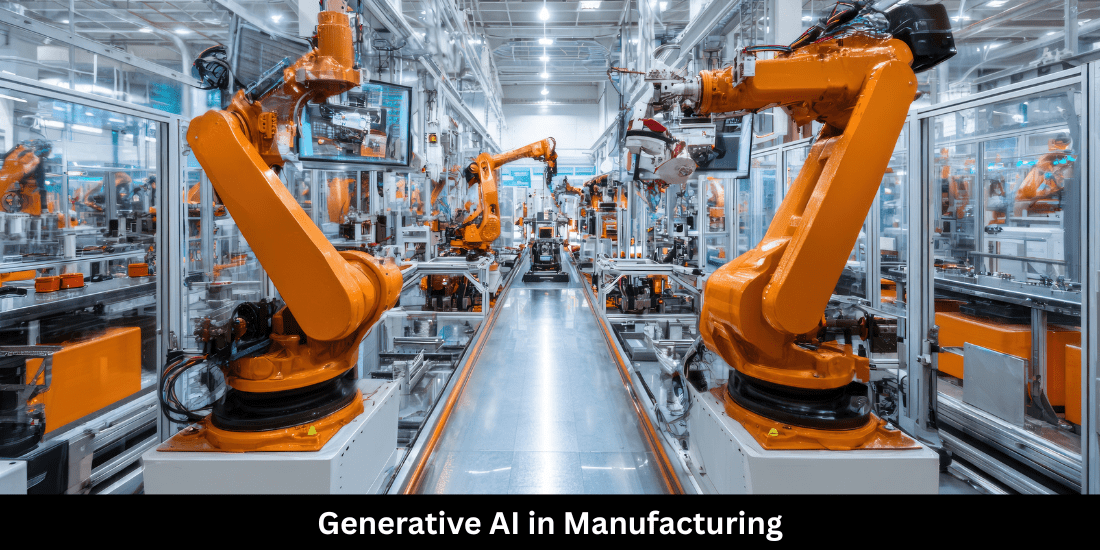
Generative AI in Manufacturing: The Future of Smart Factories
The manufacturing landscape is experiencing a revolutionary transformation driven by Generative Artificial Intelligence (GenAI), fundamentally reshaping how smart factories operate, innovate, and compete in the global marketplace. As Industry 4.0 continues to evolve, generative AI emerges as the cornerstone technology that promises to unlock unprecedented levels of efficiency, innovation, and adaptability in manufacturing operations.
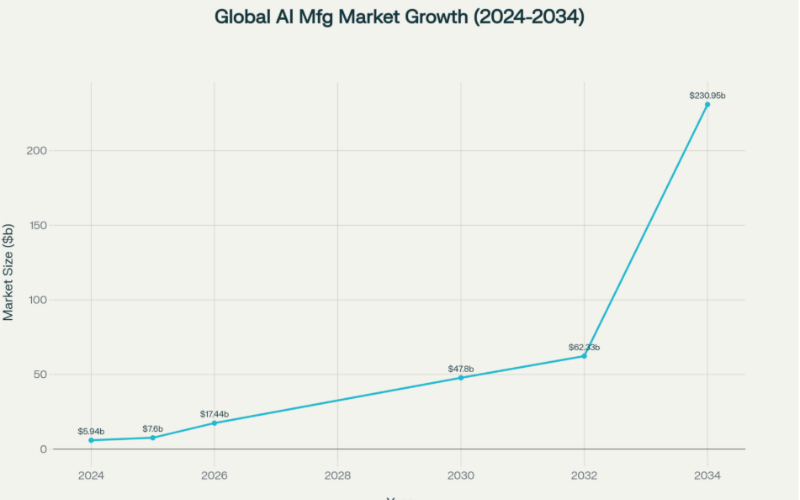
Key statistics showing AI adoption and benefits in manufacturing, including significant improvements in predictive maintenance and operational efficiency.
The Current State of AI Adoption in Manufacturing
The momentum behind AI integration in manufacturing is undeniable. In 2024, 35% of manufacturing firms utilized AI technologies, with particular emphasis on predictive maintenance and quality
control applications. The adoption rate is accelerating rapidly, with 41% of manufacturers leveraging AI to manage supply chain data, enhancing efficiency and responsiveness across their operations.
Perhaps most striking is the commitment from industry leaders: 90% of top machine manufacturers are investing in predictive analytics technology for maintenance applications. This widespread adoption reflects the tangible benefits organizations are experiencing, including 30% reduction in unexpected downtime and 25% lower maintenance costs.
The market potential is equally impressive. The global Artificial Intelligence in manufacturing market, valued at USD 5.94 billion in 2024, is projected to reach USD 230.95 billion by 2034, representing a compound annual growth rate (CAGR) of 44.20%. This exponential growth trajectory underscores the transformative potential of AI technologies in manufacturing environments.
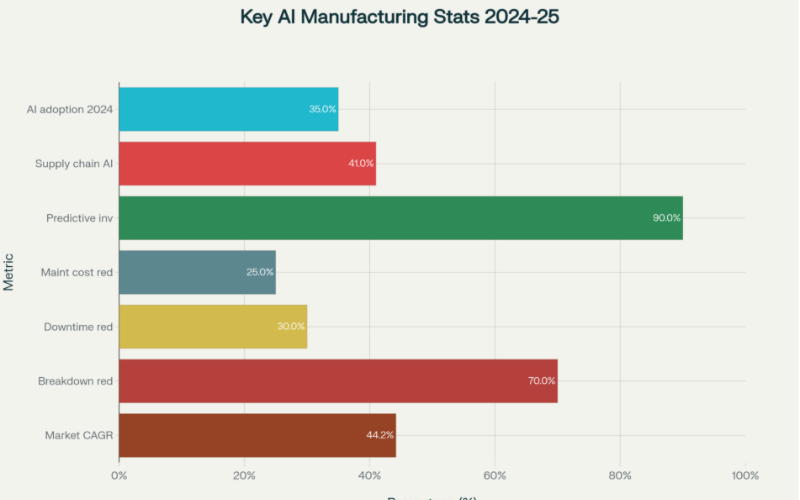
Exponential growth projection of the global AI in manufacturing market, showing dramatic expansion from $5.94 billion in 2024 to $230.95 billion by 2034.
Understanding Generative AI in Smart Manufacturing
Generative AI in manufacturing automates and optimizes operations by leveraging advanced algorithms like Generative Adversarial Networks (GANs) to create unique content, designs, and solutions. Unlike traditional AI systems that simply analyze data, generative AI creates new possibilities by analyzing large datasets to identify patterns and produce innovative outputs efficiently.
In the context of smart manufacturing, GenAI serves as a digital innovation catalyst that enhances organizational efficiency across multiple dimensions. By processing real-time data from machine sensors and interconnected devices, AI automates workflows, reduces downtime, and accelerates decision-making for both customer service teams and service engineers.
Core Technologies Powering Generative AI
The foundation of generative AI in manufacturing rests on several cutting-edge technologies:
Generative Adversarial Networks (GANs) enable machines to create new designs by learning from patterns in extensive datasets. Automotive manufacturers use GANs to generate and refine car designs based on consumer preferences and aerodynamic efficiency.
Reinforcement Learning enhances workflow optimization capabilities. Tesla employs AI to improve factory automation, analyzing real-time production lines to suggest enhancements.
Computer Vision aids in quality control by detecting flaws during production. When paired with generative AI, it helps simulate corrections, reducing defects without human intervention.
Digital Twins integrate real-world factory data with generative AI simulations to test and optimize production processes. Siemens employs generative AI in their Industrial Copilot, developed with Microsoft, to optimize complex automation tasks.
Key Use Cases and Applications
Product Design and Development Revolution Generative AI fundamentally transforms product development by automating and optimizing processes like design, prototyping, and testing. This automation enables manufacturers to iterate faster, respond swiftly to market demands, and deliver innovative products more quickly than traditional methods allow.
The technology allows product engineers to bypass time-consuming research phases and focus directly on design by setting critical metrics within AI models. GenAI leverages complex algorithms to provide multiple conceptual design options, automate design optimization, and enable precise testing for future-ready optimal product solutions.
General Motors partnered with Autodesk to integrate generative AI into their design process, with notable results including a redesigned seatbelt bracket that was 40% lighter and 20% stronger than the original multi-part assembly. This achievement not only lowered production costs but also improved vehicle efficiency—critical for GM’s shift toward electric vehicles.
Predictive Maintenance Excellence
Predictive maintenance represents one of the most impactful applications of generative AI in manufacturing. The technology analyzes sensor data to detect patterns indicating potential equipment failures or maintenance needs, enabling proactive scheduling that minimizes downtime and optimizes operational efficiency.
The quantifiable benefits are substantial: predictive maintenance can reduce breakdowns by 70% and maintenance expenses by 25%. Recent reports show that AI-driven predictive maintenance strategies can reduce maintenance costs by up to 40% and cut equipment stoppages by 30-50% while extending equipment lifespan by 20-40%.
Digital Twin Technology and Simulations
Digital twins powered by generative AI create virtual replicas of physical assets or processes. By leveraging real-time data from sensors, manufacturers can simulate and analyze operations in virtual environments, allowing for predictive analysis, production line optimization, and proactive maintenance planning without disrupting actual production processes.
Siemens’ Amberg Electronics Plant demonstrates this capability effectively, achieving a 30% increase in manufacturing volume adjustment capability, 20% boost in productivity, and 40% enhancement in space efficiency through comprehensive digital twin implementation. The technology also enables predictive maintenance, reducing unexpected equipment failures and extending machinery lifespan.
Supply Chain Optimization
Generative AI revolutionizes supply chain operations by analyzing historical datasets, consumer needs, market trends, and other relevant factors to ensure optimum resource allocation and accurate demand forecasts. This capability enables manufacturers to maintain optimal inventory levels and dynamically adapt to changing market demands, increasing capacity utilization while avoiding unnecessary expenses.
Multimodal AI optimizes logistics by planning efficient routes based on delivery schedules, traffic, and weather conditions. This comprehensive approach significantly reduces fuel consumption and expenses while ensuring the right products are available at the right time in the market.
Real-World Success Stories and Case Studies
Automotive Industry Transformation
BMW employs generative AI to design vehicle prototypes and enhance production workflows. The company’s AI-based personal assistant offers advanced voice recognition and personalized in-car experiences. BMW’s approach to quality control implements AI to scrutinize every detail with unparalleled precision, resulting in a significant reduction in defects and monumental leap in efficiency.
Ford has implemented AI-powered robotics on assembly lines, significantly increasing both production speed and accuracy. These AI-driven robots perform complex tasks with precision, reducing human error likelihood and enhancing overall vehicle quality. Ford’s AI quality control systems can identify issues with 99% accuracy, surpassing manual recognition capabilities.
Tesla’s approach to human-AI integration exemplifies collaborative synergy through its autopilot feature, which blends AI technology with human oversight to enhance driver safety. The system relies on AI for real-time decisions regarding vehicle control while keeping human drivers in the loop for necessary interventions.
Manufacturing Excellence Examples
Landing AI tackled quality control challenges at a refrigeration compressor manufacturer, where traditional water submersion testing for leak detection was time-consuming and prone to human error. The AI-powered machine vision system revolutionized the process with sophisticated computer vision that detects bubbles with unprecedented accuracy, processing multiple video frames to distinguish between actual air leaks and manufacturing artifacts.
Google’s DeepMind application in data center cooling demonstrates AI’s potential in energy-intensive manufacturing sectors. The AI system processes data from thousands of sensors monitoring temperatures, power consumption, and pump speeds, making real-time adjustments that human operators might miss. The results were unprecedented in terms of energy efficiency optimization.
Industrial Automation Success
Intel demonstrates strategic mastery over supply chain optimization through AI implementation. The technology delves deep into data, forecasts needs, and optimizes inventory with unprecedented finesse. This strategic advantage ensures Intel remains competitive by maximizing resources, minimizing waste, and delivering promises with unparalleled efficiency.
Bosch ignites the smart manufacturing revolution through smart factories where AI and IoT unite to create self-optimizing machine ecosystems. Production lines think independently, making real-time adjustments to optimize speed, quality, and efficiency. This interconnected intelligence web ensures every manufacturing process element constantly learns and improves.
Benefits of Generative AI in Manufacturing
Enhanced Productivity and Efficiency
GenAI automates repetitive tasks including inventory management, supply chain operations, order processing, quality inspection, and customer interactions. By automatically handling labor-intensive tasks, manufacturers can utilize resources for strategic and value-adding activities. AI-powered automation completes tasks consistently and error-free, ushering improved productivity while providing better operational control and visibility.
Cost Reduction and Smart Savings
Digital twin AI integration in product design processes helps smart factories test and evaluate product performance in virtual prototypes before initiating real product manufacturing. This approach minimizes material usage associated with physical prototyping, significantly reducing costs and fostering agile design approaches.
Accurate demand forecasting and market trend analysis allows manufacturing industries to maintain appropriate inventory levels, avoiding wastage. Overall, GenAI offers a tremendously sustainable and profitable manufacturing environment for future competition leadership.
Sustainability and Environmental Impact
Automated workflows and optimized product development through generative AI cut down material usage and lower energy consumption. According to the European Commission, approximately 80% of a product’s carbon emissions can be evaluated during the design phase. Efficient design processes help manufacturers reduce environmental impact and contribute to a greener future.
Siemens utilizes digital twins to model energy demand and infrastructure, finding that a 70% reduction in emissions by 2035 is achievable through AI-optimized processes. This demonstrates how generative AI contributes to sustainable manufacturing practices while maintaining operational excellence.
Agility and Speed
Generative AI services automate design and product development, helping create future-ready products. Manufacturers can ensure faster product iterations and accelerate time-to-market, meeting customer expectations more efficiently. Companies report that products developed as digital twins encounter 25% fewer quality issues upon entering production due to extensive virtual testing and validation.
Implementation Challenges and Solutions
Technical Skills Gap
Industry Week magazine reports a 36% technical skills gap that prevents industries from reaping benefits from smart factory investments. For successful implementation, industries require workforce members possessing digital dexterity—individuals who understand manufacturing processes and digital tools to support enhanced productivity.
The manufacturing industry faces a significant challenge with as many as 2.1 million manufacturing jobs potentially remaining unfilled by 2030 in the United States alone. This widening gap between required skills and current workforce capabilities represents a substantial obstacle to AI adoption.
Change Management Challenges
Inaccurate change management procedures coupled with inadequate project specifications present significant implementation hurdles. Success depends on clear requirement delineation, project scope definition, and elaborate procedure descriptions for managing change throughout various factory operation departments.
Insufficient senior-level input affects implementation success, as smart factory transformation involves all operational and management departments. Large-scale implementation requires inputs from senior-level boards for successful execution and subsequent business planning.
Solutions and Best Practices
Organizational-level initiatives ensure smart factory implementation success by involving stakeholders across information technology (IT), operational technology (OT), engineering technology (ET), and supply chain departments. This comprehensive approach emphasizes employee and work culture paradigm shifts alongside technological adoption.
Proper strategy and incremental model planning streamline transformation processes without hindering ongoing productivity. Festo Didactic’s Cyber-Physical Factory in Germany offers an innovative workforce development approach, providing immersive learning opportunities in simulated smart factory environments.
Partnership strategies prove effective for accessing necessary knowledge and resources. Rockwell Automation’s PartnerNetwork Program brings together technology providers, system integrators, and consulting firms to provide comprehensive digital transformation solutions.
Future Outlook and Emerging Trends
Rise of Fully Autonomous Factories
The widespread integration of IT-driven automation solutions will give rise to fully autonomous manufacturing units. From robots to advanced AI-driven systems, each process will be fully automated with minimal human intervention, drastically reducing errors. Generative AI and machine learning will serve as fundamental building blocks of these fully automated smart factories.
AI-Enhanced Human Collaboration
Autonomous factories will be heavily software-driven, enabling humans to engage more in supervisory roles. AI systems and robots will handle laborious and repetitive tasks, freeing humans to focus on strategic decision-making and business growth. While multimodal AI provides data-driven insights, humans bring contextual understanding for informed decision-making.
Scalable Solutions for Smart Manufacturing
Smart manufacturing will witness scalable AI solutions that adapt to evolving production needs. With growing complexities, manufacturers need comprehensive solutions ensuring seamless, scalable deployment across diverse use cases without operational disruptions.
Market Growth Projections
The generative AI market in the automotive sector alone is projected to reach USD 3,163 billion by 2033. The broader AI in manufacturing market continues its exponential growth trajectory, with Asia Pacific leading adoption at 41.81% market share in 2024.
India’s AI in manufacturing market generated USD 298.2 million in 2024 and is expected to reach USD 3,750.9 million by 2030, growing at a CAGR of 54.7%. This demonstrates the global nature of AI adoption in manufacturing across developed and emerging markets.
Conclusion
Generative AI represents a paradigm shift in manufacturing, transforming traditional production environments into intelligent, adaptive, and highly efficient smart factories. The technology’s ability to automate design processes, optimize production workflows, enable predictive maintenance, and facilitate human-AI collaboration positions it as an essential component of Industry 4.0.
The compelling statistics—from 70% reduction in equipment breakdowns to 44.2% market CAGR—demonstrate that generative AI is not merely an experimental technology but a proven solution delivering measurable business value. Success stories from industry leaders like BMW, Tesla, Ford, Siemens, and GE provide concrete evidence of AI’s transformative potential.
However, successful implementation requires addressing challenges including skills gaps, change management, and strategic planning. Organizations that invest in comprehensive workforce development, establish clear implementation roadmaps, and foster collaborative partnerships will be best positioned to capture the full benefits of generative AI.
As we advance toward 2025 and beyond, generative AI will continue reshaping manufacturing fundamentals, enabling unprecedented levels of innovation, efficiency, and sustainability. The future belongs to manufacturers who embrace this technological evolution and integrate AI capabilities into their core operational strategies.
The journey toward fully autonomous, AI-powered smart factories is underway, promising a future where manufacturing operates with intelligence, adaptability, and precision that was once considered impossible. Organizations that act decisively today will lead the manufacturing transformation of tomorrow.