
- December 22, 2025
- Posted by: Admin
- Category: Artificial Intelligence
A Complete Guide to Build an AI Copilot for Businesses
Introduction: Why AI Copilots Are Reshaping Enterprise Operations
In 2025, businesses are facing a silent productivity crisis. Teams are overwhelmed by administrative work, fragmented tools, constant notifications, and growing customer expectations. Despite digital transformation efforts, employees still spend a large part of their day searching for information, updating systems, and repeating manual processes.
This is where the AI Copilot for businesses becomes a game changer.
Unlike traditional automation tools or rule-based chatbots, AI copilots act as intelligent digital assistants that understand context, interact with enterprise systems, and support employees in real time. They don’t just answer questions — they take action, guide decisions, and streamline workflows across departments.
Organizations that adopt AI copilots early are seeing measurable outcomes: faster operations, reduced costs, better decision-making, and more engaged teams. This guide explains exactly how enterprises can design, build, and scale AI copilots that deliver long-term business value.
What Is an AI Copilot for Businesses?
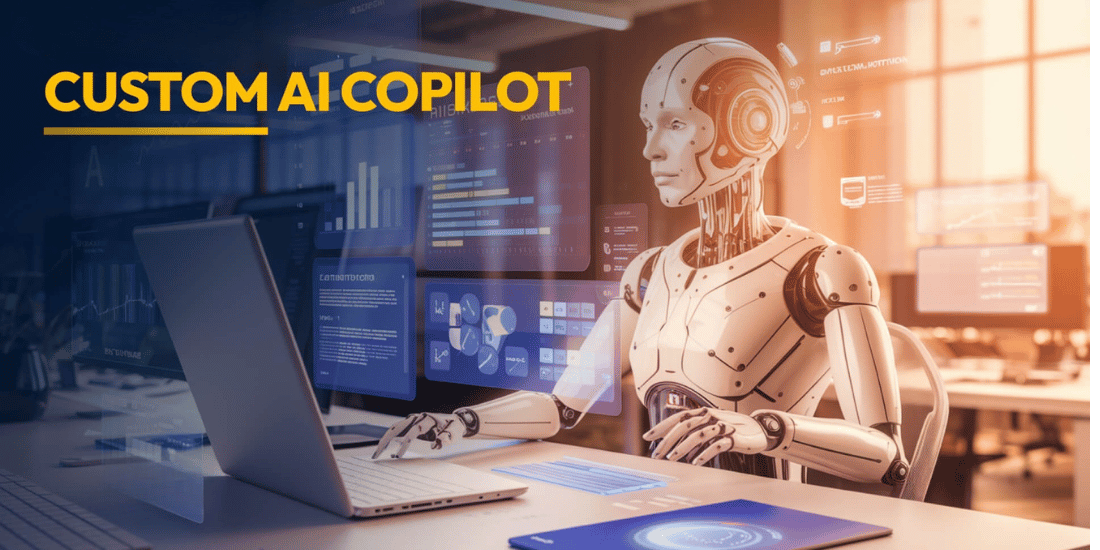
An AI Copilot for businesses is an intelligent assistant powered by large language models, automation engines, and enterprise integrations. It works alongside employees to handle repetitive tasks, analyze data, provide insights, and execute workflows using natural language commands.
What differentiates an AI copilot from a basic chatbot is its ability to understand intent, remember context, and perform multi-step actions. Instead of responding with static answers, it can fetch data from multiple systems, trigger workflows, generate documents, and adapt based on business rules.
In practical terms, an AI copilot functions like a highly capable digital employee — always available, consistently accurate, and infinitely scalable.
How AI Copilots Are Used Across Industries?
AI copilots are not limited to a single department or industry. Their value lies in their adaptability.
- In sales and marketing, copilots help teams prioritize leads, draft personalized outreach, analyze campaign performance, and keep CRM systems updated automatically. Sales professionals spend more time building relationships instead of managing data.
- In finance and accounting, AI copilots assist with budget analysis, forecasting, variance tracking, and compliance reporting. Finance teams gain faster access to insights without waiting for manual reports.
- In healthcare, copilots support patient documentation, appointment scheduling, internal knowledge access, and administrative workflows. This reduces staff burnout while improving accuracy and compliance.
- In e-commerce and retail, AI copilots enhance customer support, personalize product recommendations, manage inventory insights, and automate marketing operations.
- Across HR and operations, copilots streamline onboarding, answer internal policy questions, assist with workforce analytics, and reduce repetitive administrative tasks.
The common thread across industries is simple: AI copilots remove friction from daily work.
A Real Business Story: From Burnout to Balance
Consider a mid-sized SaaS company where the sales team was struggling with burnout. Reps spent hours every day logging calls, preparing follow-ups, and updating multiple systems. Performance wasn’t the issue — time was.
After deploying an AI sales copilot, the workflow changed dramatically. Call summaries were generated automatically. CRM updates happened in the background. The copilot suggested next actions based on deal history and customer behavior.
Within weeks, the team reported higher productivity and lower stress. No jobs were replaced — instead, employees felt supported. This is the real impact of enterprise AI solutions built with purpose.
Why AI Copilots Are Becoming Essential for Modern Businesses?
Businesses adopt AI co-pilots primarily because they deliver speed, accuracy, and efficiency at scale.
Manual processes slow teams down and introduce errors. AI copilots eliminate these inefficiencies by automating routine work and making information instantly accessible. This allows employees to focus on strategic thinking, creativity, and customer relationships — areas where humans perform best.
From a leadership perspective, AI copilots also provide better visibility into operations. Real-time insights replace delayed reports, enabling faster and more confident decision-making.
Step-by-Step Process to Build an AI Copilot for Businesses
- Identify High-Impact Business Use Cases
Every successful AI copilot starts with a clear business objective. Instead of trying to automate everything, organizations should focus on workflows that are repetitive, time-consuming, and data-driven. Common starting points include customer support, reporting, lead management, and internal knowledge access.
- Choose the Right Technology Architecture
The technology stack determines how powerful and scalable your AI copilot will be. At the core are large language models for reasoning and conversation. These models are supported by vector databases that store company knowledge and enable accurate retrieval.
Automation tools handle workflow execution, while APIs connect the copilot to enterprise systems such as CRM, ERP, and finance platforms. Cloud infrastructure ensures scalability, performance, and security.
- Build a Structured Enterprise Knowledge Base
An AI copilot is only as reliable as the information it uses. Businesses must organize internal documentation, policies, SOPs, training materials, and historical data into a structured knowledge base. This ensures responses are accurate, contextual, and aligned with company standards.
- Enable AI Workflow Automation
This is where the copilot evolves from an assistant into an operator. Workflow automation allows it to generate documents, send notifications, update records, analyze data, and trigger actions across systems — all through natural language commands.
- Integrate with Enterprise Tools and APIs
For real-world impact, the copilot must work inside existing business ecosystems. Integrations with tools like Salesforce, HubSpot, SAP, accounting software, and internal dashboards turn the copilot into a true business assistant capable of handling end-to-end processes.
- Design a User-Friendly Interface
Adoption depends on usability. Whether deployed as a web dashboard, Slack bot, Microsoft Teams assistant, or embedded chat interface, the copilot should feel intuitive and helpful rather than intrusive.
- Test, Train, and Optimize Continuously
Before full deployment, the copilot must be tested for accuracy, performance, and security. Human-in-the-loop feedback helps refine responses and workflows. Continuous monitoring ensures the system improves over time instead of degrading.
- Scale Across Departments
Once value is proven in one area, organizations can expand the copilot across teams, adding new capabilities and AI agents as needs grow.
Choosing the Right Development Approach
| Feature | No-Code Platforms | Low-Code Platforms | Fully Custom AI Copilot |
|---|---|---|---|
| Best Fit | Small teams | Mid-size businesses | Large enterprises |
| Flexibility | Low | Medium | Very high |
| Customization | Limited | Good | Unlimited |
| Security & Compliance | Basic | Advanced | Enterprise-grade |
| Long-term Scalability | Limited | Moderate | High |
Benefits of AI Copilots for Business Growth
AI copilots reduce operational costs by automating routine tasks and minimizing errors. They improve employee productivity by eliminating low-value work. Customers benefit from faster, more consistent support, while leadership gains real-time visibility into performance.
Because copilots scale without proportional increases in staffing, businesses can grow faster without increasing overhead.
- Risks and Challenges to Consider: Despite their benefits, AI copilots come with challenges. Poor data quality can lead to inaccurate outputs. Over-automation without human oversight may cause compliance issues. Integration complexity and user adoption resistance are also common hurdles. These risks can be mitigated with strong governance, phased rollouts, and continuous monitoring.
- Best Practices for Building Enterprise AI Copilots: Successful organizations start small, validate ROI, and expand gradually. They prioritize data quality, maintain human oversight, and implement strong security controls. Regular audits and performance reviews ensure the copilot remains reliable and trustworthy.
Frequently Asked Questions
How long does it take to build an AI copilot?
Most enterprise copilots take between 3 and 10 weeks, depending on complexity and integrations.
Does an AI copilot replace employees?
No. It supports employees by automating repetitive work and improving efficiency.
Is coding required?
Basic copilots may use no-code tools, but enterprise-grade solutions typically require custom development.
Is an AI copilot secure for enterprises?
Yes, when built with encryption, role-based access, and compliance standards such as GDPR, HIPAA, SOC 2, and ISO 27001.
Conclusion: AI Copilots Are the Future of Enterprise Work
AI copilots are quickly becoming the backbone of modern enterprises. They streamline workflows, enhance decision-making, improve customer experiences, and support teams at scale.
Organizations that invest in building AI copilots today position themselves for long-term efficiency, agility, and competitive advantage. The future of work is not about replacing humans with AI — it’s about empowering people with intelligent digital partners.