
- April 10, 2026
- Posted by: Jhansi G
- Category: Artificial Intelligence
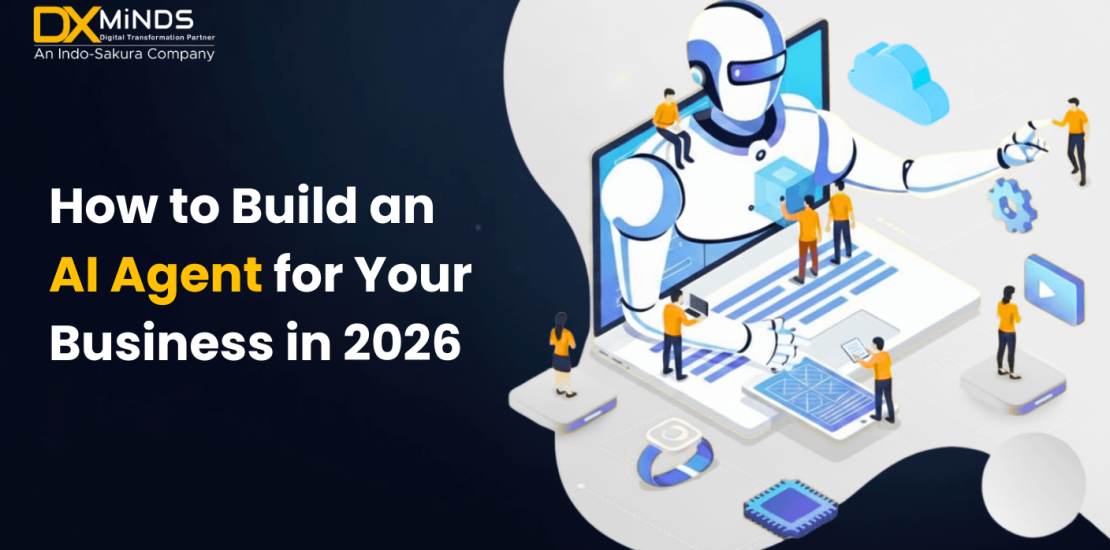
Introduction
Artificial intelligence is no longer optional; it’s a business necessity in 2026.
From automating customer interactions to increasing conversions and reducing operational costs, AI agents are helping companies scale faster than ever. But while many businesses understand the importance of AI, very few know how to build an AI agent that drives measurable business outcomes.
What Is an AI Agent?
An AI agent is an intelligent software system that can:
- Understand human language (text or voice)
- Make decisions based on context
- Automate tasks without human intervention
- Continuously learn and improve
AI Agent vs Chatbot
|
Feature |
Chatbot | AI Agent |
| Responses | Predefined |
Context-aware |
|
Learning |
Limited | Continuous |
| Automation | Basic |
Advanced workflows |
|
Decision Making |
No |
Yes |
Why AI Agents Are Critical for Businesses in 2026
- Rising Customer Expectations
Customers expect instant, personalized responses 24/7.
- Increased Competition
Businesses leveraging AI are outperforming traditional companies.
- Cost Optimization
AI agents reduce operational costs by up to 60% in support and sales.
- Data-Driven Decision Making
AI agents analyze user behavior to improve conversions.
Real-World Experience
Based on industry implementations across SaaS, IT staffing, and service businesses, companies using AI agents have seen:
- 3x increase in lead conversion rates
- 40–70% reduction in support workload
- Faster response times (under 2 seconds)
Types of AI Agents You Can Build
To rank for broader keywords like “types of AI agents for business,” here’s a structured breakdown:
- Customer Support AI Agent
Handles FAQs, complaints, and real-time support.
- AI Sales Agent
- Lead qualification
- Demo booking
- Follow-ups
- AI Voice Agent
- Call automation
- Appointment scheduling
- Customer verification
- AI Recruitment Agent (High Relevance for You)
- Screens candidates
- Matches resumes
- Schedules interviews
- E-commerce AI Agent
- Product recommendations
- Cart recovery
- Order tracking
Step-by-Step: How to Build an AI Agent for Your Business
Step 1: Define a High-Impact Use Case
Start with a clear business problem:
Wrong: “We need an AI chatbot.”
Right: “We need an AI agent to qualify leads and book sales calls.”
Pro Tip:
Focus on revenue-generating or cost-saving use cases first.
Step 2: Choose the Right AI Model (Authority Section)
Selecting the right AI model is crucial for performance.
Options:
- GPT-based models (high accuracy)
- Open-source models (cost-effective)
- Enterprise AI platforms (secure + scalable)
Step 3: Build a Strong Knowledge Base
Your AI agent’s performance depends on data quality.
Include:
- Website content
- FAQs
- Case studies
- Internal SOPs
Step 4: Design Intelligent Conversation Flows
Even advanced AI needs structured guidance.
Key Elements:
- User intent detection
- Context-aware replies
- Multi-step conversations
- Human escalation
Step 5: Integrate with Business Tools
This is where AI agents deliver real ROI.
Must-have Integrations:
- CRM (HubSpot, Salesforce)
- Email automation tools
- Calendar booking systems
- WhatsApp API
Example Workflow:
Visitor → AI chat → Lead captured → CRM → Meeting booked
Step 6: Enable Automation & Actions
Your AI agent should not just talk—it should act.
Examples:
- Send emails
- Assign leads
- Generate reports
- Trigger workflows
Step 7: Train, Test, and Optimize
Testing Checklist:
- Accuracy
- User experience
- Edge cases
- Conversion flow
Step 8: Deploy Across Multiple Channels
High-Converting Channels:
- Website chatbot
- Voice calls
- Mobile apps
Best Tech Stack for AI Agent Development
Frontend:
React / Next.js
Backend:
Python / Node.js
AI Layer:
OpenAI / LLM APIs
Database:
Vector databases (Pinecone, Weaviate)
Automation:
Zapier / Make
Cost of Building an AI Agent in 2026
|
Type |
Cost Range |
|
Basic AI Agent |
$500 – $2,000 |
| Mid-Level Agent |
$2,000 – $10,000 |
| Advanced AI Agent |
$10,000+ |
Ongoing Costs:
- API usage
- Maintenance
- Hosting
Use Cases That Drive ROI
IT Staffing & Recruitment
- Resume screening
- Candidate engagement
- Interview scheduling
SaaS Companies
- Lead qualification
- Product onboarding
- Customer success
Healthcare
- Appointment booking
- Patient support
E-commerce
- Personalized recommendations
- Upselling
Common Mistakes to Avoid
- No Clear Goal
Leads to poor ROI.
- Weak Data
Impacts AI accuracy.
- Over-Automation
Can harm user experience.
- No Human Backup
Reduces trust.
- Ignoring Analytics
Missed optimization opportunities.
Future of AI Agents (2026 & Beyond)
Autonomous AI Agents
Complete workflows independently.
Multi-Agent Systems
Multiple AI agents are collaborating.
Voice-First Interfaces
Replacing traditional call centers.
Hyper-Personalization
AI tailored to each user.
Why Trust This Guide?
This guide is built using:
- Real-world AI implementation insights
- Industry best practices
- Proven frameworks used in SaaS and IT services
We focus on practical, results-driven AI adoption, not just theory.
Conclusion
Building an AI agent in 2026 is one of the smartest investments a business can make.
It’s not just about automation—it’s about the following:
- Increasing revenue
- Reducing costs
- Delivering better customer experiences
Start with a clear use case, build strategically, and continuously optimize.
The businesses that adopt AI agents today will dominate tomorrow.
Frequently Asked Question
-
What is an AI agent in business?
An AI agent is a software system that automates tasks, interacts with users, and makes decisions using artificial intelligence.
-
How much does it cost to build an AI agent?
Costs range from $500 to $10,000+, depending on complexity and features.
-
Can small businesses use AI agents?
Yes, affordable AI tools make it accessible for startups and SMEs.
-
What is the difference between a chatbot and an AI agent?
Chatbots follow scripts, while AI agents understand context and perform actions.
-
How long does it take to build an AI agent?
Typically 2–12 weeks based on project scope.