
- February 19, 2026
- Posted by: Admin
- Category: Artificial Intelligence
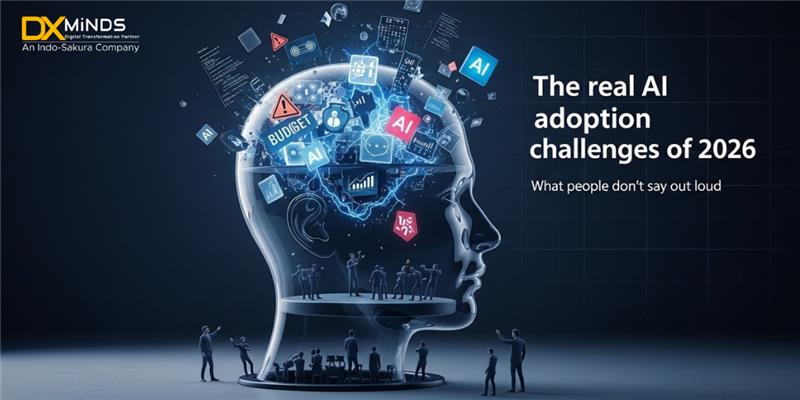
Let’s start with the uncomfortable truth about AI adoption in 2026
In 2026, almost every company says they’re using AI.
If you stop there, it sounds impressive.
But when you actually sit with the people doing the work—engineers, QA teams, analysts—
Product managers—the confidence fades a bit.
Yes, the tools exist.
Yes, the dashboards are live.
Yes, the models are running.
And still… There’s this lingering question nobody wants to ask too loudly:
Is this really helping us?
That quiet uncertainty explains why so many AI adoption challenges in 2026 don’t show up as
failures. They show up as hesitation. Low usage. Careful distance.
This perspective comes from working alongside QA teams, product leaders, and enterprise IT
groups during real AI rollouts—especially the ones that looked successful on paper but
struggled in production.
What’s holding things back isn’t the technology. It’s everything around it: people, processes,
trust, and the messy reality of how work actually happens.
I’ve watched teams with advanced enterprise AI systems struggle to explain their impact. I’ve
Also, I’ve seen teams with far simpler setups quietly deliver real value.
The difference isn’t intelligence.
It’s clarity.
The first mistake in AI adoption usually happens before AI even shows up
Here’s a pattern I’ve seen repeatedly across organizations adopting AI.
Someone senior decides the company “needs AI.”
A few tools get shortlisted.
A pilot begins.
Only later does someone finally ask,
“What problem were we trying to solve again?”
That’s not a small oversight. That’s the foundation.
When AI enters before the problem is clearly defined, it becomes an experiment instead of a
solution. Interesting, yes. Sustainable, rarely.
Teams that succeed tend to start small and unglamorous. One painful workflow. One recurring
bottleneck. One decision that keeps creating friction.
They don’t chase AI trends.
They chase relief.
This is where many enterprise AI adoption challenges either dissolve—or quietly multiply.
Why measuring AI ROI is a top challenge in enterprise AI adoption
Most AI initiatives don’t fail loudly.
They fade.
I’ve reviewed AI systems that genuinely improved decision quality but were eventually switched
off because no one could explain their value in simple business terms.
The issue is subtle: teams measure models instead of outcomes.
Accuracy charts don’t convince leadership.
Human impact does.
What actually builds confidence are questions like
- Are people saving time?
- Are fewer errors happening?
- Are decisions easier to justify?
- Is operational risk going down?
This is where operational AI adoption earns trust. Especially in enterprise environments,
where AI investment scrutiny increases every quarter.
If AI value can’t be explained in a hallway conversation, it rarely survives a boardroom
discussion.
The AI skills gap is misunderstood—literacy matters more than specialists
There’s a persistent belief that successful AI implementation requires elite, hard-to-find talent.
In practice, most organizations benefit far more from AI literacy than deep specialization.
Across real production environments, QA teams, analysts, platform engineers, and product
owners. I’ve seen people adapt quickly once they understand why AI exists and how it fits into
their workflow.
Tools change.
Context lasts.
That’s why teams making progress focus on:
- Upskilling existing staff
- Cross-functional AI collaboration
- Clear ownership instead of isolated expertise
In one rollout, the QA team discovered a subtle data bias early, preventing costly errors
downstream.
AI becomes sustainable when understanding spreads beyond a few specialists.
How poor data quality quietly undermines trust in AI systems
AI failures rarely announce themselves.
They whisper.
“This doesn’t feel right.”
“Why does this look different today?”
“Let’s double-check manually.”
Almost always, the issue is data.
In enterprise AI systems, biased inputs, outdated records, and missing context slowly erode
trust. Even strong models struggle when data discipline is weak.
This is where responsible AI practices actually begin—not with policy documents, but with
How teams manage data daily.
Basic AI observability, continuous data review, and honest feedback loops matter more than
people expect. Without them, teams can’t explain why systems behave differently in production
than they did during testing.
Clean inputs don’t guarantee perfect outcomes.
But poor data almost guarantees skepticism.
Why legacy systems make scaling AI in organizations so difficult
Many organizations attempt to layer AI on top of systems built a decade ago.
It works—until it doesn’t.
Integrations become fragile. Deployment slows. Costs creep up quietly.
Here’s a truth many teams learn late:
Scaling AI in organizations depends more on infrastructure choices than on the model
sophistication.
Teams making real progress in 2026 modernize incrementally. APIs, modular services, selective
cloud adoption. No dramatic overhauls.
It’s not flashy.
But it supports AI risk management in enterprises without disrupting daily operations.
AI governance, explainability, and trust are no longer optional
There’s a moment in most AI discussions when the tone shifts.
Early on, people ask, “Does it work?”
Later, they ask, “Can we trust it?”
This is where AI governance frameworks stop being theoretical.
In real enterprise environments, a lack of explainability damages trust faster than technical errors.
Stakeholders need to understand not just outcomes, but reasoning.
That’s why human-in-the-loop processes, transparency, and accountability are now standard
expectations.
Organizations often slow down here.
And honestly, they should.
Rushing AI deployment without trust creates bigger failures later.
This aligns with OECD AI Principles, which emphasize transparency, accountability, and
human oversight in AI systems.
The most overlooked AI adoption challenge: human resistance
Most resistance to AI isn’t technical.
It’s emotional.
People worry about relevance. Control. Accountability. When leadership avoids these
conversations, adoption doesn’t stop loudly—it fades. Low usage. Shadow workflows. Quiet
skepticism.
Teams that move forward address this head-on. They explain what AI will change—and what it
won’t.
Clarity doesn’t remove fear completely.
But silence makes it worse.
This is often the turning point where enterprise AI adoption accelerates—or quietly fails.
Scaling AI reveals deeper organizational adoption challenges
Pilots are easy.
Scaling is revealing.
Scaling exposes siloed teams, unclear ownership, and weak governance. It forces organizations
to confront how decisions are actually made.
The companies that scale successfully treat AI as shared infrastructure. Not a side project. Not
a showcase. Something that belongs to everyone and gets reviewed continuously.
This is where AI stops being a tool—and becomes part of how the organization operates.
Conclusion: The real advantage behind AI adoption in 2026
The biggest AI adoption challenges in 2026 aren’t technical.
They’re organizational.
The teams succeeding aren’t chasing every new model. They’re focusing on clarity, trust, data discipline, and people.
AI doesn’t replace judgment.
It strengthens it—when implemented thoughtfully.
The advantage is still there.
But it belongs to organizations willing to slow down, ask better questions, and build trust before
scaling.
Frequently Asked Questions
Q1: Why do AI initiatives struggle even with advanced technology?
Because technology exposes existing organizational gaps.
Q2: Is building the model the hardest part?
Usually not. Integration, governance, and trust are harder.
Q3: Do companies need more AI experts?
Sometimes. But shared understanding often matters more.
Q4: Why do people keep double-checking AI outputs?
Because trust grows slower than technology.
Q5: Should organizations move faster with AI?
Only after clarity catches up.