


- September 19, 2025
- Posted by: Admin
- Category: Artificial Intelligence
10 Ways Generative AI is Transforming the Fintech Industry in 2025
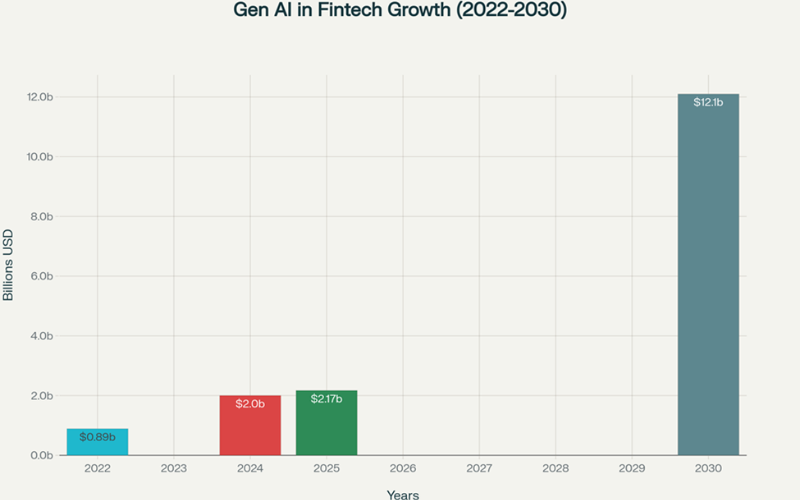
The financial technology sector is experiencing a revolutionary transformation, and generative AI is leading the charge. With the global generative AI in fintech market expected to reach $12.1 billion by 2030, growing at an impressive 35.5% CAGR, this technology is reshaping how financial services operate, serve customers, and manage risks.
-
Smart Customer Support That Never Sleeps
The Problem: Traditional customer service struggles with high volumes, long wait times, and repetitive queries that frustrate customers and drain resources.
The AI Solution: Generative AI-powered chatbots and virtual assistants now handle complex financial conversations with human-like understanding. Unlike basic chatbots, these systems can process context, handle multi-turn conversations, and provide personalized responses.
Real Results: Commonwealth Bank’s virtual assistant Ceba now handles over 200 different tasks, significantly reducing call center volumes while improving response times. Similarly, Federal Bank Limited achieved 98% accuracy in answering customer queries and expects to save 50% in customer care costs by 2025.
Key Benefits:
- 24/7 availability across all time zones
- Instant responses to complex financial questions
- Significant reduction in operational costs
- Improved customer satisfaction scores
-
Revolutionary Fraud Detection Systems
The Challenge: Financial fraud is becoming increasingly sophisticated, with traditional rule-based systems struggling to keep up with evolving threats.
The Game-Changer: Generative AI creates synthetic fraud scenarios to train detection models, enabling systems to identify previously unseen fraud patterns. These models analyze transaction behaviors in real-time, spotting anomalies that human analysts might miss.
Success Stories:
- FinSecure Bank achieved a 60% reduction in fraudulent activities within the first year of implementing AI-driven fraud detection
- HDFC Bank leveraged machine learning algorithms to identify unusual spending patterns, significantly reducing credit card fraud rates
- Visa reported a 25% reduction in fraud since implementing its AI-powered system
Impact Metrics:
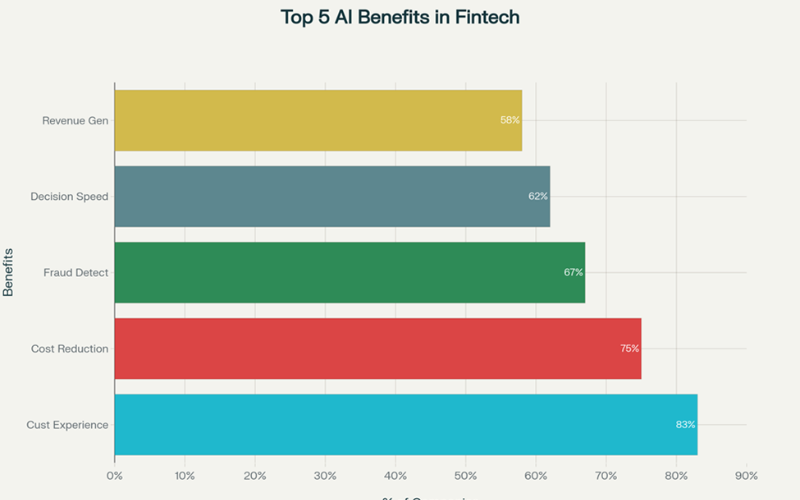
- Up to 67% improvement in fraud detection accuracy
- Real-time transaction monitoring capabilities
- Dramatic reduction in false positives
-
Hyper-Personalized Financial Services
The Evolution: Moving beyond basic recommendations, generative AI creates truly personalized financial experiences by analyzing vast amounts of customer data in real-time.
How It Works: AI algorithms process transaction history, spending patterns, life events, and financial goals to generate customized advice, product recommendations, and investment strategies.
Real-World Applications:
- Morgan Stanley deployed a GPT-4 powered assistant that gives 16,000 financial advisors instant access to 100,000 research documents, enabling highly personalized client consultations
- Bunq’s Finn AI assistant helps customers with personalized financial planning, transaction searches, and spending analysis
Customer Impact:
- 83% of fintech companies report improved customer experience
- Personalized services drive higher customer satisfaction and loyalty
- Increased cross-selling opportunities through relevant product suggestions
-
Lightning-Fast Credit Scoring and Lending
Traditional Problem: Loan applications often take days or weeks to process, with rigid criteria that exclude many potentially creditworthy applicants.
AI Revolution: Generative AI analyzes unconventional data sources like utility payments, social media activity, and spending behaviors to create more inclusive and accurate credit assessments.
Success Case: Metro Credit Union integrated a generative AI system that evaluates thousands of potential loan scenarios, significantly speeding up decision-making and reducing application rejections.
Breakthrough Benefits:
- 50% faster loan processing times
- More inclusive lending decisions
- Reduced default rates through better risk assessment
- Automated document processing and validation
-
Intelligent Risk Management and Portfolio Optimization
The Challenge: Managing investment portfolios and assessing risks requires analyzing vast amounts of market data, economic indicators, and global events.
AI Solution: Generative AI processes real-time market data, news sentiment, and economic indicators to optimize investment strategies and predict market movements.
Case Study: Quantum Capital achieved a 35% improvement in portfolio performance compared to industry benchmarks, with a 20% decrease in losses during market downturns.
Strategic Advantages:
- Real-time risk assessment and adjustment
- Predictive analytics for market volatility
- Automated rebalancing based on changing conditions
- Enhanced stress testing capabilities
-
Advanced Regulatory Compliance and Reporting
The Burden: Financial institutions face increasingly complex regulatory requirements, with compliance costs consuming significant resources.
AI Efficiency: Generative AI automates regulatory reporting, summarizes complex regulations, and ensures consistent compliance across all operations.
Operational Impact:
- 40-60% reduction in compliance and servicing costs
- Automated extraction of key information from regulatory documents
- Real-time monitoring for compliance violations
- Streamlined audit trails and documentation
-
Next-Generation Trading and Investment Strategies
Market Reality: Traditional trading strategies struggle to process the massive amounts of data available in modern financial markets.
AI Advantage: Generative AI analyzes market sentiment, news feeds, social media trends, and technical indicators to generate sophisticated trading strategies and investment insights.
Performance Results:
- Enhanced algorithmic trading capabilities
- Real-time market sentiment analysis
- Improved execution timing and pricing
- Better risk-adjusted returns
-
Seamless Document Processing and Automation
Old Way: Manual processing of financial documents like loan applications, KYC forms, and tax documents is slow and error-prone.
New Reality: Generative AI extracts, validates, and processes information from various document formats, significantly reducing processing time and human error.
Efficiency Gains:
- HSBC reduced document turnaround time by 50% using AI technology
- Automated extraction from pay slips, tax forms, and applications
- Multi-language and multi-format document processing
- Reduced manual review requirements
-
Proactive Financial Planning and Advisory Services
Traditional Limitation: Basic financial advice often lacks personalization and real-time market integration.
AI Enhancement: Generative AI creates dynamic financial plans that adapt to changing circumstances, market conditions, and life events.
Client Benefits:
- WealthFlow Solutions saw a 30% increase in client satisfaction and 20% growth in assets under management after implementing AI-enhanced advisory tools
- Real-time plan adjustments based on market changes
- Personalized investment recommendations
- Automated rebalancing and optimization
-
Enhanced Data Security and Privacy Protection
Critical Need: With increasing cyber threats, financial institutions must protect sensitive customer data while maintaining service quality.
AI Solution: Generative AI creates synthetic datasets for testing and training, enabling innovation without compromising real customer data. It also enhances security monitoring and threat detection.
Security Improvements:
- Synthetic data generation for secure model training
- Advanced anomaly detection for cybersecurity threats
- Privacy-preserving analytics and insights
- Enhanced encryption and data protection protocols
The Road Ahead: Key Statistics and Projections
The transformation is accelerating rapidly:
- 91% of financial firms are now either evaluating or actively using AI in production
- 78% of organizations worldwide use AI in at least one business function, up from 55% just two years ago
- 75% of banks with over $100 billion in assets are expected to fully integrate AI strategies by 2025
- $35 billion was invested in AI by financial services in 2023, with banking accounting for $21 billion
Success Factors for Implementation
Based on successful case studies, the most effective AI implementations in fintech share these characteristics:
- Start with Clear Business Objectives: Focus on specific problems rather than implementing AI for its own sake
- Invest in Data Quality: Clean, comprehensive data is essential for AI success
- Maintain Human Oversight: Keep humans in the loop for critical decisions
- Ensure Regulatory Compliance: Build explainable AI models that meet regulatory requirements
- Plan for Scalability: Design systems that can grow with business needs
Challenges to Navigate
While the benefits are substantial, successful AI implementation requires addressing:
- Data Privacy and Security: Protecting sensitive financial information
- Regulatory Compliance: Meeting evolving AI governance requirements
- Skill Gaps: Finding and training AI-capable talent
- Integration Complexity: Connecting AI systems with legacy infrastructure
- Ethical Considerations: Ensuring fair and unbiased AI decisions
The Bottom Line
Generative AI is not just enhancing existing fintech services—it’s creating entirely new possibilities for how financial institutions operate and serve their customers. From reducing costs by up to 60% to improving customer satisfaction by 83%, the technology delivers measurable value across every aspect of financial services.
The question for fintech leaders isn’t whether to adopt generative AI, but how quickly they can implement it effectively. As the market continues its explosive growth toward $12.1 billion by 2030, early adopters will gain significant competitive advantages in efficiency, customer experience, and innovation capabilities.
The future of fintech is being written by AI—and that future is happening now.